
In trading, the ups and downs will bring both profits and losses. We need to know which direction suits us: do we prefer going long or short? Do we like fluctuations or trends? Using a fluctuation mindset in a trending market and a trend mindset in a fluctuating market is the fundamental reason why countless people lose money. Understanding the market environment helps you know how to act today.
Many people encounter situations where the trend is just starting, and when you enter to chase a short position, the market is still fluctuating. You gamble on a breakout when the direction is unclear, causing increasing chaos and worsening results. Before you know it, your capital is reduced by half, making dozens of trades in a day without making a profit, further affecting your mindset. This isn't due to poor skills or bad luck; it's because you haven't clearly understood the real market environment.
There are only two types of markets: trends and oscillations—each type corresponds to different strategies, different stop loss locations, and different rhythms. If you get them mixed up, you will definitely lose!
First, let's clarify what a trend is: A trend is a market environment where highs and lows are interconnected, direction is clear, market behavior is consistent, and rhythm is steady. Some say, 'who doesn’t know this?' But did you chase longs in the recent bull market? You wouldn’t go short from 4200 to 4900, right?
To judge a trend, only look at two sentences:
1. Raise the highs, raise the lows, only go long, absolutely no shorts, buy more on pullbacks, do not chase up, boldly chase long only when breaking structures. The worst is to chase tops, halfway up, and go against the trend. Clearly, you could wait to go long at 2950 but instead chase at 3100 and get stuck waiting to break even; others went long at 2950 and profited while you might not even break even.
2. On the contrary, continuously making new lows, yet you want to go long against the trend; if you don’t lose money, who does? In a bear market, if it slightly pulls back, you call it a bull market; this is too emotional and too one-sided in trading!
Now, let's take a look at what oscillation is.
Prices fluctuate back and forth in the range, direction is unclear, and the structure does not push up or down.
To judge a range-bound market, remember this: Highs do not break through again, and highs and lows constrain each other within the range.
How to trade here? Look to short at the upper edge of the range and go long at the lower edge without chasing breakouts; don’t trust false breakouts, keep your stop losses small and take profits quickly.
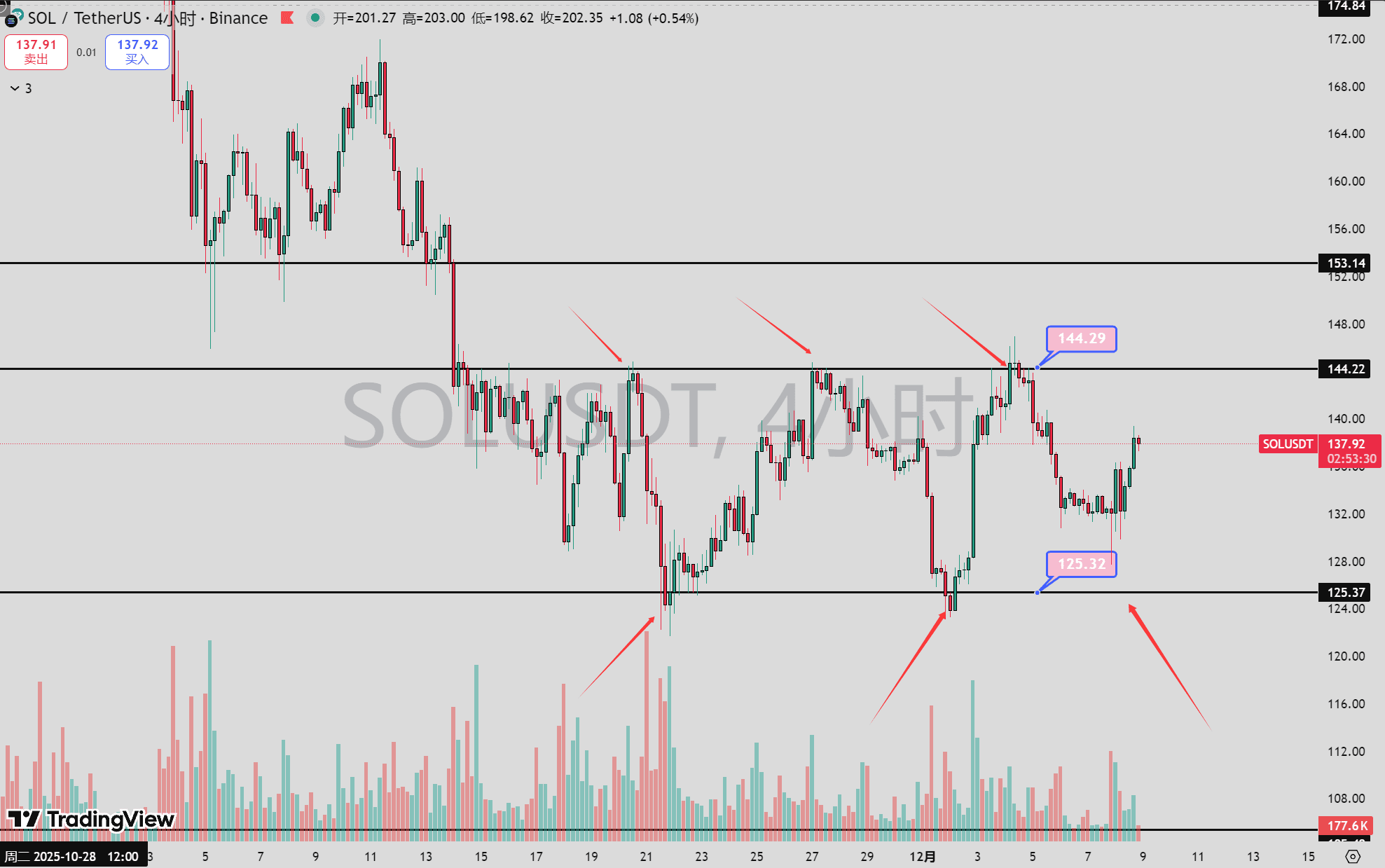
For example, in the 4-hour chart of sol, you can see it has been oscillating between 144 and 125. This is the chart I drew on 11.20, and I opened positions at both upper and lower edges; this is a typical oscillating market. The worst thing to do here is to chase highs or lows while halfway up.
Remember this phrase: Trends require waiting and patience—feast on one wave; oscillations require precision and accuracy—eat both long and short.
Trend: Ride the waves, take profits: Buy on pullbacks (or sell on rebounds), let profits run, set profit targets higher, and stop losses should not be too close (easy to get stopped out)
Remember: You can never buy at the lowest or sell at the highest; you only need to capture the most comfortable part in the middle.
Oscillating market: Quick in and out, look at key levels: Long at the range low and short at the range high, do not chase, do not hold too long, and stop losses should be very close.
You must know that oscillating markets lack directional sense; you must trade lightly and swiftly. Once there is a breakout or breakdown, you must stop loss and admit mistakes!
You lose money because you always treat trends as ranges and ranges as trends. When you don't understand the market, you still force trades, not reviewing leads to never distinguishing structures. The market is not decided by you; you decide 'which strategy to use.' You can never decide how the market will move today, but you can decide: how to enter, how to set stop losses, how to control positions, and how to choose strategies. The most important thing is whether you can distinguish between trends and ranges. Understanding the market means you understand trading. Understanding trading means you won't be dominated by the market.
Wish you continue to get rich and never die. Follow me, and may your trading journey become smoother!


