

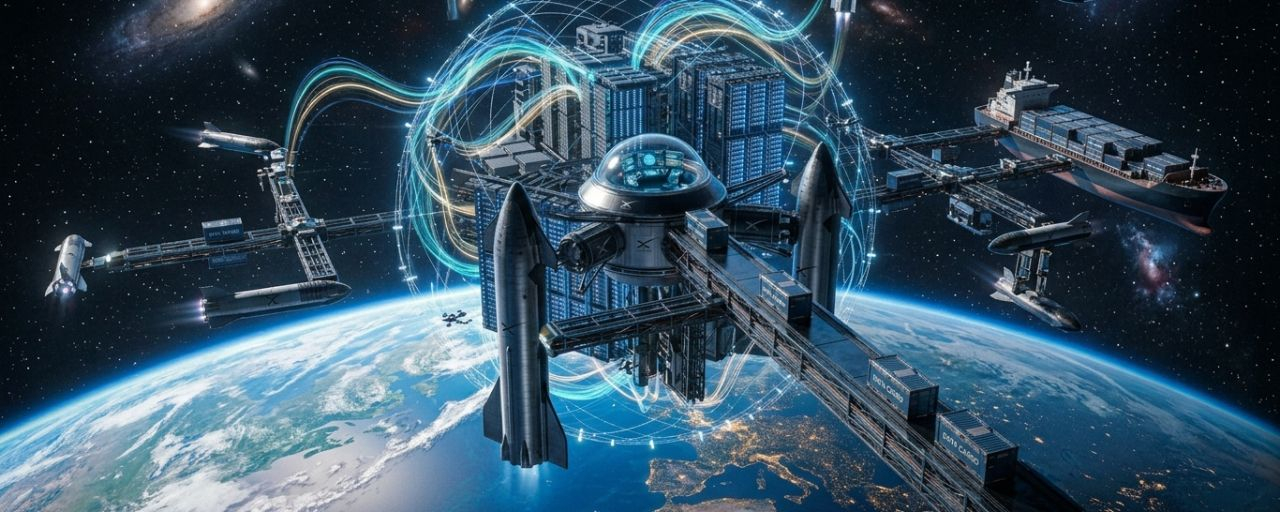

There are moments in history when a financial event transcends mere economics and becomes civilizational. SpaceX's IPO is one of those rare turning points.
This isn't just about the largest IPO ever conceived in terms of liquidity. It's about the formalization of a new kind of power — private, transnational, and above all, structural. For the first time, an individual is not just stacking wealth on a trillion-dollar scale, but consolidating control over critical infrastructures that were previously the exclusive domain of nation-states.
Elon Musk stops being only an extraordinary businessman. He positions himself as a geopolitical actor.

Capital that buys sovereignty
The projections are, at the very least, indecent: a valuation in the $1.75 trillion range and a fundraising of more than $70 billion. It’s not just big — it’s disruptive.
Although Saudi Aramco displayed larger numbers in valuation, SpaceX rewrites the game by luring massive volumes of fresh capital. It’s new money buying new power.
And here lies the most sophisticated irony of the entire narrative: this leap is only possible thanks to the institutional predictability of the United States — the same framework that Musk, progressively, begins to work around.
Private sovereignty is born, paradoxically, from public stability.
The monopoly of the invisible
SpaceX isn’t competing in a market alone — it occupies a domain.
Today, it controls the overwhelming majority of orbital launches and operates a large share of the planet’s active satellites. Translated: whoever controls access to space controls the backbone of global communication, navigation, and intelligence.
Space is no longer a territory contested between nations. It has become an operational asset of a company.
States now orbit — literally and metaphorically — this infrastructure.
The smartest bet: selling the toll
If the AI race produces uncertain winners, Musk has already secured his position on the board.
The integration between SpaceX and xAI isn’t about beating language models. It’s about owning the infrastructure where all models will run.
Orbital data centers promise to drastically reduce energy and cooling costs, turning space into a new computing hub. In this scenario, it matters little who wins the AI war — real power will belong to whoever charges the toll.
As Nvidia and TSMC did on Earth, Musk tries to replicate that domain in the cosmos.
Starlink: internet without borders — literally
Starlink is silently moving toward something much bigger than rural connectivity.
“Direct-to-cell” technology could connect billions of devices directly via satellite, eliminating the need for terrestrial infrastructure. The impact is immediate: less state control, less intermediation, more power concentrated in a single private network.
For the first time, individuals can connect to the world without passing through the filter of governments.
It’s not just innovation. It’s the deintermediation of sovereignty.
Starship and the collapse of cost
If Falcon 9 made launches viable, Starship intends to make them trivial.
The ambition to reduce the cost to around $180 per kilo in orbit completely changes the economics of space. Even more important: the operating cadence.
Musk doesn’t want rockets — he wants logistics.
Frequent takeoffs, full reusability, and fast turnaround transform space into an extension of the terrestrial production chain. No government agency operates with that kind of agility.
The sovereign individual
We are witnessing the emergence of a new historical entity: the sovereign individual.
Not elected, not limited by borders, not fully subject to traditional regulations — yet still holding structural power over communications, transportation, and computing.
Unlike States, this kind of power has no clear accountability mechanisms. There are no elections, no turnover, no institutional correction.
Private efficiency scales. Responsibility, not always.
The inevitable clash
Every deep economic transformation requires a political reconfiguration. That’s what happened in the Agricultural, Industrial, and Information Revolutions.
Now, we enter an even more uncomfortable phase: when companies don’t just influence states — but begin to replace them in critical functions.
SpaceX’s IPO may be remembered not as a financial event, but as the moment the classic concept of sovereignty began to dissolve.
The question isn’t whether there will be a state backlash.
The question is when — and how chaotic it will be.