Today is December 4, 2025.
The bull is still here! Just lowered its head to take a drink.
The cycles in the crypto world are often:
Big rise - pullback - bear market - accumulation - new bull market.
On-chain data shows that the turnover rate of Bitcoin decreased the day before yesterday, and investors remain relatively cautious about this rebound, with the market mainly driven by short-term funds.
URPD data:
$104,500-$112,000 range has accumulated 2.536 million Bitcoins.
$91,000-$96,000 range has accumulated 1.197 million Bitcoins.
Overall, Bitcoin has shown signs of a rebound from oversold conditions in the short term, and bullish sentiment may continue.
If the market progresses smoothly in the next two months, Bitcoin is expected to challenge the $103,000 area.
However, if the price falls below $80,600 again, panic sentiment may spread quickly and could become a key signal before the bear market arrives.
Even if entering a bear market cycle, as the correlation between Bitcoin and US stocks continues to strengthen, the future trend is expected to differ from previous deep bear markets, and the speed of market recovery may be faster.
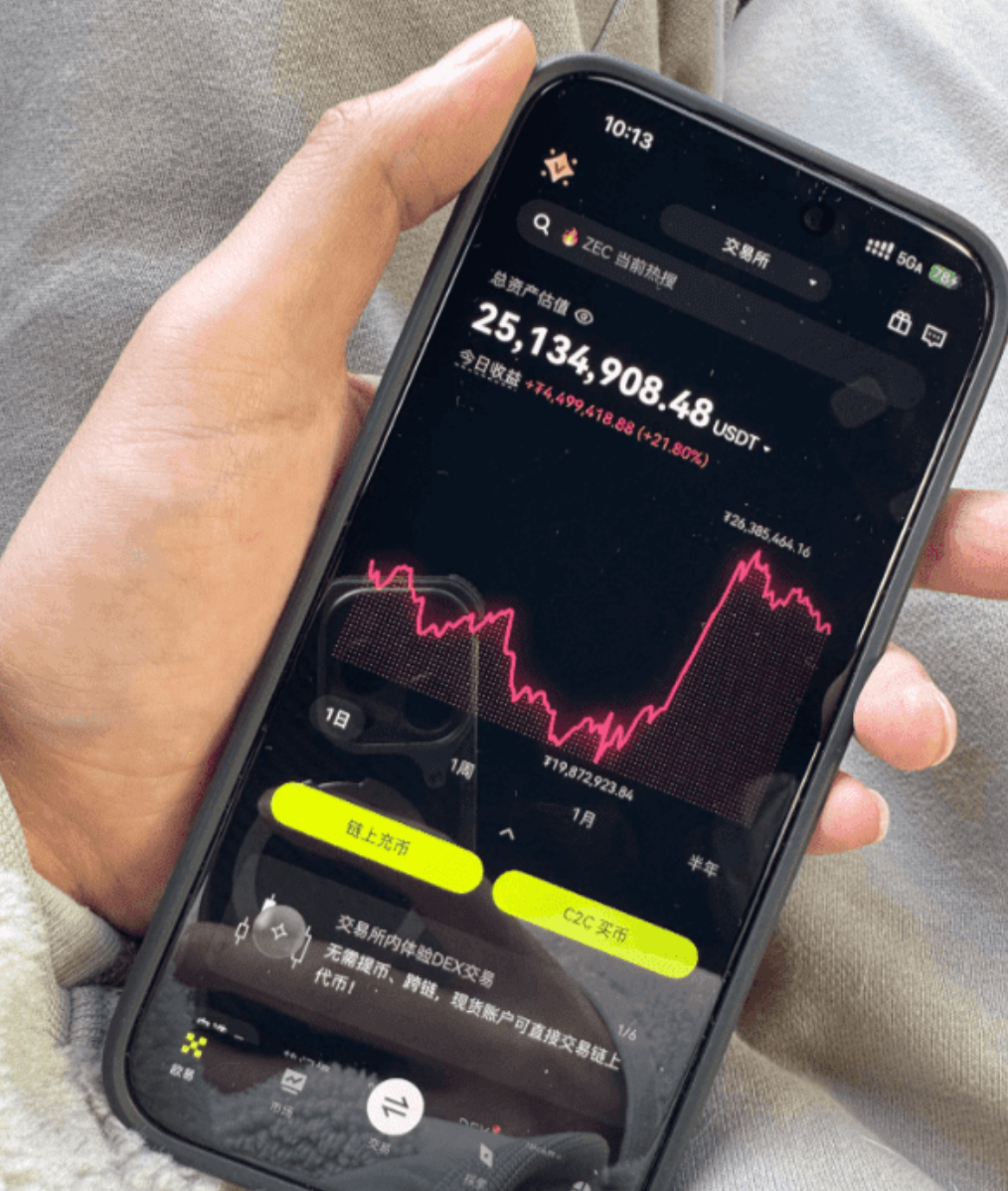
【Grassroots Counterattack Reflection】 Starting from 5,000 yuan to financial freedom 💰, I spent a full 10 years understanding these truths❗️
Friends, do you often come across wealth myths like 'turning hundreds in half a year' and 'crossing social classes in a year'? Today, I won't share motivational quotes or draw big pictures. As someone who started with 5,000 yuan and stepped in all the pits, I summarized these hard-earned experiences over 10 years. After reading this, you may lose sleep, but you will definitely avoid five years of detours.
One, the paradox of wealth: The more you want to get rich quickly, the less you can achieve it.
In 2015, I entered the market with 5,000 yuan, with a clear goal - to buy a villa in three years. What happened? I lost almost everything in the first two years. Until I understood this truth: the cryptocurrency market is not an ATM, but a place for cognitive transformation.
Real case:
· Old Wang went all in on altcoins with a principal of 100,000 in 2019; during the peak of the bull market in 2021, his account rose to 3 million without taking profits, now only 280,000 is left.
· Xiao Li invested 50,000 in BTC/ETH during the same period, withdrawing 10% each time it rose by 50%, now holding 1.2 million in cash plus 800,000 in positions.
The cruel truth: Those who want to 'get rich overnight' ultimately become fuel, while those who do proper asset allocation and strictly take profits navigate through bull and bear markets.
Two, the only path for ordinary people to counterattack: The modern version of the tortoise and the hare.
Stop believing the 'hundredfold myth'. I will break down the real and feasible wealth accumulation formula for you:
Stage one: Primitive accumulation (5,000 → 50,000).
· Only use spare money for trading; losing it will not affect your life.
· 80% of funds are invested in BTC/ETH, 20% left for flexibility.
· Learn key skills: Dollar-cost averaging in bear markets, phased profit-taking in bull markets.
· Goal: Complete initial accumulation in 2-3 years, the focus is to survive.
Stage two: Snowball phase (50,000 → 500,000).
· Establish your own trading system: What signals to buy? Where to set stop-loss? When to take profit?
· Position management rule: Do not exceed 20% of total funds in a single cryptocurrency, and strictly enforce stop-loss lines.
· Case: In 2023, someone used the '3331 rule' (30% BTC/30% ETH/30% stablecoins/10% altcoins) to achieve an annualized return of 40%.
Stage three: Wealth fission (500,000 → 5,000,000).
· Wait for big cycle opportunities (such as positioning six months before halving).
· Extract profits in batches, keeping the principal always safe.
· The ultimate mindset: Make money in bull markets, earn coins in bear markets.
Three, what doesn't kill you makes you stronger - Insights after 18 liquidations.
I have faced liquidation 18 times in a row and summarized these life-saving rules:
1. Leverage is a tool, not a gambling device.
· 3x leverage is the ceiling for ordinary people.
· Never use essential living funds to trade.
· Real risk = leverage multiple × position ratio.
1. Stop-loss is breathing, not cutting losses.
· Set a 'stop-loss line' to avoid electric shock: single loss ≤ 3% of capital.
· 2024 data shows: Holding positions for over 3 hours increases the liquidation probability to 94%.
1. Positioning is an art, not mathematics.
· Ladder building method: Start with 10% to test the waters and increase with profits.
· Three-phase take profit: Take 1/3 profit at 20%, take another 1/3 at 50%, and clear positions below the 5-day line.
Four, the truth about financial freedom: it is not a numbers game but a cognitive upgrade.
I have seen too many people:
· When floating profits reach several million, one feels like a stock god.
· Cursing operators everywhere after a crash.
· Always be trapped in the cycle of chasing highs and cutting losses.
Those who truly achieve social class leaps possess these traits:
1. Anti-human behavior operation.
· Greed during market panic, fear during market greed.
· The 312 crash in 2023 saw some counter-trend buying, with a 300% return six months later.
1. Systematic thinking.
· Establish your own investment checklist: What to buy? When to buy? How much to buy? When to sell?
· Turn trading into assembly line work, eliminating emotional interference.
1. Lifelong learning.
· Spend 2 hours daily studying underlying technology.
· Join quality circles and stay away from signal callers.
Five, practical advice for beginners.
If you currently have only 5,000 yuan:
1. Invest 3,000 yuan in BTC/ETH, unwavering.
2. Leave 2,000 yuan to pick up cheap chips at the bear market bottom.
3. Practice trading systems with a simulation account.
4. Most importantly: Preserve capital and survive until the next bull market.
If you have 50,000 yuan:
1. Allocate 30,000 yuan to mainstream coins.
2. Participate in DeFi mining with 10,000 yuan.
3. Flexible operation with 10,000 yuan.
4. Withdraw 20% every time profits reach 50% to improve life.
Let me say a few heartfelt words:
The cryptocurrency market indeed offers ordinary people the opportunity to cross social classes, but this path is full of thorns. Those who truly make it are not the smartest but the most disciplined and patient.
Wealth is like a butterfly; if you chase it desperately, it will fly away. If you cultivate good flowers, it will come naturally. When you stop obsessively watching the price and instead focus on enhancing your understanding, you will discover that crossing social classes is merely a byproduct of cognitive improvement.

Bull market red K-line is a sugar-coated artillery shell! As someone who has experienced three bull-bear cycles, I will reveal the survival rules and three stages of the 'roller coaster market' traps and life-saving tips.
"When your friends are all showing off double returns, the real slaughter is just beginning!" I have seen too many retail investors charge into the market with full positions amid shouts of 'breaking previous highs', only to end up standing guard at the mountain peak. Today, we won't discuss metaphysics; instead, I will break down the three major stages of the 'roller coaster market' and life-saving secrets. After reading this, you'll be able to smile while counting your bullets during the next major drop.
Stage one: The ghost story washing period - the main force picks up chips in the darkness.
Don't be fooled by the cries of 'the industry is dying'! A certain mainstream coin once created a 'ghost story' of a 30% drop followed by 20 days of sideways movement, with the community crying for liquidation. In reality, this was the main force's 'psychological massage' - using panic to force out blood-stained chips. My unique strategy is: set an alarm on major drop days, buying 5% positions every hour. Remember, cash is not bullets; it's your torch in the dark. Last year, when BTC dropped to 28,000, I used this method to accumulate positions at 31,000 and 29,000, ultimately benefiting from a 50% rebound.
Stage two: The onboarding bell trap - The easiest meat grinder for newcomers to get liquidated.
"The candlestick that sets a new high after five days of squats is the most poisonous!" A certain popular coin once used this trick to make newcomers fully invest amid FOMO of 'if you don't board now, it will be too late', only to see a 40% drop the following week. My rule is: only use 30% of the position to test the waters, locking the stop-loss line at 15%. Remember, the market never lacks opportunities; what it lacks is the patience to 'stay alive to see opportunities'. During last year's meme coin frenzy, I avoided 90% of the air coin traps by relying on this strategy.
Stage three: The bait-and-switch period - negative news turns into good news, leading to a path of being trapped.
When the turnover rate suddenly spikes by 300%, negative news is interpreted as 'good news', and the community starts shouting 'last chance to board', run! Run immediately! Before the LUNA collapse last year, I observed that the negative of 'stablecoins losing their peg' was packaged into a 'buying opportunity'. I cleared my positions overnight and avoided a halving. Remember, a true peak will never give you a 'last chance to board'.
Three life-saving tips: turnover rate + position management + exit planning.
1. The turnover rate is the market's electrocardiogram: during the washing period, the turnover rate is below 1%, suddenly spiking above 10% at the end - be alert immediately!
2. Always keep half of the cash in hand: Don’t believe in the ghost stories of 'inevitably breaking new highs'. I have seen too many 'all-in warriors' go bankrupt during crashes.
3. Separate living expenses from investment capital: Last year, a fan invested his house payment into contracts and faced bankruptcy. Remember, earning 100% is not as good as having a warm home with family.
Last but not least: The market is never gentle, but you can choose to be smart. During the next major drop, take three deep breaths, open this 'roller coaster survival map', and avoid greed, over-investment, and following the crowd; you will survive until the next bull market.
Coin trading must know: The 'resonance' law that institutions are secretly using: Smart money uses POI + Fibonacci to lock in the 'optimal trading area'; high-probability entry points are nowhere to hide.
In 'smart money' strategies, points of interest (POI) are key locations in the market where significant price actions occur. These locations are areas where institutions and retail investors make decisions. POIs can provide important clues about market structure, liquidity, and potential reversals or trend continuations.
Common types of POIs.
1. Fair value gap (FVG).
The fair value gap (FVG) is a price inefficiency area caused by aggressive price movements, creating gaps between candlesticks. The market usually returns to these areas to seek balance.
FVG forms when rapid price movement causes gaps between candlesticks. The market often fills these gaps to restore balance.
When strong price fluctuations leave gaps between adjacent candlesticks, FVG forms.
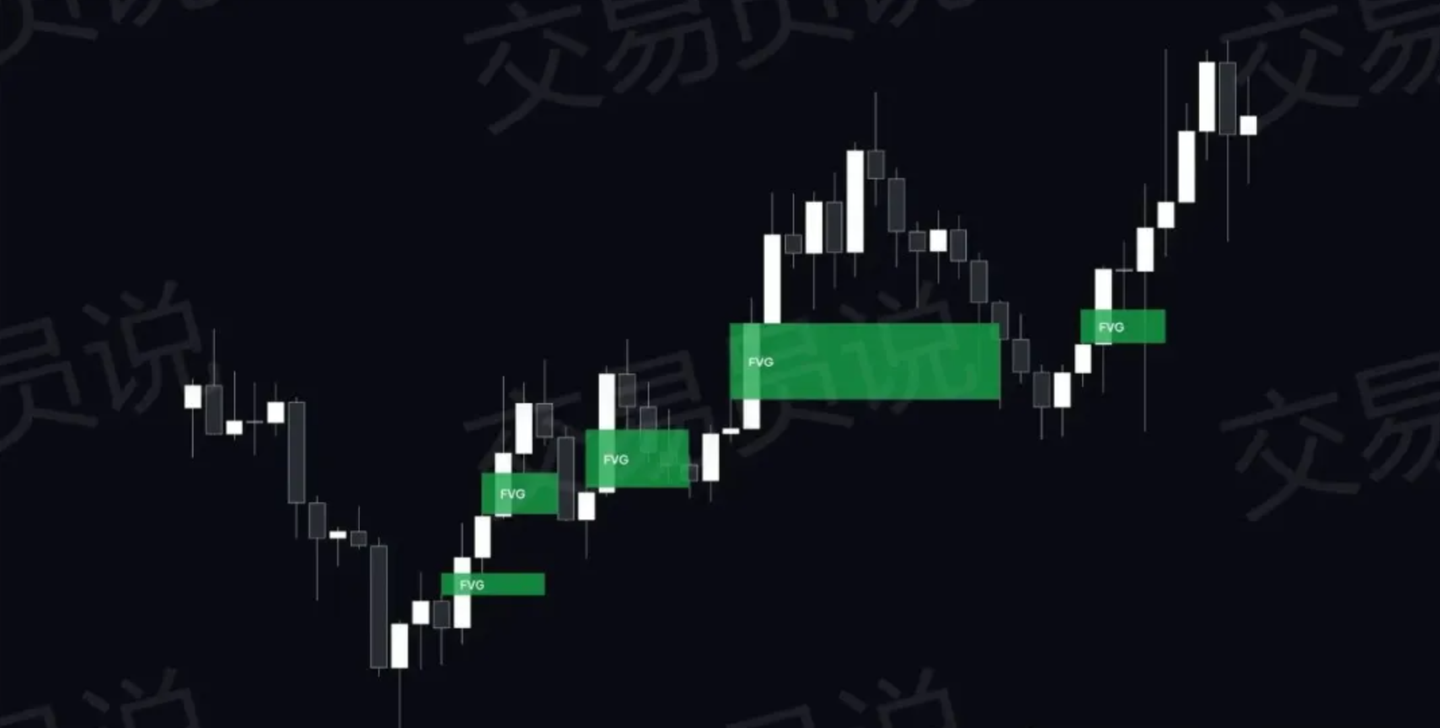
These gaps indicate an imbalance between buyers and sellers, making them areas where prices may be tested.
Traders focus on FVG to predict potential retracements before trends continue.
2. Order Blocks (OB).
Order blocks represent areas where institutions have placed large orders. Since smart money tends to return to these areas to continue executing orders, OB often becomes support or resistance.
⊖ Bullish order block: The last bearish candlestick before a strong upward move. Prices usually return to this area, forming buying opportunities.
⊖ Bearish order block: The last bullish candlestick before a strong downward move. Prices usually return to this area, providing short-selling opportunities.
Prices often test order blocks before continuing in the original direction. Strong OBs often overlap with liquidity areas and other resonating factors, thus providing high-probability trading opportunities.
3. Breaker Blocks (BB).
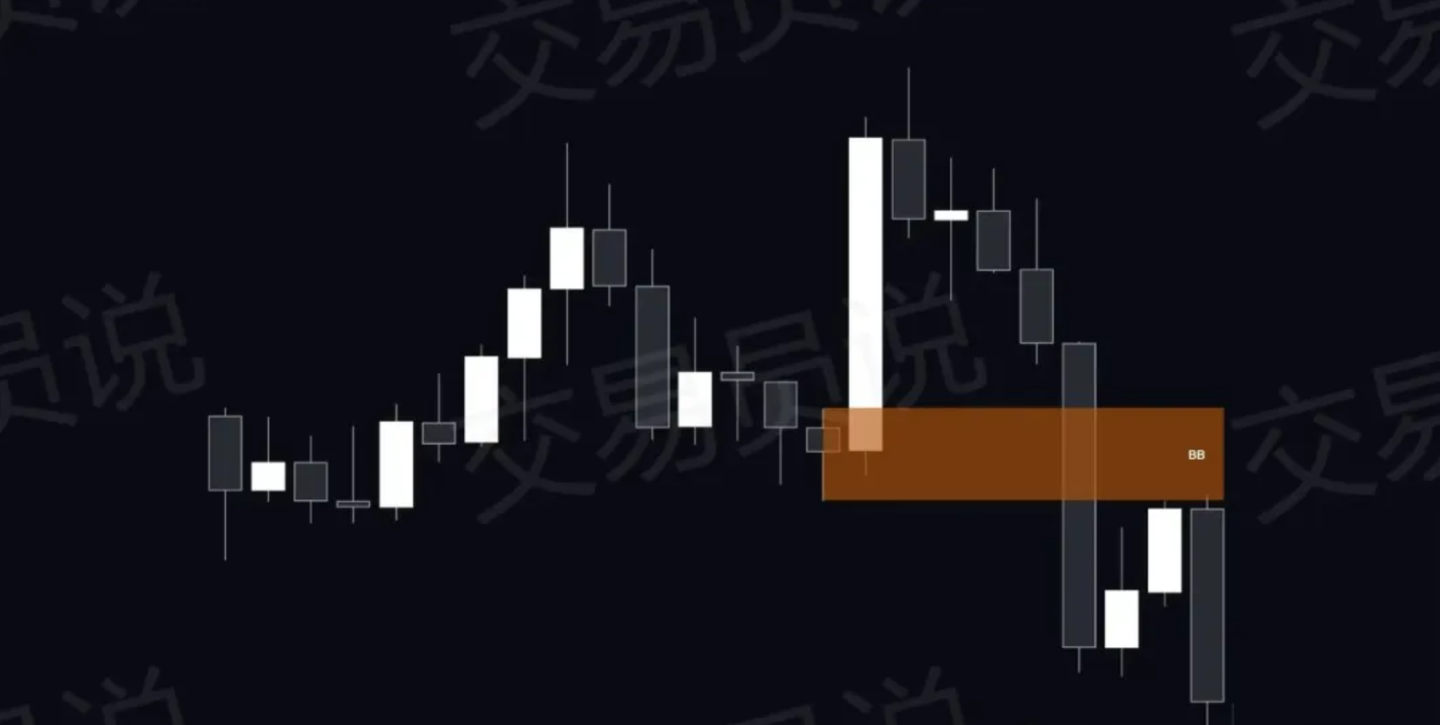
Breaker Blocks (BB) are previous support or resistance levels that undergo a role reversal after a strong price movement. Breaker Blocks indicate that previous liquidity has been absorbed, making them key areas for savvy traders.
⊖ Bullish breaker block: Previous resistance levels that have been broken through and turned into support.
⊖ Bearish breaker block: Previous support levels that have been broken down and turned into resistance.
When breaker blocks combine with liquidity areas and market structure, they can become a powerful resonating tool.
4. Rejection Block (RB).
Rejection Blocks (RB) occur when the market strongly rejects a certain price level, usually leaving long wicks as signs of failed false breakouts. These areas often become price zones that smart money traders focus on.
RB indicates strong resistance or strong support, often leading to reversal or continuation of trends.
They usually appear near liquidity pools, where institutional traders trigger stop-losses or limit orders.
Smart money uses RB to identify areas where prices may react, optimizing high-probability trading entry points.
When RB is used in conjunction with fair value gaps (FVG) or order blocks (OB), they can provide strong resonant support for trading patterns.
Why POI is important.
✍ Institutional trading activity: Institutions often execute orders at these key locations, making them significant.
✍ Market reversals and continuations: POI helps traders anticipate potential turning points or trend continuations.
✍ Enhance trading setups: When POIs overlap with Fibonacci levels, they can provide high-probability trading opportunities.
Fibonacci trading and its role in POIs.
As is well known, Fibonacci retracement is a technical indicator tool widely used by traders to help identify potential reversal areas by measuring the depth of price retracements. When Fibonacci overlaps with POIs, it provides strong resonance for trading.
Application of Fibonacci retracement in trading.
The usage method of the Fibonacci retracement tool is as follows:
⊚ Pull from swing low to swing high (for uptrends).
⊚ Pull from swing high to swing low (for downtrends).
Key Fibonacci retracement levels:
⊚ 0.236 (23.6%) - Slight retracement level.
⊚ 0.382 (38.2%) - Shallow retracement.
⊚ 0.5 (50%) - The midpoint of the trend (although not a Fibonacci sequence, it is widely used).
⊚ 0.618 (61.8%) - Golden ratio; strong retracement level.
⊚ 0.786 (78.6%) - Deep retracement, often tested before reversal.
Premium and discount zones.
⊚ Premium zone (above 0.5) - More suitable for finding shorting opportunities.
⊚ Discount zone (below 0.5) - More suitable for finding long opportunities.
⊚ Balance point (0.5 level) - Represents the fair price area.
POI and the best trading entry area (OTE).
The best trading entry area OTE (Optimal Trade Entry) is located between 0.618 and 0.79 of the retracement zone, considered the most ideal high-probability entry area. When POIs overlap with OTE areas, the probability of significant price reactions increases dramatically.
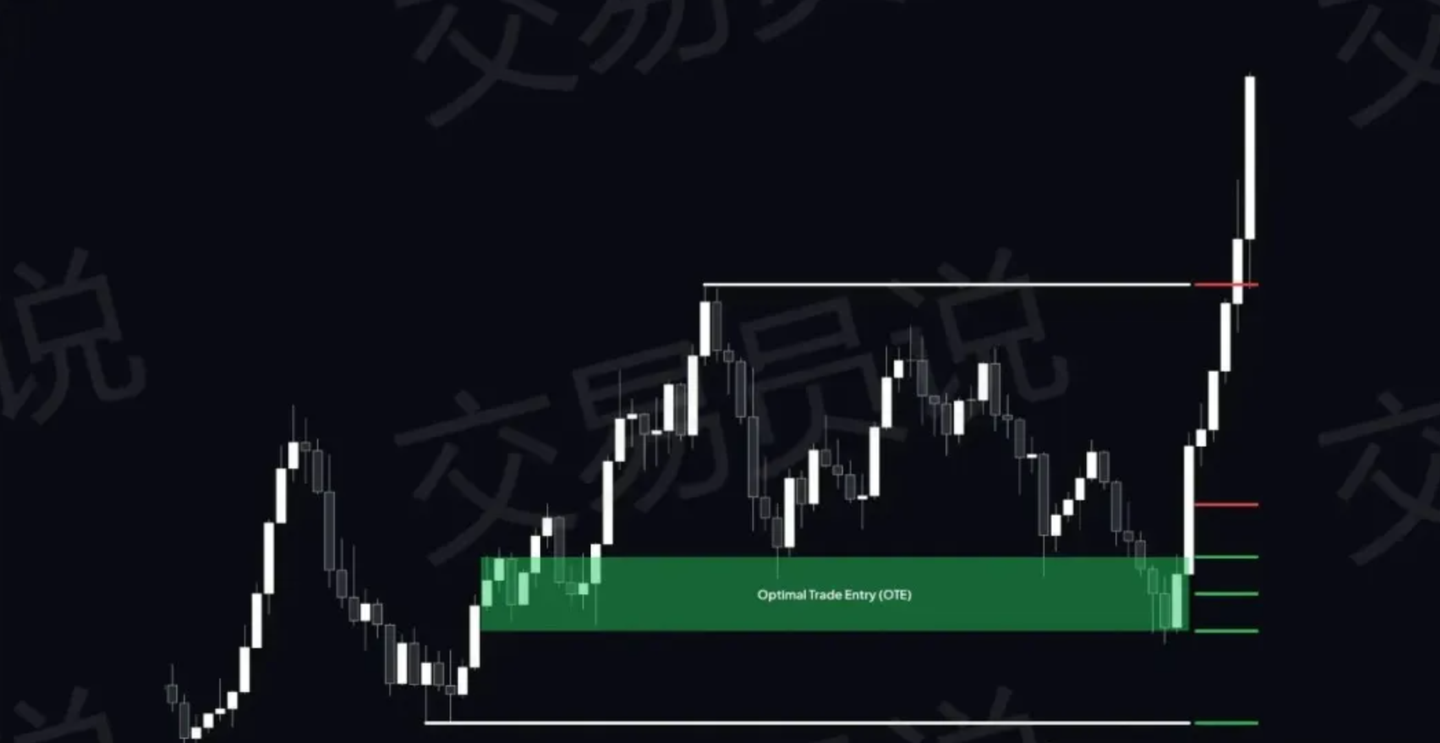
How POI and OTE work together.
POI marks key decision-making areas.
When the price retraces within the POI into the OTE area, the trading pattern will be stronger.
Institutional participants typically build or distribute positions within this range.
Steps to apply the Fibonacci sequence to POIs.
1. Identify market volatility points.
Traders first identify key swing highs and lows on the chart. These positions are the basis for drawing Fibonacci retracements and assessing potential price movements.
2. Draw Fibonacci levels.
Once key highs and lows are determined, traders apply Fibonacci retracement tools to visualize potential retracement areas where prices may pause or reverse; these areas usually occur at critical positions before trends continue.
3. Seek resonance with POI.
After drawing Fibonacci, traders look for POIs that overlap with key retracement areas.
For example: If a bullish order block is just near the 61.8% retracement, it may form a more statistically advantageous buying opportunity.
4. Confirm entry signals.
When Fibonacci retracement levels overlap with POI, traders can optimize their execution strategies. They will wait for confirmation of price action, such as bullish or bearish candlestick patterns appearing at significant Fibonacci levels that overlap with POI before deciding to enter a trade.
How to apply POI and Fibonacci in upward and downward trends.
Upward trend (buying scenario).
#1. Confirm a POI (such as order blocks, breaker blocks, liquidity pools, or FVG).
#2. Draw Fibonacci retracement lines from swing low to swing high.
#3. Look for the best trading entry areas within POIs (OTE, between 0.618 and 0.79).
#4. Enter after confirming signals (e.g., bullish candlestick patterns or structure breakthroughs BOS).
Downward trend (selling scenario).
#1. Confirm a POI.
#2. Draw Fibonacci retracement lines from swing high to swing low.
#3. Look for OTE ranges overlapping with POIs.
#4. Enter after confirming signals (e.g., bearish price action or rejection at resistance).
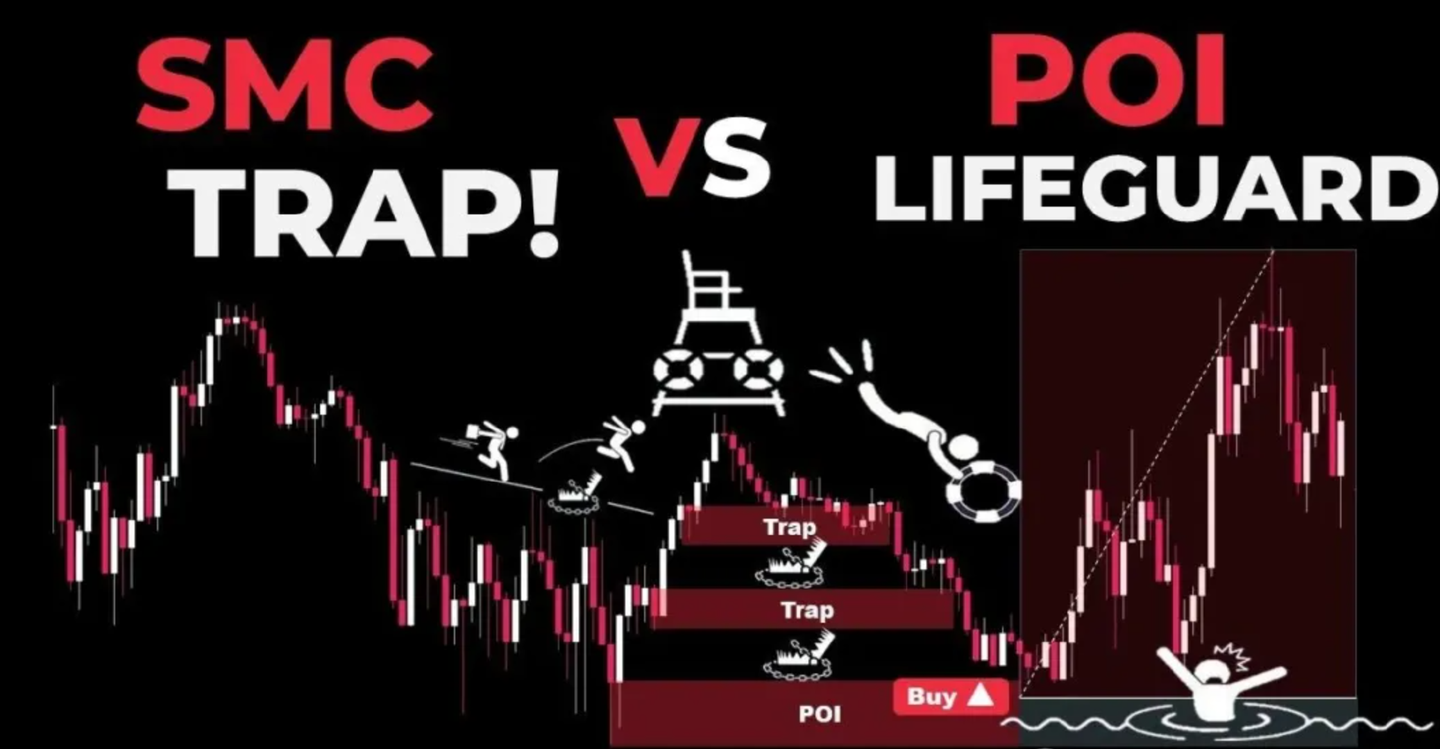
Common mistakes when using POI with Fibonacci.
1. Expect Fibonacci levels to always be effective.
Not every retracement will conform to Fibonacci. Price actions and POIs must provide additional confirmations.
2. Ignore market structure and POI.
Fibonacci works best when paired with strong POIs. Traders should first analyze market structure before trading.
3. Over-reliance on Fibonacci as the sole entry reason.
Fibonacci can only serve as a resonating factor, not the basis for trading itself. Other technical factors and fundamentals should also support trading decisions.
Conclusion
Combining POIs with Fibonacci retracement can strengthen trading models because it can:
1. Identify the best entry points through key liquidity areas.
2. Enhance returns/risk ratios by leveraging high-probability reversal areas.
Provide multiple resonance between price action, liquidity, and market structure.
If you can understand and apply POI and Fibonacci, you will be able to make more reasonable judgments and seize more high-probability smart money trading opportunities.

50 knowledge points that newcomers to the cryptocurrency market must master; first learn not to lose money, then think about making money!
One, basic concept classes (15 items).
Blockchain: A distributed shared ledger technology that records transactions transparently and immutably; Blockchain is the underlying technological support for cryptocurrencies.
Bitcoin: The core currency in the crypto world, as the first cryptocurrency, it has extremely high market recognition, often referred to as 'digital gold' due to its scarcity and value retention properties.
Wallet: A tool for storing cryptocurrencies, divided into cold wallets (offline storage, high security) and hot wallets (online use, easy to operate).
Private key: Equivalent to the wallet's 'key'; possessing the private key allows control over the assets within the wallet, and it must be kept confidential and not leaked or lost.
Public key: generated by an algorithm from the private key, can be publicly used to receive cryptocurrency, serving as the 'identity identifier' for asset Public Key reception.
Address: A string of characters generated based on the public key, equivalent to the 'house number' for receiving cryptocurrency; the corresponding address must be accurately filled in during transfers.
Ethereum: A mainstream blockchain platform with smart contract functionality, most cryptocurrency projects are developed based on ETH/Ethereum, with a wide range of application scenarios.
Altcoins: Other cryptocurrencies besides Bitcoin, encompassing various altcoins like Ethereum and Litecoin, some projects possess unique technologies or application scenarios.
Stablecoins: Cryptocurrencies pegged to fiat currencies like the US dollar, with minimal price fluctuations; common varieties include USDT and USDC, which are important tools for trading and hedging.
Mining: In blockchains using PoW (Proof of Work) mechanisms like Bitcoin, the process of providing computing power through mining machines to solve puzzles, validate transactions, and receive token rewards.
Hash rate: The unit of computational power of mining machines; the higher the hash rate, the greater the probability of successfully solving the hash puzzle and obtaining mining rewards in a PoW mechanism.
Consensus mechanism: The rules by which nodes in a blockchain network reach data consistency; common types include Bitcoin's PoW and Ethereum's current PoS (Proof of Stake).
White paper: An official document released by a cryptocurrency project that details the project's technical principles, development plans, team background, and application scenarios; it is the core material for understanding the project.
NFT: Non-fungible tokens, each NFT represents a unique digital asset that can be used in digital artworks, virtual items, etc., and possesses non-replicability.
Metaverse: A digital world where virtual and reality merge, cryptocurrencies and NFTs are the core carriers of its internal economic system, supporting transactions and value circulation.
Two, market and trading categories (21 items).
Bull market: The cryptocurrency market is in a long-term upward trend, with prices continuously rising, investor sentiment optimistic, and market activity high.
Bear market: The cryptocurrency market is in a long-term downtrend, with prices continuously declining, investor sentiment pessimistic, and market activity low.
Volatility: Cryptocurrency prices fluctuate within a narrow range in the short term, lacking a clear direction, and the market is in an unstable state.
Waterfall: A sharp drop in cryptocurrency prices within a short period, with significant declines and fast speeds, often triggering market panic.
Rebound: After a drop in cryptocurrency prices, a short-term rise occurs, showing a certain upward trend, but may not change the long-term trend.
Retracement: A brief decline after a rapid rise in cryptocurrency prices, representing normal fluctuations within the trend, usually of minor amplitude.
Consolidation: Cryptocurrency prices fluctuate slightly within a specific range, with limited ups and downs, and the market is in a state of sideways movement.
Whales: Institutions or individuals holding large amounts of cryptocurrency, due to their substantial holdings, have the ability to influence market price movements.
Washing: Operators deliberately create price fluctuations to wash out indecisive retail investors in the market, prompting them to sell their holdings to gain subsequent control of the market.
Pump: Operators buy large amounts of cryptocurrency, driving prices up rapidly, attracting retail investors to follow suit.
Smash: Operators sell large amounts of cryptocurrency, causing prices to plummet sharply, aiming to harvest retail investors or lower holding costs.
Trading pair: A trading combination consisting of two cryptocurrencies, such as BTC/USDT, representing the amount of USDT needed to purchase 1 BTC, which is the basic unit traded on exchanges.
Market order: A trading order submitted by investors at the current real-time market price, which is executed immediately after placing the order, suitable for scenarios that pursue rapid trading.
Limit order: A trading order submitted at a specific price set by the investor, which will only be executed when the market price reaches the set price, helping to lock in expected costs or profits.
DEX: Decentralized exchanges that do not require intermediaries; users complete transactions directly via wallets, with assets controlled by users without needing to be held on the platform.
CEX: Centralized exchanges, such as Binance and Huobi, managed by the platform, making trading processes and user assets easy to manage but reliant on platform credibility.
Airdrop: An activity where cryptocurrency project parties distribute tokens for free to specific users to attract attention and expand the project's influence; some require completing simple tasks.
Candy: Similar to airdrops, small amounts of tokens distributed for free by project parties in the early promotion phase, usually as a benefit or a means to attract users.
ICO: Initial Coin Offering, a way for project parties to raise funds by issuing new tokens. Currently, most regions worldwide have strict compliance requirements, posing higher risks.
Private placement: In the early stages of a cryptocurrency project, a method of raising funds directed at specific institutions or high-net-worth investors, with a high participation threshold, typically occurring before public fundraising.
Three, technology and application categories (4 items).
Smart contracts: Automated protocols written on the blockchain that execute automatically when preset conditions are met, without the need for third-party intervention, are core functionalities of platforms like Ethereum.
DApp: Decentralized applications developed based on blockchain technology, with data stored on the blockchain network, featuring characteristics of transparency and immutability, commonly found in finance and other fields.
DeFi: Decentralized finance, a financial system built on blockchain technology, covering services like lending, trading, and wealth management, without the need for traditional intermediary institutions like banks and brokers.
Gas fees: The transaction fees that users must pay when initiating transactions or executing smart contracts on Ethereum and other blockchain networks, with costs varying based on network congestion.
Four, investment strategies and psychology (11 items).
Retail investors: Referring to individual investors who have just entered the cryptocurrency market, lack professional knowledge and investment experience, and are easily 'harvested' by the market due to following trends or information gaps.
Bottom fishing: Investors judge that the price of cryptocurrency has dropped to a low point, buying tokens in anticipation of subsequent price increases to profit, requiring accurate judgment of the market bottom.
Topping: Investors predict that the price of cryptocurrency has reached a high point, selling tokens to lock in profits and avoid losses caused by subsequent price declines.
Leverage: A method where investors borrow funds to magnify their investment amounts several times for trading, which can enhance potential returns but also amplifies investment risks.
Going long: Investors expect cryptocurrency prices to rise; they first buy tokens and sell after prices rise to earn the price difference.
Going short: Investors expect cryptocurrency prices to decline; they first borrow tokens to sell, and then buy back at lower prices to repay, earning the price difference.
Take profit: Investors actively sell part or all of their tokens after achieving certain returns, converting paper profits into actual profits, avoiding subsequent price declines that lead to reduced earnings.
Stop-loss: Investors set a specific price threshold to control risks; when the cryptocurrency price falls to this threshold, they automatically or manually sell tokens to reduce the extent of losses.
Stuck: After investors buy tokens, the price continues to fall, resulting in paper losses. Due to unwillingness to bear losses, they choose to hold and cannot sell to exit.
Unwinding: When the price of tokens held by investors rises from a loss state back to the buying cost or above, eliminating paper losses, allowing tokens to be sold to achieve a state of no loss or profit.
FOMO: An abbreviation for 'fear of missing out'; investors impulsively follow trends to buy in fear of missing market upswings, often resulting in overpaying.
If you are still struggling in this liquidation cycle, force yourself to do these three things:
1: Reduce trading frequency.
2: Strictly enforce stop-loss.
3: Do not let any small losses spiral out of control.
If you still feel confused in the market, not knowing how to position next, I am here, willing to share more specific strategies and mindset management methods with you. Opportunities are right in front of you; as long as you take the initiative, we will have stories.
Investing is like practicing; in addition to steadfastly adhering to one’s investment philosophy in the face of severe market fluctuations, it is necessary to create a simple and easy-to-implement profit model. However, many retail investors do not know where to start. There are both fish and fishing methods collected, including solutions to common problems encountered in cryptocurrency trading, such as spot trading and contracts (essential skills for cryptocurrency traders). I hope fans can find suitable methods they want to learn from this to help establish a clear and effective trading system.