
Standing at the end of 2025, looking back on this year, the capital market can be described as 'turbulent'.
In 2025, China's bond market is generally weak and volatile, with frequent fluctuations testing the operational capabilities of institutions. The stock market, on the other hand, is engaged in a tug-of-war between policy tailwinds and fundamental repairs, with the Shanghai Composite Index once surging to over 4000 points, and then retreating back to over 3800 points.
Many investors are facing a common 'asset anxiety' at the end of the year:
Pure bond yields are declining: As the central interest rate gradually decreases, the yield on one-year high-grade credit bonds has retreated to around 1.7%, making it difficult to rely solely on coupon payments to meet the demand for beating inflation or appreciating value.
The equity market is highly volatile: although optimistic about the long term, the recent significant fluctuations at the end of the year have made many investors experience the difficulties of the stock market again.
Timing is extremely difficult: the stock-bond 'seesaw' effect is becoming more pronounced, making it hard for ordinary people to accurately time their investments.
In this context, the 'fixed income +' strategy, especially the secondary bond fund with bonds as the base and stocks as the enhancement, has become a 'bridge' connecting low risk and high returns due to its characteristics of 'can attack and can defend'.
The selection of the current stage's base - secondary funds
What is a secondary bond fund? It is based on bond assets as the base, but can flexibly allocate a certain proportion of stocks, convertible bonds, and other equity assets (usually not exceeding 20%-30%).
When the equity market becomes more volatile and valuations are no longer easily increased, secondary bond funds provide returns through coupons, interest spreads, and duration management, relatively reducing overall portfolio drawdown and enhancing risk resistance; when the securities market rebounds, they can also provide β enhancement through equity positions not exceeding 20%.
Therefore, within the asset allocation framework, it is a pivotal asset that connects the upper and lower in a volatile market.
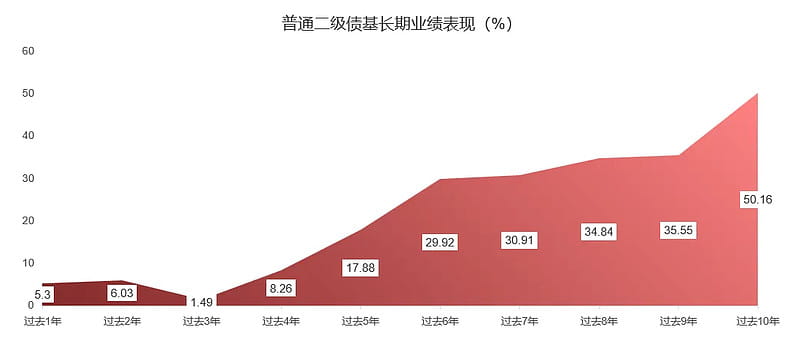
Data source: China Galaxy Securities Fund Evaluation Business Public Release Column - Long-term Performance Summary of Various Types of Funds, belonging to the classification: Galaxy Securities Primary Classification (Bond Funds), Galaxy Securities Secondary Classification (Ordinary Bond Funds), Galaxy Securities Tertiary Classification (Ordinary Bond Funds (Secondary) (Class A)), the latest number of funds officially operated under this classification is 567, with a number of performance representative funds also being 567; data as of: 2024/12/27.
Data shows that ordinary secondary bond funds have achieved an average net value growth rate of 50.16% over the past ten years, and their yield volatility is smaller compared to the CSI 300. (As of 2024/12/27, historical performance does not predict future fund trends)
The competitiveness of Huatai-Pb Fund's Tian Tian Le Shuang Ying Fund
Investing in secondary bond funds is not an easy task; its strategy is not simply a stock-bond mix, but rather tests the fund manager's capability in major asset allocation, research ability on individual stocks and bonds.
Comparatively, based on personal observation, Huatai-Pb Tian Tian Le Shuang Ying Bond Securities Investment Fund (Code: Class A 017592 Class C 017593) is a relatively excellent secondary bond fund.
As a newly established fund in 2023, its investment logic is very clear, aiming to construct a stock-bond collaboration mechanism tested in practice through scientific asset allocation ratios.
Mainly has several outstanding advantages:
I. Historical performance: pursue stability while seeking progress, the stock-bond collaboration mechanism has been tested in practice and has performed well since establishment.
The investment objective of this fund: under the premise of strictly controlling risks and maintaining liquidity, to pursue long-term stable value appreciation of fund assets through proactive investment management.
This fund invests at least 80% of its assets in bonds, while the total proportion of investments in stocks (including Hong Kong Stock Connect), convertible bonds, and exchangeable bonds does not exceed 20%.
Through scientific asset allocation ratios, this fund establishes a stock-bond collaboration mechanism that has been tested in practice:
First, the bond base is selected under the premise of strictly controlling credit risk, choosing high-cost performance bonds.
Second, selectively pick stocks to fully leverage the investment advantages of Huatai-Pb's active equity, aiming to contribute excess returns to the portfolio.
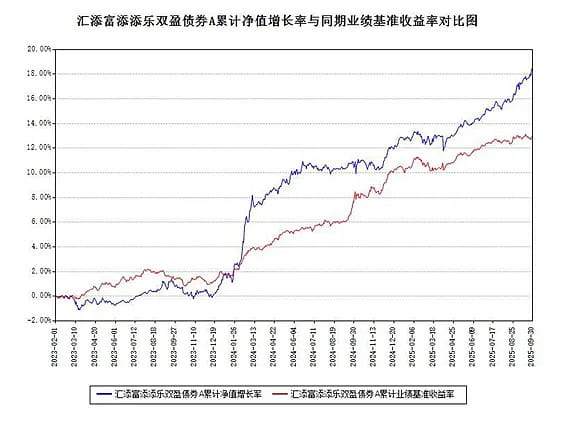
Note: Huatai-Pb Tian Tian Le Shuang Ying (017592) has established since 2023/02/01, with annual and first half of 2025 performance and benchmark performance of: 1.01%/2.03%, 11.53%/8.30%, 1.80%/1.52%, sourced from the fund's 2023 annual report, 2024 annual report, and 2025 Q2 report. Performance data is as of 2025/9/30. The Wind Mixed Bond Secondary Fund Index (885007) data is sourced from Wind. Past performance does not represent future performance and does not predict the performance of future indices or related funds.
As of September 30, 2025, Huatai-Pb's Tian Tian Le Shuang Ying has returned 18.50% since its inception, surpassing the performance benchmark (12.98%) and the Wind Mixed Secondary Bond Fund Index return (8.96%). (Data source: Fund Q3 report, statistical period 2023/2/1-2025/9/30)
II. Fund manager configuration: strong combination, with rich multi-asset management experience.
The fund adopts a dual-fund manager configuration, with Cai Zhiwen responsible for equity investment and Chen Sixing responsible for fixed income investment.
Cai Zhiwen has 10 years of experience in the securities industry, is a master's degree in statistics from Shanghai University of Finance and Economics, and is also a Chinese Certified Public Accountant (CPA). This background makes him extremely sensitive to numbers and able to discover the true value of enterprises from the subtleties of financial statements.
His investment style is distinct: 'not following the crowd, not clustering, not banding together'.
Investment characteristics: uncover 'black and gray horses', balancing growth and valuation, striving to control the portfolio's low volatility and low drawdown.
Management idea for equity part: focus on 'undervalued + dividends + growth potential', exploring Alpha in industries with low attention. In recent years, the selected investment targets have mainly concentrated on less focused industry segments, primarily in resource industries, as well as high-quality companies in transportation, machinery, home appliances, and other fields.
The bond part fund manager, Chen Sixing, has 15 years of fixed income investment experience and holds a master's degree in finance from Fudan University.
Chen Sixing's investment style is stable, with rich investment experience, possessing years of practical experience in independently managing large bond portfolios at top financial institutions.
Pay attention to analyzing the stock-bond allocation structure and risk-return characteristics of the investment portfolio. Good at grasping the long-term trends of fixed income assets.
Focus on investing in AAA-rated credit bonds, strictly controlling credit risks.
III. Platform advantages: strong in both stocks and bonds, with an early layout of product lines, providing ample platform support.
Excellent fund managers cannot be separated from the support of the underlying research team and platform.
Huatai-Pb Fund is a company I have repeatedly introduced in my articles, having won the Golden Bull Award multiple times. It is a comprehensive asset management company with deep accumulation in both active equity and fixed income business lines.
Fixed income business is one of Huatai-Pb's core strategies, with the company establishing the goal of 'after long-term efforts, becoming one of the best fixed income asset management companies in China'.
The company's fixed income team is highly stable, with the core investment team having an average of over ten years of experience and rich practical experience, along with extensive business resources.
Huatai-Pb implements integrated research on stocks and bonds, 'marrying' active investment advantages in the fixed income field. Transforming deep understanding of companies/industries into deeper understanding of credit risks, with stronger risk pricing ability.
A strong company platform supports the long-term development of its fixed income products.
IV. Outlook: optimistic about multiple opportunities.
For the most concerned questions from investors, 'Can we still buy now?' and 'What will we earn in the future?', both fund managers provided extremely clear judgments and layout directions in the latest communication.
1. Outlook for the bond market: looking for structural opportunities in volatility
Strategy: Chen Sixing stated that the neutral duration will be maintained, primarily 'to prevent risks', configuring at high points when market adjustments occur.
Opportunity point: short-term assets are highly certain, with considerable interest rate spreads. The portfolio's bond base will strive to serve as a 'stabilizer' for products, continuously optimizing the risk-return ratio of the products.
2. Outlook for the stock market: four main lines, optimistic and aggressive
Compared to the defenses of the bond market, Cai Zhiwen maintains an optimistic attitude towards the equity market for the upcoming quarter, clearly optimistic about four major directions. These four directions are also the potential sources of excess returns for Huatai-Pb's Tian Tian Le Shuang Ying in the future:
A. Optimistic about dividend assets
Logic: This is a capital-driven logic. Insurance companies will see a surge in sales during the 'opening red' period in 2026, facing tremendous asset allocation pressure (asset scarcity). Large insurance funds often borrow in advance to buy dividend assets, pushing up the market.
B. Inflation expectations for resource assets
Logic: On a macro level, if the Federal Reserve replaces dovish members, coupled with the resolution of local government debt pressures in China, the global trend of monetary 'easing' will continue. In the long term, excessive currency issuance is beneficial for physical assets.
C. 'Bottom reversal' of new energy assets
Logic: Overseas AI data centers (AIDC) have a strong demand for energy storage support; domestic photovoltaic installations bring huge consumption demand, and the energy storage industry has an excellent supply-demand pattern, facing an explosion.
D. 'Mental consumption' of domestic demand assets
Logic: Although overall domestic demand is weak, the consumption demand for 'mental' categories remains strong. We are optimistic about some industry leaders with reasonable valuations.
V. Suitable investor groups: various types of investors.
Regarding suitable investor groups, I personally believe that the following three types of investors can pay attention to this fund:
1. Bank wealth management replacement
In the past, I was accustomed to buying bank wealth management products, but I found that the yield was becoming lower and lower. This fund is based on over 80% bonds, combined with a management style that strictly controls drawdown (with a low risk level of R2), striving to provide better yield elasticity than pure bonds, while keeping risks controllable.
2. Worry about missing out on the stock market
Optimistic about the stock market warming in 2026, but hesitant to heavily invest in stocks. This fund's equity position does not exceed 20%, and the fund manager is clearly optimistic about high-probability directions such as dividends and resources, striving to allow holders to share in the stock market's gains without bearing excessive psychological pressure.
3. A 'backup' that can be attacked at any time
Compared to fixed-term products, the open-ended Tian Tian Le Shuang Ying provides better liquidity. It can be used as a 'mobile force' in family asset allocation, able to attack or defend.
Finally, let's summarize: the flow does not compete for the front, but for the endless stream.
In the current environment of asset scarcity and high volatility, what we need is not just a series of fluctuating yield numbers, but also a sense of confidence that can traverse cycles. Huatai-Pb Fund's Tian Tian Le Shuang Ying builds a foundation with 80% debt and attacks with 20% equity, striving to create a relatively certain 'safety net' in an uncertain market.
Huatai-Pb Tian Tian Le Shuang Ying Bond Fund (Code: Class A 017592 Class C 017593) is worth investors' attention.
Author: Cangdu Jia Man
Link: https://xueqiu.com/3213890140/364249956
Source: Xueqiu
Copyright belongs to the author. For commercial use, please contact the author for authorization; for non-commercial use, please indicate the source.
Risk warning: The views mentioned in this article only represent personal opinions, and the involved targets are not recommendations. Trading based on this is at your own risk. Looking at the end of 2025
, looking back on this year, the capital market can be said to be 'turbulent'.
In 2025, the overall bond market in China will be weak and volatile, with frequent fluctuations testing institutions' operational capabilities. The stock market will repeatedly struggle in the game between policy warmth and fundamental restoration, with the Shanghai Composite Index once surging to over 4000 points, then retreating to over 3800 points.
Many investors are facing a common 'asset anxiety' at the end of the year:
Pure bond yields are declining: as the interest rate center gradually moves down, the yield of high-grade credit bonds for one year has adjusted to around 1.7%, making it difficult to rely solely on coupons to meet the needs of outpacing inflation or appreciation.
The equity market is highly volatile: although optimistic about the long term, the recent significant fluctuations at the end of the year have made many investors experience the difficulties of the stock market again.
Timing is extremely difficult: the stock-bond 'seesaw' effect is becoming more pronounced, making it hard for ordinary people to accurately time their investments.
In this context, the 'fixed income +' strategy, especially the secondary bond fund with bonds as the base and stocks as the enhancement, has become a 'bridge' connecting low risk and high returns due to its characteristics of 'can attack and can defend'.
The selection of the current stage's base - secondary funds
What is a secondary bond fund? It is based on bond assets as the base, but can flexibly allocate a certain proportion of stocks, convertible bonds, and other equity assets (usually not exceeding 20%-30%).
When the equity market becomes more volatile and valuations are no longer easily increased, secondary bond funds provide returns through coupons, interest spreads, and duration management, relatively reducing overall portfolio drawdown and enhancing risk resistance; when the securities market rebounds, they can also provide β enhancement through equity positions not exceeding 20%.
Therefore, within the asset allocation framework, it is a pivotal asset that connects the upper and lower in a volatile market.
Data source: China Galaxy Securities Fund Evaluation Business Public Release Column - Long-term Performance Summary of Various Types of Funds, belonging to the classification: Galaxy Securities Primary Classification (Bond Funds), Galaxy Securities Secondary Classification (Ordinary Bond Funds), Galaxy Securities Tertiary Classification (Ordinary Bond Funds (Secondary) (Class A)), the latest number of funds officially operated under this classification is 567, with a number of performance representative funds also being 567; data as of: 2024/12/27.
Data shows that ordinary secondary bond funds have achieved an average net value growth rate of 50.16% over the past ten years, and their yield volatility is smaller compared to the CSI 300. (As of 2024/12/27, historical performance does not predict future fund trends)
The competitiveness of Huatai-Pb Fund's Tian Tian Le Shuang Ying Fund
Investing in secondary bond funds is not an easy task; its strategy is not simply a stock-bond mix, but rather tests the fund manager's capability in major asset allocation, research ability on individual stocks and bonds.
Comparatively, based on personal observation, Huatai-Pb Tian Tian Le Shuang Ying Bond Securities Investment Fund (Code: Class A 017592 Class C 017593) is a relatively excellent secondary bond fund.
As a newly established fund in 2023, its investment logic is very clear, aiming to construct a stock-bond collaboration mechanism tested in practice through scientific asset allocation ratios.
Mainly has several outstanding advantages:
I. Historical performance: pursue stability while seeking progress, the stock-bond collaboration mechanism has been tested in practice and has performed well since establishment.
The investment objective of this fund: under the premise of strictly controlling risks and maintaining liquidity, to pursue long-term stable value appreciation of fund assets through proactive investment management.
This fund invests at least 80% of its assets in bonds, while the total proportion of investments in stocks (including Hong Kong Stock Connect), convertible bonds, and exchangeable bonds does not exceed 20%.
Through scientific asset allocation ratios, this fund establishes a stock-bond collaboration mechanism that has been tested in practice:
First, the bond base is selected under the premise of strictly controlling credit risk, choosing high-cost performance bonds.
Second, selectively pick stocks to fully leverage the investment advantages of Huatai-Pb's active equity, aiming to contribute excess returns to the portfolio.
Note: Huatai-Pb Tian Tian Le Shuang Ying (017592) has established since 2023/02/01, with annual and first half of 2025 performance and benchmark performance of: 1.01%/2.03%, 11.53%/8.30%, 1.80%/1.52%, sourced from the fund's 2023 annual report, 2024 annual report, and 2025 Q2 report. Performance data is as of 2025/9/30. The Wind Mixed Bond Secondary Fund Index (885007) data is sourced from Wind. Past performance does not represent future performance and does not predict the performance of future indices or related funds.
As of September 30, 2025, Huatai-Pb's Tian Tian Le Shuang Ying has returned 18.50% since its inception, surpassing the performance benchmark (12.98%) and the Wind Mixed Secondary Bond Fund Index return (8.96%). (Data source: Fund Q3 report, statistical period 2023/2/1-2025/9/30)
II. Fund manager configuration: strong combination, with rich multi-asset management experience.
The fund adopts a dual-fund manager configuration, with Cai Zhiwen responsible for equity investment and Chen Sixing responsible for fixed income investment.
Cai Zhiwen has 10 years of experience in the securities industry, is a master's degree in statistics from Shanghai University of Finance and Economics, and is also a Chinese Certified Public Accountant (CPA). This background makes him extremely sensitive to numbers and able to discover the true value of enterprises from the subtleties of financial statements.
His investment style is distinct: 'not following the crowd, not clustering, not banding together'.
Investment characteristics: uncover 'black and gray horses', balancing growth and valuation, striving to control the portfolio's low volatility and low drawdown.
Management idea for equity part: focus on 'undervalued + dividends + growth potential', exploring Alpha in industries with low attention. In recent years, the selected investment targets have mainly concentrated on less focused industry segments, primarily in resource industries, as well as high-quality companies in transportation, machinery, home appliances, and other fields.
The bond part fund manager, Chen Sixing, has 15 years of fixed income investment experience and holds a master's degree in finance from Fudan University.
Chen Sixing's investment style is stable, with rich investment experience, possessing years of practical experience in independently managing large bond portfolios at top financial institutions.
Pay attention to analyzing the stock-bond allocation structure and risk-return characteristics of the investment portfolio. Good at grasping the long-term trends of fixed income assets.
Focus on investing in AAA-rated credit bonds, strictly controlling credit risks.
III. Platform advantages: strong in both stocks and bonds, with an early layout of product lines, providing ample platform support.
Excellent fund managers cannot be separated from the support of the underlying research team and platform.
Huatai-Pb Fund is a company I have repeatedly introduced in my articles, having won the Golden Bull Award multiple times. It is a comprehensive asset management company with deep accumulation in both active equity and fixed income business lines.
Fixed income business is one of Huatai-Pb's core strategies, with the company establishing the goal of 'after long-term efforts, becoming one of the best fixed income asset management companies in China'.
The company's fixed income team is highly stable, with the core investment team having an average of over ten years of experience and rich practical experience, along with extensive business resources.
Huatai-Pb implements integrated research on stocks and bonds, 'marrying' active investment advantages in the fixed income field. Transforming deep understanding of companies/industries into deeper understanding of credit risks, with stronger risk pricing ability.
A strong company platform supports the long-term development of its fixed income products.
IV. Outlook: optimistic about multiple opportunities.
For the most concerned questions from investors, 'Can we still buy now?' and 'What will we earn in the future?', both fund managers provided extremely clear judgments and layout directions in the latest communication.
1. Outlook for the bond market: looking for structural opportunities in volatility
Strategy: Chen Sixing stated that the neutral duration will be maintained, primarily 'to prevent risks', configuring at high points when market adjustments occur.
Opportunity point: short-term assets are highly certain, with considerable interest rate spreads. The portfolio's bond base will strive to serve as a 'stabilizer' for products, continuously optimizing the risk-return ratio of the products.
2. Outlook for the stock market: four main lines, optimistic and aggressive
Compared to the defenses of the bond market, Cai Zhiwen maintains an optimistic attitude towards the equity market for the upcoming quarter, clearly optimistic about four major directions. These four directions are also the potential sources of excess returns for Huatai-Pb's Tian Tian Le Shuang Ying in the future:
A. Optimistic about dividend assets
Logic: This is a capital-driven logic. Insurance companies will see a surge in sales during the 'opening red' period in 2026, facing tremendous asset allocation pressure (asset scarcity). Large insurance funds often borrow in advance to buy dividend assets, pushing up the market.
B. Inflation expectations for resource assets
Logic: On a macro level, if the Federal Reserve replaces dovish members, coupled with the resolution of local government debt pressures in China, the global trend of monetary 'easing' will continue. In the long term, excessive currency issuance is beneficial for physical assets.
C. 'Bottom reversal' of new energy assets
Logic: Overseas AI data centers (AIDC) have a strong demand for energy storage support; domestic photovoltaic installations bring huge consumption demand, and the energy storage industry has an excellent supply-demand pattern, facing an explosion.
D. 'Mental consumption' of domestic demand assets
Logic: Although overall domestic demand is weak, the consumption demand for 'mental' categories remains strong. We are optimistic about some industry leaders with reasonable valuations.
V. Suitable investor groups: various types of investors.
Regarding suitable investor groups, I personally believe that the following three types of investors can pay attention to this fund:
1. Bank wealth management replacement
In the past, I was accustomed to buying bank wealth management products, but I found that the yield was becoming lower and lower. This fund is based on over 80% bonds, combined with a management style that strictly controls drawdown (with a low risk level of R2), striving to provide better yield elasticity than pure bonds, while keeping risks controllable.
2. Worry about missing out on the stock market
Optimistic about the stock market warming in 2026, but hesitant to heavily invest in stocks. This fund's equity position does not exceed 20%, and the fund manager is clearly optimistic about high-probability directions such as dividends and resources, striving to allow holders to share in the stock market's gains without bearing excessive psychological pressure.
3. A 'backup' that can be attacked at any time
Compared to fixed-term products, the open-ended Tian Tian Le Shuang Ying provides better liquidity. It can be used as a 'mobile force' in family asset allocation, able to attack or defend.
Finally, let's summarize: the flow does not compete for the front, but for the endless stream.
In the current environment of asset scarcity and high volatility, what we need is not just a series of fluctuating yield numbers, but also a sense of confidence that can traverse cycles. Huatai-Pb Fund's Tian Tian Le Shuang Ying builds a foundation with 80% debt and attacks with 20% equity, striving to create a relatively certain 'safety net' in an uncertain market.
Huatai-Pb Tian Tian Le Shuang Ying Bond Fund (Code: Class A 017592 Class C 017593) is worth investors' attention.