

x_Rex
X @x_Rex_yhy |Social Butterfly🌸😋😸| Gold Trader😎✨🌼|
Open Trade

NIL Holder
Frequent Trader
1.6 Years
356 Following
20.9K+ Followers
10.8K+ Liked
Posts
Portfolio
All
Quotes
Videos
Live
PINNED


帝王AM_1688
·
--
I never imagined I'd fall this hard for someone I once knew nothing about. I had no idea I'd get this attached, that I'd care this deeply, that I'd end up loving you with all my heart. And now, here I am, so completely in love with this beautiful stranger I once knew nothing about.
#someone
#someone


国王 jack jacky
·
--
$BTC Finding peace where the golden fields meet the setting sun. Sometimes, the best way to move forward is to sit back, breathe, and appreciate how far you’ve come. 🌾✨

x_Rex
·
--
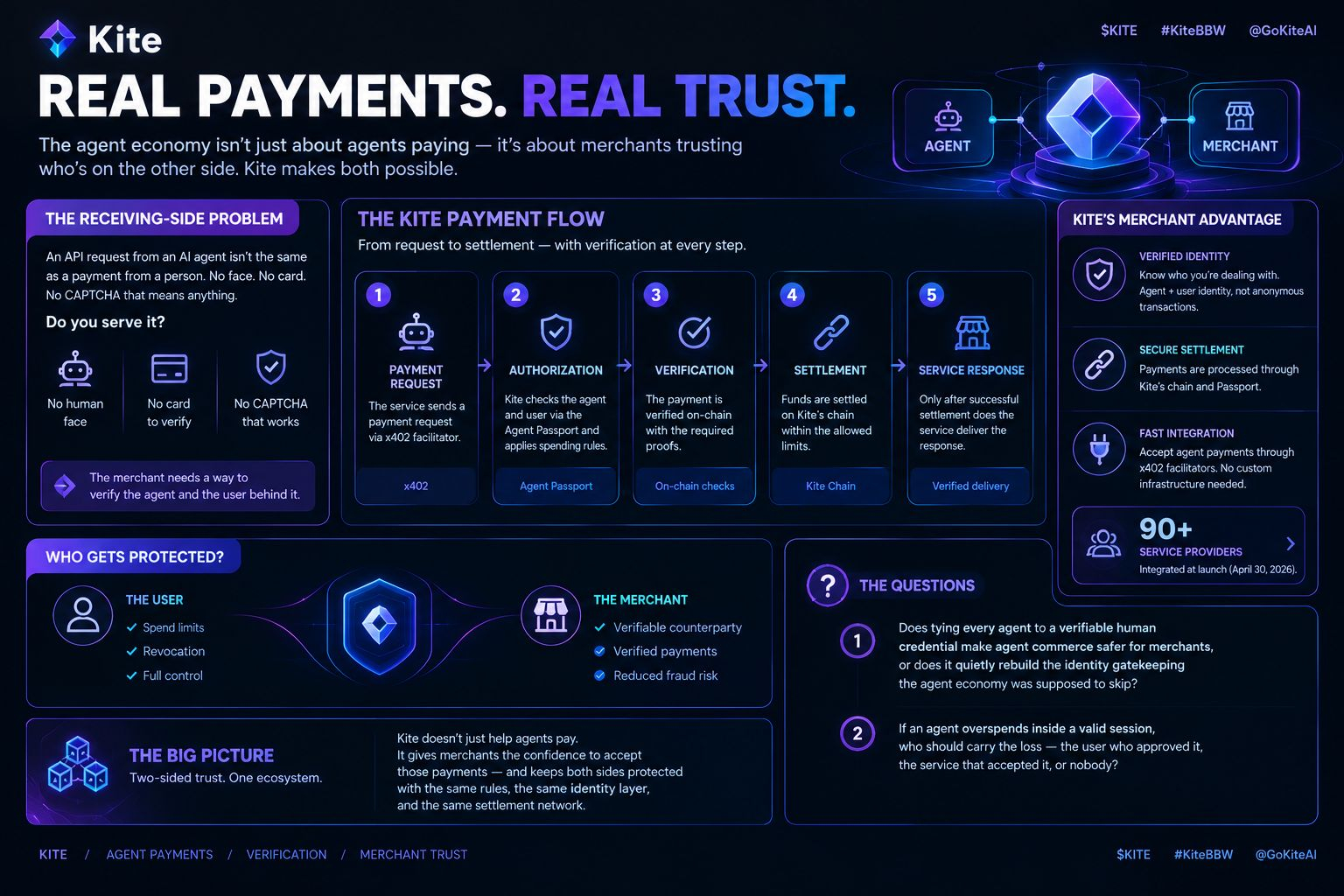
#KiteBBW $KITE
Card payments protect the buyer and expose the seller😒.
A customer can dispute a charge months later, and the merchant eats the chargeback.
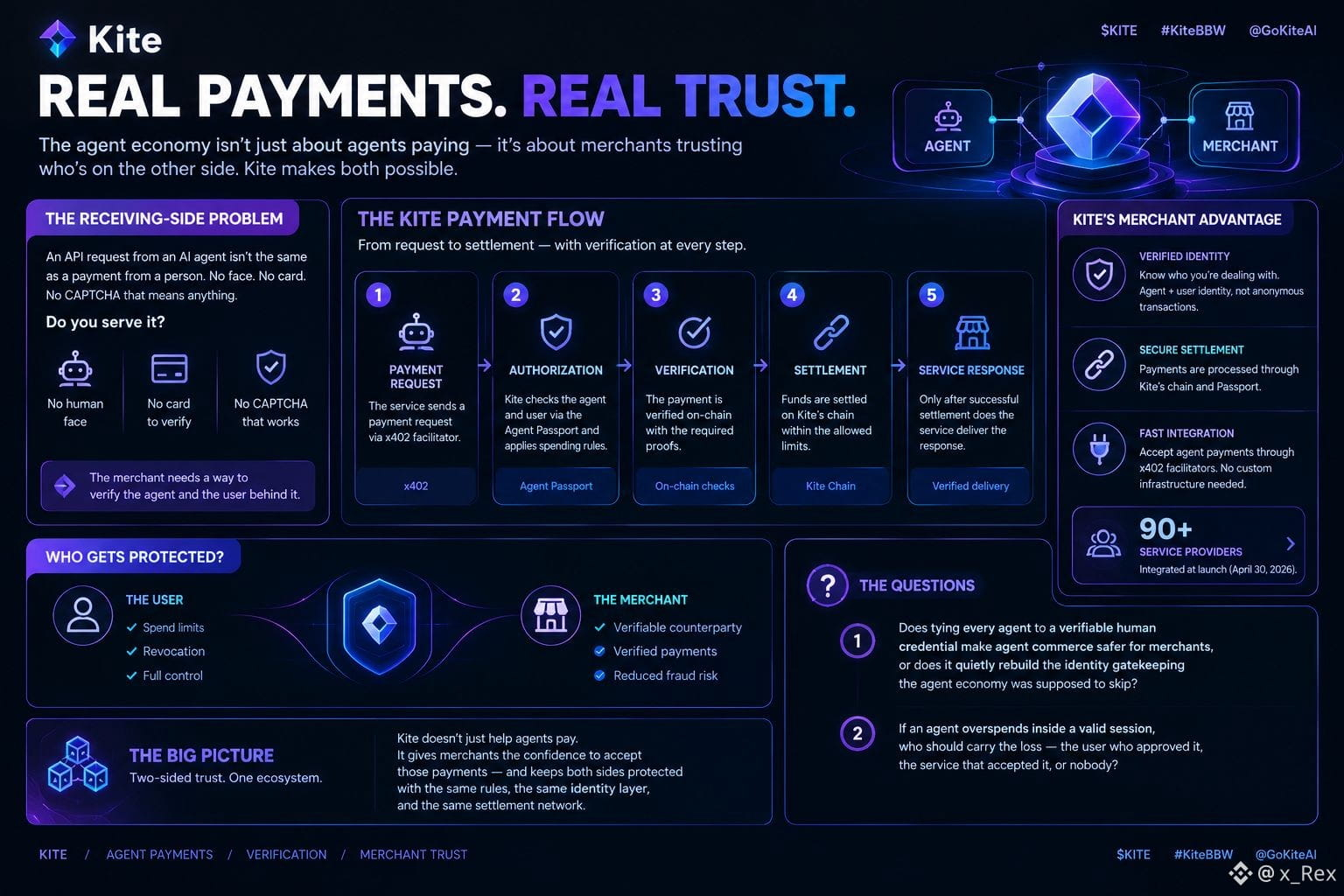
Kite's service provider guide describes a flow that flips this, and I think the flip is the most underrated design choice in the agent economy😁.
The flow is short.
An agent calls an endpoint, and the service replies with a 402 Payment Required that states the price, the pay-to address and a timeout.
The agent answers with a signed authorization drawn from the user's approved session.
The service verifies it, a facilitator settles the transfer on chain, and only then does the service deliver the response.
Settlement FIRST, delivery SECOND🤷♀️.
The merchant doesn't extend credit or wait for an invoice to clear.
That's what makes tiny per-request prices workable in principle🤓.
Card rails carry fixed costs per transaction that small payments can't absorb, and per-request pricing only works if the payment itself is nearly free.
The guide says any service that already speaks x402 or the machine payments protocol Stripe co-authored can be paid by a Passport agent today.
More than 90 providers were integrated at mainnet launch on April 30, 2026.
But the risk didn't disappear, it moved to the buyer.
Once settlement clears before delivery, a service that returns junk has already been paid, and the provider guide I read describes no refund or dispute step.
The user's protection is the session😃: the per-transaction cap and the total cap limit what any one bad call can cost
In my view those caps do the job chargebacks do in the card world, just before the damage instead of after😌
That trade looks fine at small per-call prices, real trouble is big buys of the agent.
If settlement is final before the service responds and a paid call returns something useless, what should replace the chargeback: reputation scores for services, refund escrow built into the protocol, or nothing, because per-call prices are too small to justify the machinery?
Drop 'kite' if you got good info here
x_Rex
·
--
#KiteBBW $KITE
Card payments protect the buyer and expose the seller😒.
A customer can dispute a charge months later, and the merchant eats the chargeback.
Kite's service provider guide describes a flow that flips this, and I think the flip is the most underrated design choice in the agent economy😁.
The flow is short.
An agent calls an endpoint, and the service replies with a 402 Payment Required that states the price, the pay-to address and a timeout.
The agent answers with a signed authorization drawn from the user's approved session.
The service verifies it, a facilitator settles the transfer on chain, and only then does the service deliver the response.
Settlement FIRST, delivery SECOND🤷♀️.
The merchant doesn't extend credit or wait for an invoice to clear.
That's what makes tiny per-request prices workable in principle🤓.
Card rails carry fixed costs per transaction that small payments can't absorb, and per-request pricing only works if the payment itself is nearly free.
The guide says any service that already speaks x402 or the machine payments protocol Stripe co-authored can be paid by a Passport agent today.
More than 90 providers were integrated at mainnet launch on April 30, 2026.
But the risk didn't disappear, it moved to the buyer.
Once settlement clears before delivery, a service that returns junk has already been paid, and the provider guide I read describes no refund or dispute step.
The user's protection is the session😃: the per-transaction cap and the total cap limit what any one bad call can cost
In my view those caps do the job chargebacks do in the card world, just before the damage instead of after😌
That trade looks fine at small per-call prices, real trouble is big buys of the agent.
If settlement is final before the service responds and a paid call returns something useless, what should replace the chargeback: reputation scores for services, refund escrow built into the protocol, or nothing, because per-call prices are too small to justify the machinery?
Drop 'kite' if you got good info here
Card payments protect the buyer and expose the seller😒.
A customer can dispute a charge months later, and the merchant eats the chargeback.
Kite's service provider guide describes a flow that flips this, and I think the flip is the most underrated design choice in the agent economy😁.
The flow is short.
An agent calls an endpoint, and the service replies with a 402 Payment Required that states the price, the pay-to address and a timeout.
The agent answers with a signed authorization drawn from the user's approved session.
The service verifies it, a facilitator settles the transfer on chain, and only then does the service deliver the response.
Settlement FIRST, delivery SECOND🤷♀️.
The merchant doesn't extend credit or wait for an invoice to clear.
That's what makes tiny per-request prices workable in principle🤓.
Card rails carry fixed costs per transaction that small payments can't absorb, and per-request pricing only works if the payment itself is nearly free.
The guide says any service that already speaks x402 or the machine payments protocol Stripe co-authored can be paid by a Passport agent today.
More than 90 providers were integrated at mainnet launch on April 30, 2026.
But the risk didn't disappear, it moved to the buyer.
Once settlement clears before delivery, a service that returns junk has already been paid, and the provider guide I read describes no refund or dispute step.
The user's protection is the session😃: the per-transaction cap and the total cap limit what any one bad call can cost
In my view those caps do the job chargebacks do in the card world, just before the damage instead of after😌
That trade looks fine at small per-call prices, real trouble is big buys of the agent.
If settlement is final before the service responds and a paid call returns something useless, what should replace the chargeback: reputation scores for services, refund escrow built into the protocol, or nothing, because per-call prices are too small to justify the machinery?
Drop 'kite' if you got good info here
x_Rex
·
--
#nil $NIL @Nillion
A builder I follow shipped a vault with a rebalancing trigger 🤔.
Took MONTHS to get the logic right.
Within a WEEK, someone had read the contract, worked out exactly what it watched for, and was front-running it every time it fired.
So in the end the strategy didn't fail. It just stopped being SECRET the moment it went onchain.
Covenants exist for that exact failure mode.
The mechanics are simpler than they sound.
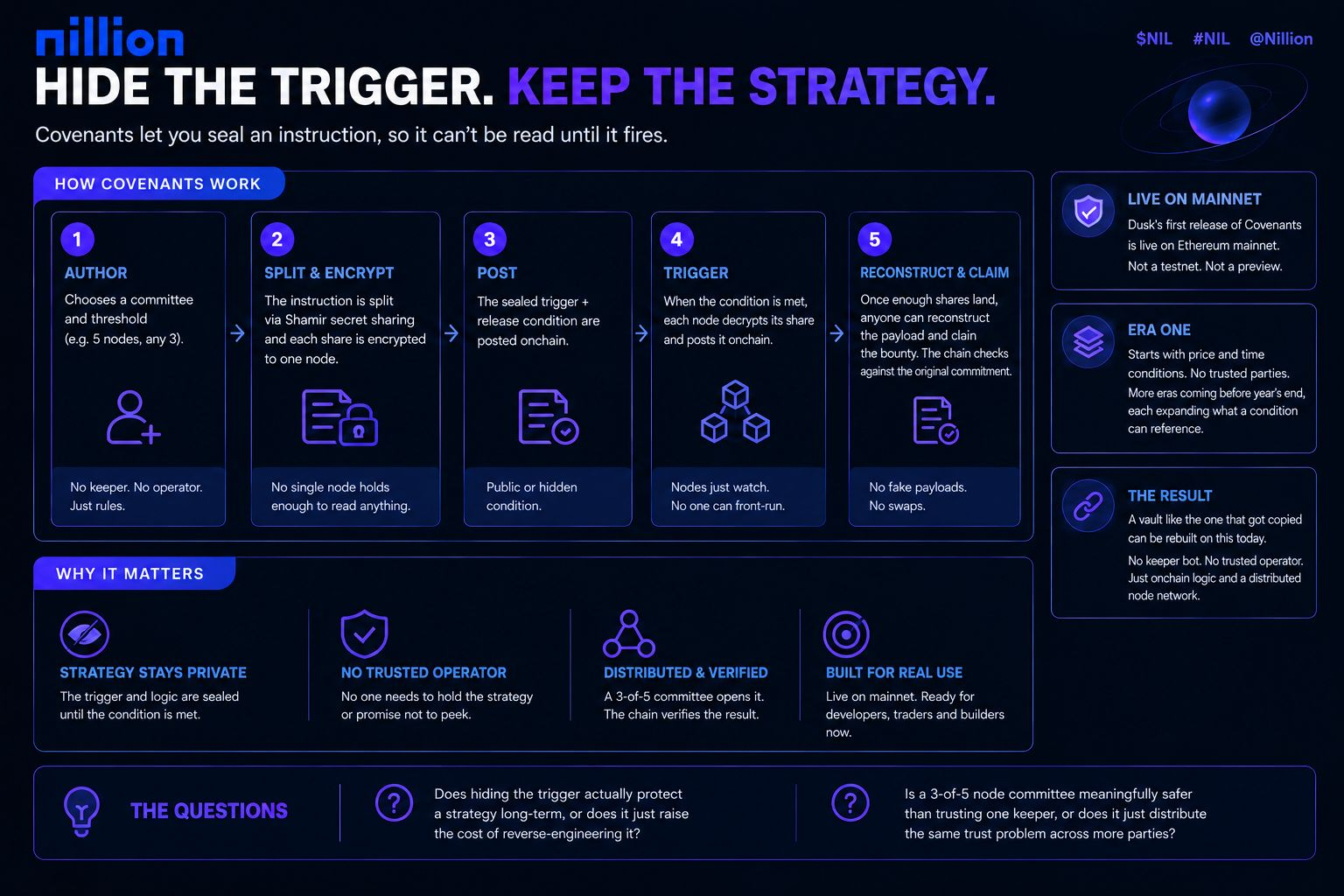
An author picks a committee of nodes and a threshold, let's say 5 nodes, any 3 can open it.
The instruction gets split into shares, Shamir secret sharing, and each share gets encrypted to one specific node.
No node ever holds enough on its own to read anything.
The author posts the sealed trigger plus a release condition, public or hidden, and that's it. Nodes just watch.
When the condition is actually met, each one decrypts its own share and posts it onchain.
Once enough shares land, anyone can reconstruct the payload and claim the bounty for doing it, the chain checks the result against a commitment made upfront, so nobody can swap in a fake payload at reveal.
Nothing about that needed a keeper bot or a trusted operator holding the strategy and promising not to peek.
Dusk, the first release of Covenants, is live on Ethereum mainnet right now.
Not a testnet, not a preview. A vault like the one that got copied could be rebuilt on this today.
It's also only era 1 of 7. This version stays deliberately narrow, price and time conditions, because that's the part that works now with zero trusted parties involved.
More eras ship before the year's out, each one widening what a sealed condition can reference.
So, Two things I keep thinking.Does hiding the trigger actually protect a strategy longterm, or does it just raise the cost of reverse-engineering it instead of removing the threat?
And is a 3-of-5 node committee meaningfully safer than trusting one keeper, or does it just distribute the same trust problem across more parties.
And just for your info guys, Nillion's Dusk and the Layer1 #dusk are not the same😅

Luke_龙
·
--
#KiteBBW $KITE
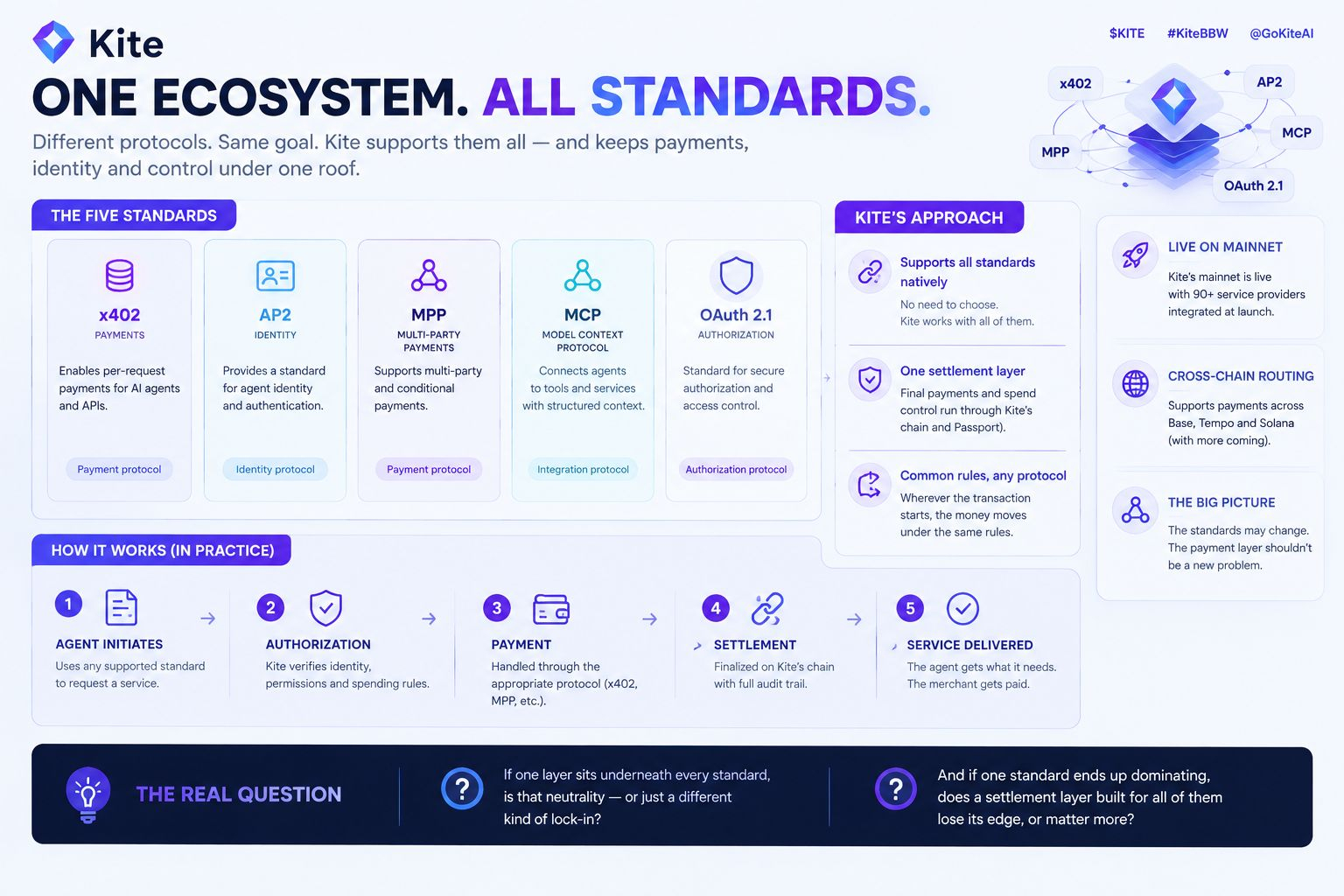
x402, AP2, MPP, MCP, OAuth 2.1.
Five protocols an agent might be asked to speak, and nobody knows which one wins.
Kite’s answer is to not pick.
Each covers a different piece. x402 revives HTTP “payment required” status so a service can charge per request.
AP2 is Google’s agent payments protocol, MPP is Stripe’s machine payment protocol, MCP is Anthropic’s way of connecting agents to tools, and OAuth 2.1 handles authorization
As one research report framed it, an agent using x402 can pay per request, still needs a separate wallet, a separate identity layer and its own spending-limit logic.
Kite’s stated approach is to support all of them natively and keep the part that matters, final settlement and spend control, anchored to its own chain and Passport.
Whatever protocol starts the transaction, the money is meant to move under the same rules the user set: a budget, a time limit, a passkey approval, instant revocation.
Kite also lists sub-second deterministic finality and dedicated agent payment lanes, which matter more for an agent than a person.
A human can wait for a confirmation.
An agent acting alone needs to know a payment is actually done.I like the logic because it sidesteps the standards fight.
It’s also a quiet bet on where value sits in the agent economy:
not in the request layer, which could change every year, but in the layer that decides whether a payment is allowed to clear.
Kite is also a member of the Linux Foundation’s Agentic AI Foundation, which suggests it wants a seat inside the standards conversation, not just underneath it.
Mainnet launched April 30, 2026 with 90+ service providers already integrated, so the real test is whether that neutrality and those payment lanes hold under real traffic
Would like other people’s takes
1. If one layer sits underneath every standard, is that neutrality or just a different kind of lock-in?
2. If one standard ends up dominating anyway, does a settlement layer built for all of them lose its edge, or matter more because everything runs through it?


🔵 NEAR short squeeze
47%
🔐 PROVE ZK network
26%
🤯 BTC is Insane
24%
📈 Pre-IPO access
3%
38 votes • Voting closed
Log in to explore more content