

Today, the topic that is trending is the government's rectification of cryptocurrency speculation. Everyone is discussing whether this is negative news, but I believe this issue can be explained from a higher perspective...
I don't know if you dare to believe it, but China is actually building a decentralized currency settlement network through gold, with principles similar to BTC...
This chart shows the trend of China's central bank gold reserves over the past 10 years, essentially one word: 'Buy!' Meanwhile, the central banks of the other six countries with the most gold reserves in the world: the United States, Germany, Italy, France, Russia, and Japan have not shown such signs...
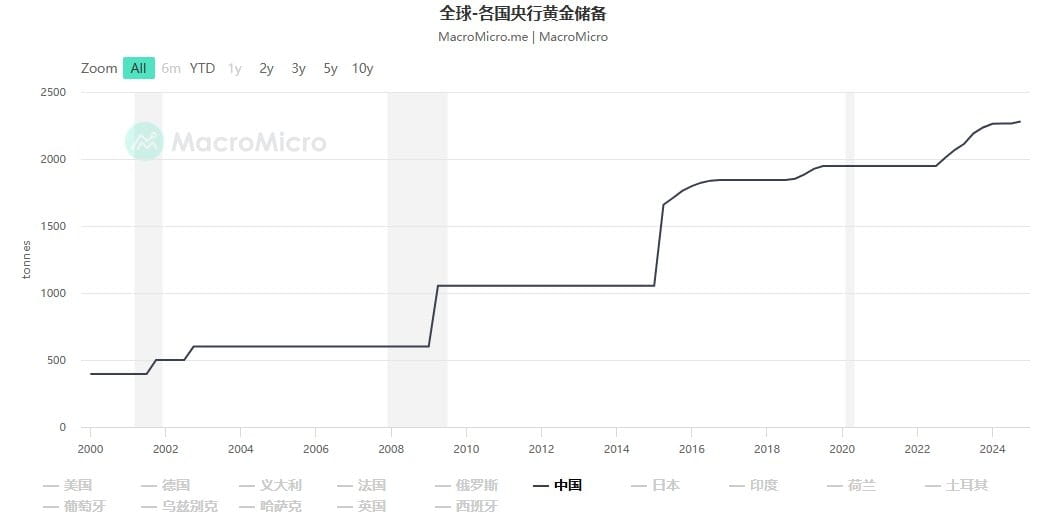
Japan has slightly increased its holdings, while the gold reserves of the other five countries have been declining year by year...
Why does China so despise cryptocurrencies while being so obsessed with gold?
This leads to today's controversial statement: China is attempting to re-establish a link between gold and the RMB, aiming to create a decentralized multinational physical gold settlement network, ultimately preparing to replace the dollar as the international reserve currency...
The basic idea of this controversial statement comes from the TFTC podcast, and I will briefly summarize it here...
Here's the situation: As shown in the image above, for decades, the People's Bank of China has been the largest buyer of physical gold in the world. What they have been doing is very simple: selling US treasuries and buying gold...
At the same time, the Shanghai Gold Exchange has gradually become the world's largest physical gold trading market. Not only that, China is also establishing a gold vault network called the "gold corridor," which has an interesting distribution mainly based on the BRICS countries...
This network allows all countries holding RMB to directly exchange gold within it. Unlike the centralized network enforced by the Bretton Woods system, this gold is not stored by China alone, but is distributed in a decentralized manner across all BRICS countries...
This allows the RMB to possess a monetary value similar to what the "dollar" had in the last century, while also avoiding currency credit dilution since you can always exchange RMB for physical gold stored in your own country!
Unlike the current dollar dilemma, gold cannot be frozen by electronic systems, nor is there a risk of devaluation under a regime's control. For example, the gradual devaluation of the dollar after the Federal Reserve's massive monetary easing during the pandemic...
The reason this matter has been brought to the table is that in July 2025, gold was reclassified as a Tier 1 asset under the Basel III agreement. It doesn't matter if you don't understand this; just remember that this upgrade in asset attributes means that from now on, gold will have a status on bank balance sheets almost equal to cash or government bonds!
Before this, the value of gold on bank balance sheets was only half of what it is now...
The next level after Tier 1 assets under the Basel III agreement is: HQLA, which simply means high-quality liquid assets, the most important of which are currently US treasuries...
So, to put it simply, gold is just one step away from being equivalent to US treasuries as an asset. This is also why China has been continuously buying gold and pushing for this upgrade in asset attributes over the years!
The above is the groundwork; the main event is yet to come...
============Divider=============
Now we can return to the topic of the gold vault network!
If you understand the establishment of the Bretton Woods system last century, then you would scoff at China's intention to establish this gold-currency anchoring system. In fact, this is precisely the case; the main reason the RMB could not become an international trade settlement or reserve currency in the past was its lack of credibility and the absence of an anchor!
The dollar, or the original dollar, had all its gold reserves stored in the United States. When Americans announced the removal of the gold standard, the anchor of the dollar's credibility gradually shifted to oil settlements and America's technological and military advantages...
However, these anchors are completely different from gold; their value fluctuations are quite illusory and even difficult to quantify, which gave the US and the Federal Reserve a lot of room for monetary policy operations. This is why there has been a dollar tide under the global economy.
China's current "gold corridor" is essentially a decentralized vault network, similar to how the ledger on the BTC network is recorded by distributed miners. Each vault located in different countries is linked together, collectively recording the ownership, purity, and weight of every gold bar in all vaults...
With this design, all countries that use RMB for settlement can ensure: the gold is in my hands, and I can exchange it in real-time!
This grants the RMB something the dollar has lost for a long time: trust...
Countries joining this network will be able to conduct international trade through gold-RMB in the future, and the entire process will not require any involvement of the dollar. In simple terms, it establishes a new settlement network within the existing international currency settlement framework...
If gold further becomes an HQLA asset in the future, then this gold itself can be viewed as an asset that is as safe as US treasuries. These countries will not need to purchase any US treasuries; simply holding gold will suffice!
At that time, within this dollar-shielded settlement network, a completely dollar-free financial system can develop because HQLA assets can be used for lending, collateral, and a series of basic financial operations. These are the cornerstones of the financial network.
In summary, through these step-by-step operations, the main goal is to anchor the RMB to gold and defeat the dollar in the currency war...
===========Divider===========
Why does China want to crack down on cryptocurrencies?
The answer is simple. After Trump took office, there was indeed a similar trend in the regulatory openness towards cryptocurrencies, but unlike China, the US is looking for a backdoor in crypto assets, maybe BTC, maybe others...
In the currency war that is bound to happen in this century, both China and the US are searching for the best anchor for their currencies. China has chosen gold, while the US may currently be choosing crypto assets.
So, for China, the further it goes down this road, the less likely it is to accept BTC and other cryptocurrencies.
Similarly, for the US, maintaining the dollar's status as a reserve currency is the biggest goal of this century!
===========Divider===========
In conclusion: If this controversial statement continues, China will never open the cryptocurrency market in the future, while the US may increasingly embrace cryptocurrencies...
For China, not only BTC but even stablecoins will be considered enemies...
By the way, some say that isn't the US the country with the most gold reserves? Isn't that just sitting back and enjoying the benefits?
But in fact, according to some institutions' analysis, China's actual gold reserves may currently be second only to the US, with much of it undisclosed, while the gold held by the US has some discrepancies, with a significant portion of it not even on US soil but in London...
From Crypto_Painter