
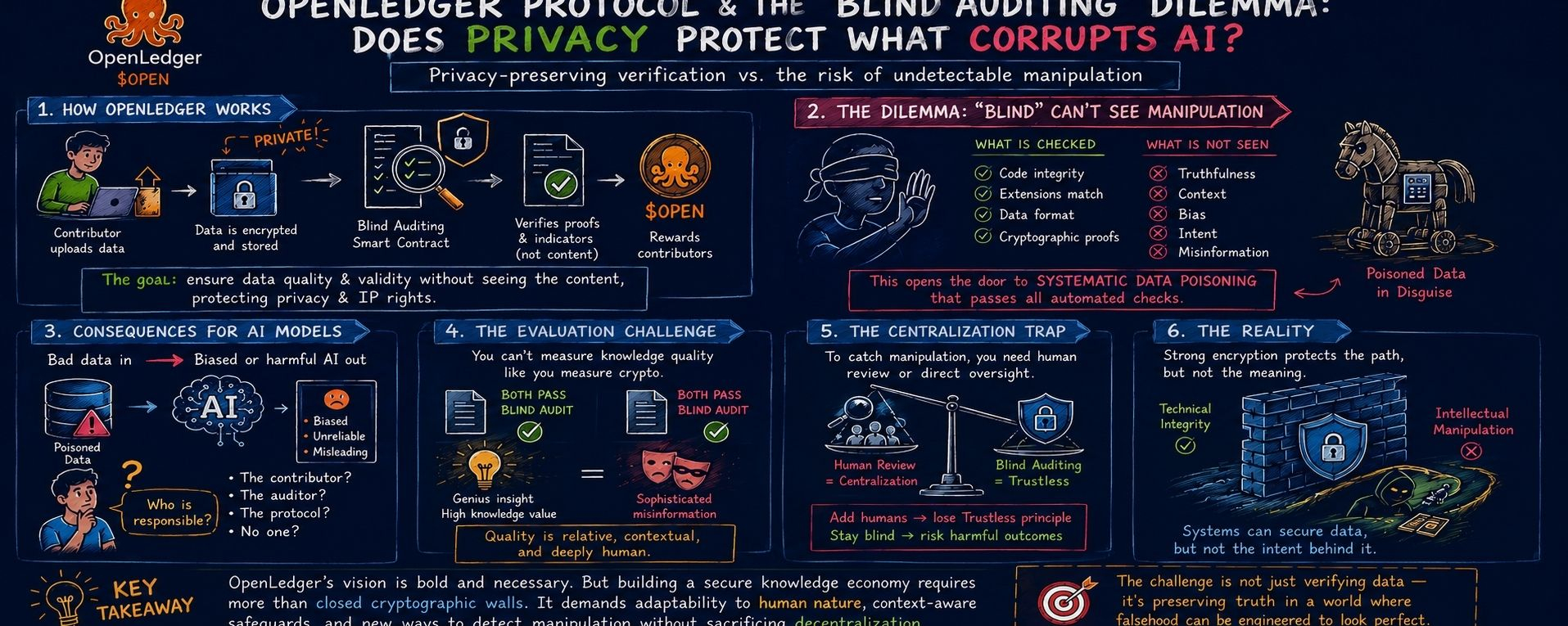

What really grabs my attention when diving into the security audit mechanisms on the OpenLedger platform isn’t just the cryptographic efficiency of "Blind Auditing"; there’s a wave of projects offering software solutions to block third parties from peeking at stored content. But the burning question, and Karl’s thought structure, is whether this complete closure actually safeguards the integrity of knowledge, or if it creates a perfect environment for behavioral manipulations that are impossible to spot programmatically.
The thesis appears perfect in theory. The protocol seeks to ensure data quality and validity through smart contracts that inspect indicators without touching the intrinsic substance of the uploaded material, to preserve contributors’ privacy and ownership rights through $OPEN. This balance seems sound, but turning cryptographic obfuscation mechanisms into a tool for sorting truths is where the challenges intertwine and their inevitable integrity slips away.
The network’s technical vision assumes that isolating data and concealing its visibility automatically creates a secure environment. But I see this approach as an excessive simplification of a highly complex equation. The ability to verify the safety of code and the compatibility of extensions on the public ledger without examining the epistemic content may open a wide backdoor to what is known as “systematic data poisoning” (Data Poisoning). There is a very thin line between preserving a message’s digital identity and delivering intelligent misdirection (Sophisticated misinformation). Strict cryptographic equations do not always possess sufficient awareness to determine where that line lies.
This dilemma takes root when considering the responsibility of the final models. Decentralization and content concealment provide a sense of absolute safety until AI algorithms begin to reveal catastrophic biases or misleading outputs as a result of being fed structurally corrupted data that was smuggled under the cover of privacy. At that moment, who bears responsibility? A protocol that relies entirely on encryption may face a structural inability to trace the roots of behavioral exploitation. Meanwhile, shifting to human review or direct oversight would immediately pull the system back into the square of centralization and erase the project’s “no need for trust” slogan.
The evaluative side of content imposes additional dilemmas. The data directed to artificial intelligence cannot be measured for quality like standardized crypto coins, because its value is relative and depends entirely on context and human meaning. Two pieces of code could pass the “blind audit” test with the same numerical score; one, however, carries a brilliant stream of knowledge, while the other bears carefully crafted misdirection dressed in technical sophistication. Accordingly, betting on automating the quality of intellectual assets without understanding their nature may prove more complex than the project’s technical literature portrays.
This contradiction does not diminish OpenLedger’s ambition; it clarifies that building a secure knowledge economy requires more than just blind cryptographic walls. The final outcome will not depend only on how tightly “blind verification” contracts are enforced, but on the protocol’s flexibility in handling the elusive nature of humans who master the exploitation of regulatory loopholes. Source code may guarantee the integrity of the technical pathway, but it stands powerless in protecting content from systematically engineered intellectual falsification.