



I've been eyeing the news about OpenAI updating its Codex tools for a while now. The name has 'Open' in it, which immediately made me think of OPENLEDGER. A lot of retail traders see that similar prefix and instinctively mix the two up. Looking through the AI agent industry data, the market volume for 2024 is only $5.4 billion, but institutions estimate it could soar to $236 billion by 2034. The growth curve looks like bamboo shooting up, definitely exponential gains. Right now, the vast majority of retail traders haven't even stepped into the AI agent space yet; the whole sector is like a pressure cooker just waiting to explode.@OpenLedger Riding this wave, leveraging the hype around this sector to boost the market. But just hopping onto the name and painting a big picture narrative is worlds apart from the real iterative tech that OpenAI is delivering. No matter how big the hype bubble gets, it ultimately can't land in the realm of actual deployment.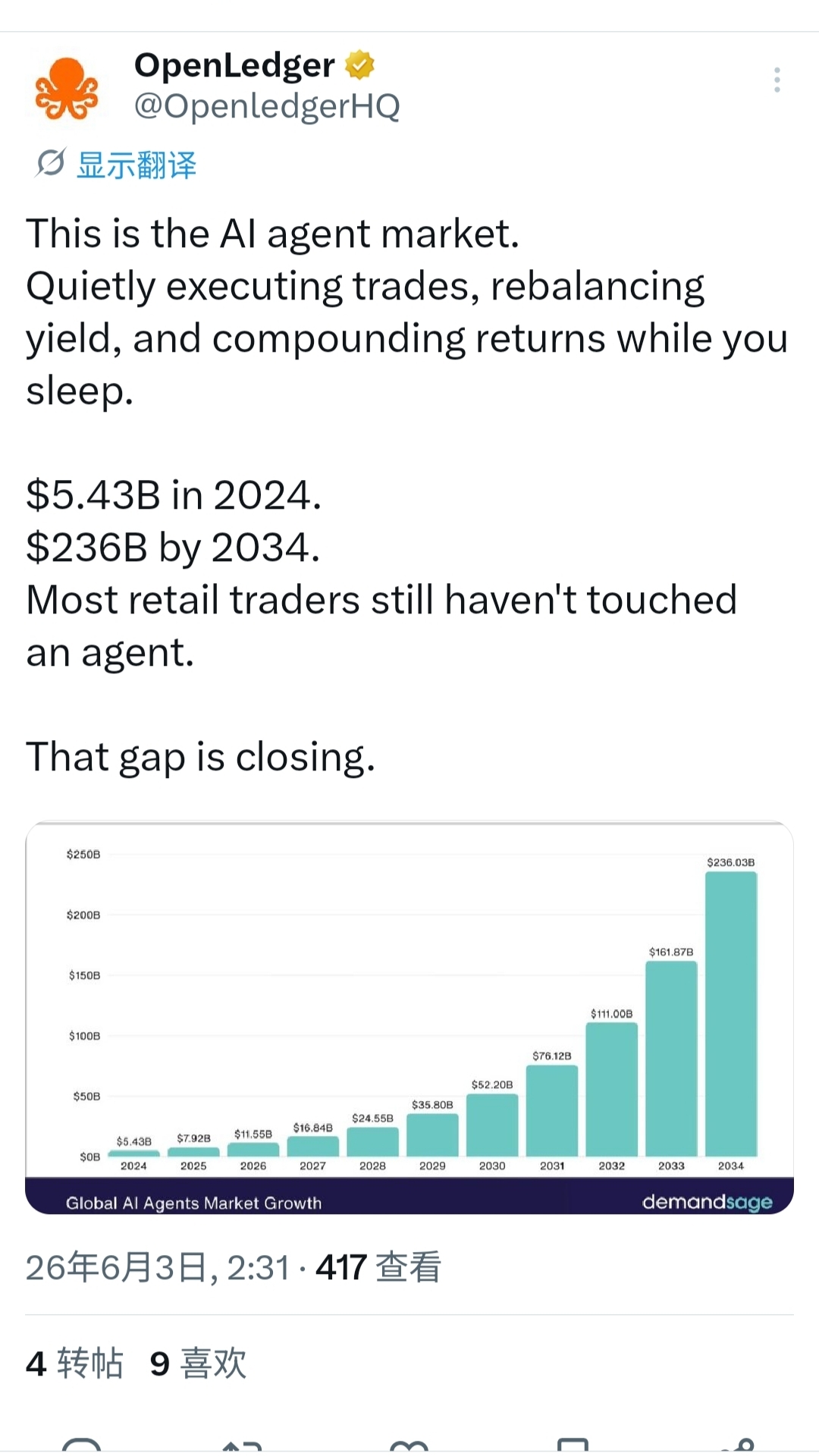
When I first opened their website’s page for recruiting high-level nodes and saw that little line of text, I couldn’t help but laugh coldly. Robbery? The barrier is strictly set at 'locking 5K OPEN', which amounts to a whopping $1K! And it doesn’t stop there; it’s also packed with all sorts of strict physical IP restrictions. I’ve figured it out: this isn't about decentralization at all! It’s clearly a setup to keep the doors closed on the poor, shoving retail investors with little cash out the door?!#OpenLedger
I rubbed my sore eyes and switched back to the chart, planning to test out their so-called 'super fast cross-chain' with real money. What happened? I was left speechless after just one try. I specifically took a small amount of a hundred bucks to test the LayerZero cross-chain, and guess what? They hit me with a fee of about $13! The cost shot up to 2%! This is downright robbing retail investors. Even if you dump a lot of money and do transfers over a thousand bucks, you might squeeze the fee down to 0.2%, but does that mean our retail money is just falling from the sky, and doesn’t deserve to be called money?$BTC
The most suffocating part came later. I was glued to the screen watching the transfer countdown, my eyes nearly popping out. Testing the BSC cross-mainnet, the gray progress bar was stuck there for a full 490 seconds! The evidence is right here, over eight minutes! In this AI era, where milliseconds matter, this tortoise-speed delay, and they still have the audacity to claim they can adapt for real-time AI inference? It’s simply ridiculous.
They're bragging in their whitepaper about bridging over 130 public chains, but I'm not buying it. I followed the breadcrumbs on the blockchain explorer and uncovered the truth in a flash. Right now, only ETH and BSC have deployed valid contracts! The rest of those over a hundred public chains have liquidity pools so weak, they’re like a piece of tissue paper. Just a little money in there, and the slippage can be high enough to wipe out all your profits. What’s even more suspicious is that the official stance on whether the mainnet OPEN is natively issued or a bridged token is vague. If it's an OFT wrapped token, it can't even interact with native OPEN for staking. Who's bold enough to step on that landmine?
I dug into their so-called 'transparent AI' that they keep bragging about. After researching their so-called mechanism, I can only say it’s all marketing mismatch with reality! The public's focus on 'cracking the AI black box' is a top challenge in cognitive science, but looking through it all, there isn’t even a hint of foundational research in their entire tech stack. Their actual business is at best limited to data rights and tracing; the internal decisions of the neural network can’t be explained at all, it’s just selling dog meat under the sheep's head.
When I looked deeper, I was left speechless. The profit distribution mechanism is just ugly. Each transaction consumes 2.3 OPEN (about $0.4), and the platform snatches away 1 token right off the bat. The remaining 20+ chains and thousands of data contributors collectively end up splitting a pathetic 0.26 OPEN, which is just $0.042! Are they trying to throw us a bone? This mechanism is heavily skewed towards the whales. The big players are feasting, while retail investors are left scraping by without even a sip of broth. Not to mention that over 60% of the total share is allocated to the community ecosystem, but the distribution details remain hidden. In the future, during the period of scarce computing power, it'll definitely be allocated based on holding weight, prioritizing heavy stakers. Regular folks will struggle to access resources and will have to buy them at high prices, effectively being marginalized in the ecosystem.
I'm going to steer clear of this murky water for now. Given the numerous cross-chain risks I’ve tested firsthand, the authenticity of cross-chain liquidity can't yet be verified. I’ve decisively paused my plans for transferring and adding to OPEN. From here on, I’m keeping a level head and focusing solely on two hardcore tracking metrics: the actual liquidity depth of the mainnet OPEN and when the official list of public chains with real liquidity will be disclosed. Without seeing those two points, any talk is just empty words.