

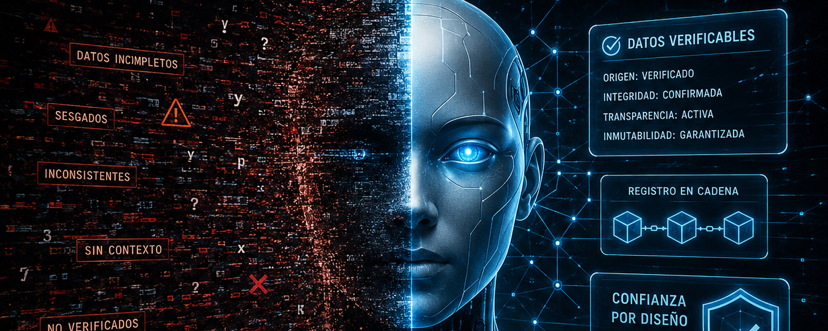

There's something that hardly anyone is asking yet:
What's the point of having super advanced AI if we don't know where its data comes from?
Today, we're living in a strange time.
We see images that seem real, but they're not.
We read news that might be manipulated.
We hear opinions that could be from bots.
And we use AI tools without knowing exactly what information is behind them.
The issue isn't just about creating more powerful tech anymore.
The real problem is trusting it.
And this is where projects like @OpenLedger start to make sense.
OpenLedger doesn’t seem appealing to me just for mixing AI and blockchain. That line is already used by everyone.
What’s interesting is the underlying idea:
👉 if AI feeds on data, then that data needs a layer of trust.
Because an AI trained with false information can make poor decisions.
An AI without traceability can repeat mistakes.
An AI without transparency can seem smart… even if it’s built on weak data.
And in a world where we increasingly rely on artificial intelligence, that could become a huge problem.
The real question isn’t:
“Which AI will be faster?”
The real question could be:
“Which AI will be able to prove that its information is reliable?”
That’s where blockchain can play an important role:
verification, traceability, data ownership, and transparency.
I’m not saying that @OpenLedger has it all figured out. No project in crypto does.
But I do believe it’s touching on a conversation that could get really big:
the trust in artificial intelligence.
Maybe in a few years we won’t just value the most powerful models.
Maybe we’ll value the models that can demonstrate where their knowledge comes from.
And if that happens, projects working with verifiable data could go from being ignored to fundamental.
Because AI without reliable data isn’t intelligence.
It’s noise with good looks.