

Extreme game theory under capital consolidation: A deep dive into the buying logic of 'left hand computing power, right hand electricity'
This isn't just emotional trading; it's a very clear industrial logic coming to fruition. We can break down the current market's funding strategies from three dimensions:
1. Computing power hegemony: From broad purchases to precise targeting
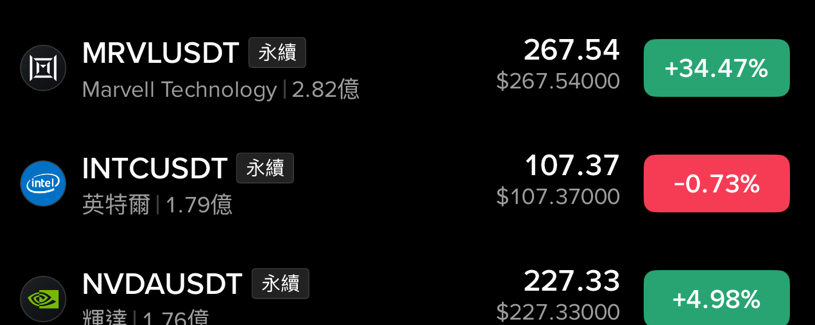
The most eye-catching aspect in the chart is undoubtedly the semiconductor sector's explosive growth. Marvell ($MRVL) skyrocketed 34.47% in a single day, Nvidia ($NVDA) steadily approached a 5% increase, and Micron Technology ($MU) is also riding high. This shows that market capital still has unshakeable faith in AI's underlying hardware.
Dispersal and concentration: What’s intriguing is that Intel ($INTC), as a chip giant, is green while it’s down slightly—about 0.73%. This shows that the current capital is extremely smart and ruthless. It’s no longer a period where you can just blindly buy any chip stock during a broad rally; instead, funds are precisely targeting the core assets that have a real technological moat and deliver actual earnings in the AI wave.
Leverage efficiency of on-exchange ETFs: the ones listed—$SOXL (a triple-long semiconductor ETF)—surged 11.01%. Compared with betting on the quarterly earnings catastrophe risk of a single company, directly using on-exchange ETFs to capture the entire semiconductor industry cycle’s upside is a highly cost-effective allocation method. In the current macro environment, decisively liquidating those traditional off-exchange fund portfolios with low operational efficiency and vague logic, then restructuring assets and concentrating them into these on-exchange ETFs with high elasticity and high liquidity, is the best solution for capturing a structural bull market.
II. The end of computing power is electricity: a hidden and highly profitable “water seller”
If loading up on Nvidia and $SOXL is the market’s obvious “on-the-record” position, then Fluence Energy ($FLNC), which blasted up 35.66% from the bottom, is the sharpest hidden line on the board.
Endless training and inference of AI large models doesn’t just consume computing power—it’s completely turning into an “electricity tiger.” With the global frenzy of data center expansion, energy storage systems and power infrastructure have become the biggest physical bottleneck limiting the growth of computing power, and at the same time the most reliably high-determinism “water-selling” business.
Fluence Energy ($FLNC), as a global leading provider of energy storage products and services, is able to produce a level of single-day surge like this—fully validating that the market’s main funding engine is shifting from “trading chips” to “trading downstream infrastructure” and “trading electricity.” The resonance between semiconductors and power infrastructure is the most core, most worth digging into wealth code in recent asset allocation.
III. Separating redundancies: the rule of the game for existing positions under high volatility
From the market action, names like MicroStrategy ($MSTR), which are highly tied to Bitcoin, are down nearly 7%. Korea’s ETF ($EWY) and Circle ($CRCL) are also trading underwater. This clearly indicates that the current market isn’t a global flood of liquidity—it’s an extreme structural行情 driven by competition among existing positions.
In such a market environment, diversified investing often translates into mediocre returns, and can even erode your principal through a slow grind downward.
Core trading strategy summary:
In today’s market, it’s no longer meaningful to allocate capital to those lukewarm, old, broad-based indexes with stagnant logic. The truly winning strategy should look just like what’s shown in this table: ruthless cleanup of redundant assets with unclear logic, concentrating “ammunition” along the trend line with semiconductors as the spear and power infrastructure ( $FLNC ) as the shield. With a U-denominated contract for 24-hour trading, API automation, and built-in leverage, as long as the underlying industry logic hasn’t been disproven by macro data, going with the trend and holding these core targets that are in the main uptrend is currently the highest-probability, best risk-reward solution in the market.