
Liquidation is a common phenomenon in the Web3 field, stemming from the triple strangulation of human desires, exchange mechanisms, and market characteristics.
This article analyzes the causes of liquidation through cases and data, and proposes systematic trading and overcoming human weaknesses as ways to transcend.

1. Liquidation: The 'cruel coming-of-age ceremony' in the Web3 world.
At 3 AM, Xiao Li suddenly sat up in bed, his fingertips trembling as he opened the trading app on his phone—the red words 'Forced liquidation completed' on the screen pierced through the 'wealth dream' he had just ignited three days ago.
With a principal of 10,000 USD and 50 times leverage to go long on SOL, I thought I could make back the previous losses by riding the market rebound, but I was instantly liquidated in a sudden drop in the early morning, even owing the platform a small amount of fees.
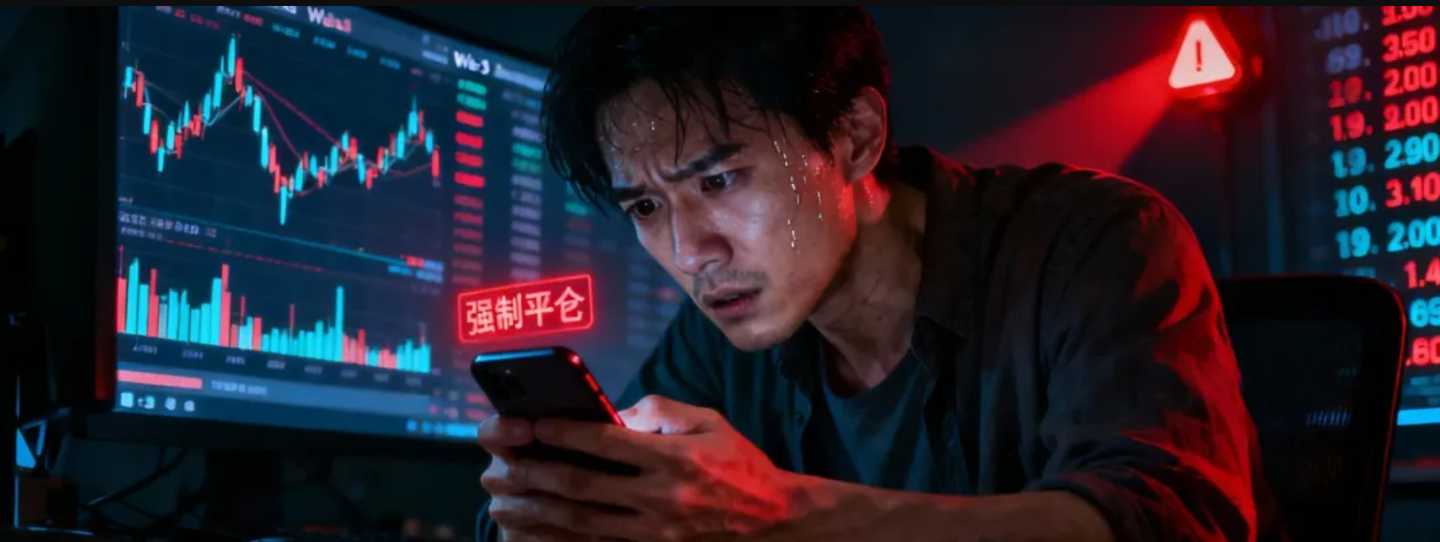
This is his third liquidation in a year since entering Web3, and it is also the most severe loss.
Such scenes unfold every day in the crypto circle.
Opening Bybt, Glassnode, and other data platforms, news like "over $1 billion liquidated across the network in 24 hours" and "$300 million liquidated in a single hour for a certain contract cryptocurrency" is no longer fresh news.
According to Glassnode's 2024 annual report, in the past year, the global cryptocurrency contract market has seen a total liquidation amount exceeding $80 billion, with an average of over $220 million evaporating daily; among them, traders using leverage above 20x had a liquidation probability of up to 78%, while users employing leverage above 50x had an average survival period of less than 1.5 months.
Liquidation seems to have become an unavoidable "threshold" for newcomers to Web3.
A survey initiated by a certain crypto community shows that over 92% of respondents admitted to having experienced liquidation, with 65% encountering their first forced liquidation within the first 3 months of entering the industry.
Even more concerning is that the identity of those who experience liquidation covers the entire crypto ecosystem—from students who have just entered the market to part-time traders and even seasoned project employees, all have fallen victim to high-leverage trading.
I have seen people use their year-end bonuses to buy ETH with 30x leverage, only to lose it all within a week; I've also seen executives from projects, wanting to "quickly recover losses," heavily invest in altcoins, ultimately being forced to sell their own project's tokens at a low price." said a risk control officer from a trading platform.
Why has liquidation become the "rite of passage" for Web3 people?
The core lies in the unique ecological atmosphere of the crypto circle and the collision of human nature.
On one hand, the crypto market never lacks the myth of "getting rich overnight"—some achieve financial freedom by holding BTC early, while others turn a bike into a motorcycle during the NFT bull market; these stories are constantly amplified, stimulating the desires of every new entrant; on the other hand, the barrier to entry for crypto trading is extremely low, requiring only a phone number to register at an exchange, and within minutes, one can complete deposits, open positions, and even use 100x leverage without any financial knowledge.
This combination of "low barriers + high temptations" has caused countless people to dive headlong into the high-risk contract market without preparation, ultimately becoming part of the liquidation statistics.
What’s more brutal is that liquidation often does not happen just once.
During the first liquidation, many attribute the reasons to "bad luck" or "market manipulation," rarely reflecting on their own issues; thus, they enter the market again with a mindset of "recovering losses," attempting to turn things around with higher leverage and more aggressive operations, ultimately falling into a vicious cycle of "liquidation—adding positions—liquidation again."
Statistics from a crypto community show that 38% of liquidators experienced forced liquidation more than 3 times, with 12% ultimately exhausting all their capital due to continuous liquidations, completely exiting the crypto circle.
Second, the triple "strangulation" behind liquidation: desire, mechanism, and market
Liquidation in the crypto circle is never a singular event caused by one factor, but rather a "strangulation net" formed by the interplay of "human desires + exchange mechanisms + market characteristics."
Many believe they are competing against the market, yet fail to realize that from the moment they open a position, they have already fallen into a web of multiple risks.
1 (I) The Trap of Desire: The Illusion of "Small Bets for Big Wins" Behind High Leverage
The starting point of liquidation is often the high-leverage choice driven by the desire for "getting rich overnight."
On the contract page of a crypto exchange, leverage options of 10x, 20x, 50x, and even 100x are clearly listed in prominent positions, often accompanied by enticing phrases like "amplify returns" and "small funds leverage large markets."
For those eager to make quick money, this temptation of "small bets for big wins" is almost irresistible—using $1,000 in capital to open 100x leverage equates to controlling a position of $100,000; with just a 1% market fluctuation, one can earn $1,000, effectively doubling the capital; but conversely, if the market fluctuates 1% in the opposite direction, the entire $1,000 capital will be wiped out, triggering liquidation.
This illusion of "amplified returns" leads many to ignore the "double-edged sword" nature of leverage.
An experiment conducted by a university finance department shows that when traders face the option of "100x leverage potentially yielding 100% returns," 83% will choose to try, even when informed that the liquidation probability exceeds 90%.
In the crypto circle, this psychology is further amplified: seeing community members post screenshots of "turning $1,000 into $100,000" and hearing KOLs exclaiming that "catching a wave can lead to financial freedom," many unconsciously overestimate their judgment and underestimate market risks, ultimately opting for leverage far beyond their capacity.
Xiao Li's first liquidation is a typical case of "leverage temptation." At the time, he had just started contract trading, seeing someone in the community make 3x profit using 50x leverage on BNB in one day, he became eager. Even though he didn’t understand the basic concepts of "margin" and "liquidation price," he followed suit and opened a 50x leveraged long position. "I thought, even if I lose, it’s just a small part of the principal; if I make a profit, it could cover several months' salary." As a result, that night, BNB dropped by 2% due to market influences, and his position was forcibly liquidated, instantly bringing his $5,000 capital to zero.
What is even more frightening is that desire escalates with losses.
When a position shows a floating loss, many fall into a "lucky mentality"—believing the market will soon reverse and thus choose to "add positions," or even continue to increase leverage in an attempt to "lower the average price."
Data from a trading platform shows that among users who experienced liquidation, 62% continued to add positions after floating losses exceeded 50%; these actions ultimately expanded their losses by 3-5 times, leading to losses far exceeding the initial position upon liquidation.
2 (II) The "Implicit Harvest" of Exchanges: Those Rules You Didn't Understand
Many traders believe their liquidation was due to "misreading the market," yet they are unaware that the design of the exchange's rules inherently contains a "harvesting" mechanism.
These mechanisms appear compliant, yet they invisibly accelerate the occurrence of liquidations, and in some cases, become the "last straw" that breaks the camel's back.
Funding rates are the most typical "implicit cost."
In perpetual contract trading, exchanges charge one party a funding fee based on the positions held by both long and short sides and pay it to the other party.
When market sentiment is extremely optimistic, with long positions far exceeding short positions, longs must pay a high funding fee to shorts; conversely, shorts must pay when the situation is reversed.
Many newcomers are unaware of the existence of funding rates or overlook their impact on positions, resulting in the funding fees that accumulate over long-term holdings "eroding" the margin, ultimately triggering liquidation.
A crypto trading blogger once conducted an experiment: using $1,000 in capital to open a long position on ETH perpetual contracts with 10x leverage, assuming the market remains stable, only considering a daily funding rate of 0.1%, one would need to pay $10 daily in funding fees ($1,000×10×0.1%). If held for 10 days, the funding fees alone would consume $100 in margin, 10% of the initial capital; if held for a month, the margin consumption would reach 30%, making liquidation very likely when there’s a slight market downturn. During periods of high volatility, funding rates could even soar above 0.5%, causing daily margin consumption to reach 5% of the principal, putting positions at risk.
In addition to funding rates, spike markets are also the "liquidation killers" under the exchange mechanism.
The so-called "spike" refers to a rapid rise or fall in price within a short period, followed by a swift return to its original position, forming a K-line shape similar to a "needle."
The emergence of such a market is often related to the exchange's "matching mechanism"—when market liquidity is insufficient, a small number of large orders can cause significant price fluctuations, while the exchange's "market order liquidation" rules can trigger stop-loss orders at the moment of price spikes, leading to liquidation.
In May 2024, SOL experienced a typical spike: in a certain exchange, SOL's price dropped from $120 to $90 within 10 minutes, then quickly rebounded back to $118. According to Bybt data, this spike caused over $200 million in long positions to be liquidated, with many users having their stop-loss prices set at $95, thinking they could avoid risks, only to be "swept out" by the momentary price drop. Afterward, some users questioned whether this spike was a result of "malicious manipulation" by certain large holders taking advantage of the exchange's insufficient liquidity, but the exchange ultimately refused to respond, citing "normal market fluctuations."
Additionally, the leverage settings of exchanges also induce liquidations.
Although most exchanges will warn about "higher risks with high leverage," in practice, they encourage users to use higher leverage through methods like "lowering margin requirements for high leverage" and "exclusive benefits for high-leverage users."
For example, a certain exchange stipulates that the initial margin rate for 10x leverage is 10%, while for 50x leverage, it is only 2%—this means that a 50x leveraged position will be liquidated with just a 2% price fluctuation in the opposite direction, while a 10x leverage requires a 10% fluctuation to trigger liquidation.
This rule design leads many users to choose leverage levels far exceeding their own risk tolerance under the temptation of "low margin."
3 (III) The "all-weather strangulation" of the 24-hour market: a dual test of volatility and fatigue
One of the biggest differences between the crypto market and traditional financial markets is the 24/7 uninterrupted trading—there are no opening and closing times, no price limits, and prices can experience intense fluctuations at any time.
This characteristic keeps traders in a "combat state," facing both market volatility risks and immense psychological pressure, making them very prone to losses due to "fatigue trading" or "sleeping liquidation."
Traditional stock markets trade for 4-6 hours daily, allowing traders enough time to rest and analyze market conditions; however, the 24-hour trading in the crypto market means that market movements can suddenly explode while you are eating, sleeping, or working.
In March 2024, the Federal Reserve suddenly announced an interest rate hike, causing BTC to plummet from $45,000 to $40,000 between 2 AM and 4 AM, with a drop exceeding 11% within 2 hours.
At that time, many domestic traders were sleeping, and upon waking found their long positions liquidated, with no time to set stop-losses.
A survey from a certain crypto community shows that 43% of liquidations occur between 1 AM and 6 AM, with 70% of users stating they "had no idea why the market fluctuated."
In addition to "sleeping liquidations," 24-hour trading also leads to emotional fatigue for traders.
Human energy is limited; staring at the screen for long periods can reduce attention and judgment, making impulsive decisions more likely.
A psychological research institution's tracking of crypto traders shows that after continuously watching the market for more than 8 hours, the accuracy of risk judgment drops by 40%, while the probability of impulsive openings increases by 60%.
Many people, after continuously monitoring the market for several days, end up making random openings because they want to quickly end the agony, or due to "overconfidence," neglecting risk signals, ultimately leading to liquidation.
What’s even more difficult to deal with is the high volatility of the crypto market.
The daily price fluctuation limit in traditional stock markets usually stays within 5%, while daily fluctuations in cryptocurrencies exceeding 20% are not uncommon.
In November 2024, a certain altcoin surged over 300% in a single day due to positive news, but then plummeted 80% in the following days due to negative news; many users who bought in at the peak were liquidated due to the subsequent plunge, losing nearly all their capital.
Such extreme volatility makes it difficult for traders who have set stop-losses to escape—sometimes stop-loss orders cannot be executed due to price gaps, resulting in actual losses far exceeding expectations.
Four, Crossing the Chasm: From "Passive Liquidation" to "Active Control"
While liquidation is a "rite of passage" for Web3 individuals, it does not mean it is "insurmountable."
Those who have survived long in the crypto circle and achieved stable profits have not avoided liquidation but have instead established systematic trading strategies, overcome human weaknesses, and engaged in continuous systematic learning, ultimately transitioning from "passive liquidation" to "active control."
1 (I) Establishing Systematic Trading: Using Rules to Combat "Impulsive Trading"
The root cause of liquidation is often "impulsive trading without rules"—opening positions based on feelings, adding positions based on emotions, and holding positions based on luck.
Systematic trading is about establishing a clear set of rules for "opening positions, stop-losses, take-profits, and position management," making trading controllable and replicable, thereby reducing the probability of liquidation.
Opening position rules are the first step in systematic trading.
Professional traders do not "open positions casually," but rather base their opening conditions on "fundamental analysis + technical analysis."
For example, fundamental analysis includes project technical strength, team background, market demand, regulatory policies, etc.; technical analysis includes the application of K-line shapes, moving average systems, MACD, RSI, and other indicators.
Only when both fundamentals and technicals meet expectations will one consider opening a position.
The opening position rules of seasoned trader Lao Wu are very clear: "I only trade mainstream cryptocurrencies like BTC, ETH, SOL, and avoid altcoins; before opening a position, I must check three indicators—MACD must show a golden cross, RSI must be in a reasonable range, and moving averages must form support; if all three indicators are met, then combined with market sentiment, I will open a position." This strict opening rule keeps his opening win rate above 60%, far exceeding the industry average.
Stop-loss and take-profit are the "lifelines" to avoid liquidation.
Many people experience liquidation simply because they "don’t set stop-losses"—always believing the market will reverse, only to end up with increasing losses and ultimately being forcibly liquidated.
Professional traders, however, set stop-loss prices before opening positions; once the price touches the stop-loss line, they automatically close the position to avoid further losses.
At the same time, they also set take-profit prices, promptly cashing in when the market reaches expected profits to avoid "giving back profits."
Stop-loss settings need to combine "risk tolerance" and "market volatility."
Generally speaking, stop-loss margins should not be too large; it is recommended to keep them within 1%-5% of the capital.
For example, if you open a position with $1,000 in capital and set the stop-loss margin at 3%, when the loss reaches $30, it will automatically close the position.
This way, even if there are several consecutive stop-losses, it will not significantly impact the capital.
Take-profit settings can refer to "support and resistance levels"—setting take-profit prices near previous resistance levels, and promptly taking profits when the price reaches resistance levels.
Position management is the "core" of controlling risk.
Many people experience liquidation due to "full investment + high leverage"—putting all capital into one position and using high leverage to amplify risks, resulting in instant liquidation when the market moves against them.
Professional traders, on the other hand, adopt a strategy of "diversified positions + low leverage," dividing their capital into several portions, investing in different cryptocurrencies and positions, while keeping leverage within 5x.
A recommended "position management method" from a trading strategy book is worth referencing: divide the capital into 10 portions, use only 1 portion for each opening, and keep leverage no more than 3x; the holding of a single cryptocurrency should not exceed 20% of total capital; during significant market fluctuations, reduce positions to below 30% of total capital. This position management strategy effectively reduces the impact of a single liquidation on the capital, ensuring that even if one position gets liquidated, it won’t lead to a significant loss of overall capital.
2 (II) Overcoming Human Weaknesses: Using Rationality to Conquer "Greed and Fear"
The essence of trading is "the game of human nature"—greed makes you chase highs, increase positions, and hold on, while fear makes you cut losses, miss opportunities, and trade frequently.
Many people clearly know that "high leverage has high risks," yet cannot resist using 100x leverage; they know they "should stop-loss," yet still hold onto positions.
To cross the chasm of liquidation, one must learn to use rationality to overcome human weaknesses.
The key to combating greed is "setting reasonable profit expectations."
Many people experience liquidation due to "insatiable greed"—earning 10% but wanting 20%, earning 20% but wanting 50%, and ultimately, when the market reverses, profits turn into losses, leading to liquidation.
To combat greed, it is necessary to set "reasonable profit targets," such as aiming for a monthly profit of 10%-20%, and once the target is reached, reduce operations or even stop trading.
A successful crypto trader shared his experience, saying: "My goal is to make a profit of 15% per month. Once I reach this goal, I withdraw 50% of the profit and keep the remaining 50% as risk capital. This way, I can ensure returns and avoid risky operations due to greed." This "contentment is happiness" mentality has allowed him to survive in the crypto market for 5 years without experiencing significant liquidation.
The key to combating fear is "preparing a risk plan."
Many people fall into fear during market fluctuations—seeing floating losses causes panic, leading to cutting losses; witnessing market rises makes them fear missing out, causing them to chase highs.
To combat fear, one needs to prepare a "risk plan" before opening a position, for example: what to do if the market fluctuates 5% in the opposite direction? How to respond to spike markets? If funding rates increase, should one liquidate?
After preparing a risk plan, when the market fluctuates, one will not make impulsive decisions out of panic.
For example, by setting stop-loss prices in advance, when the price touches the stop-loss line, even if feeling fearful, they will still close the position according to the plan; by preparing backup funds in advance, when market opportunities arise, they will not chase highs due to fear of missing out.
The key to combating luck is "respecting market rules."
Many people experience liquidation because they have "a sense of luck"—thinking "the market won't drop that much" or "this time I should be able to hold on," only to have the market exceed expectations, leading to liquidation.
To counter luck, one needs to learn to "respect market rules," acknowledge that one cannot predict the market, and accept the fact that mistakes will happen.
When the market fluctuates in the opposite direction, do not think about "why this is happening," but rather think about "what to do next"; when floating losses appear, do not think "the market will reverse," but rather close positions according to stop-loss rules.
Only by giving up the lucky mentality can one view the market objectively and make rational decisions.
3 (III) Systematic Learning: Arm "Trading Cognition" with Knowledge
In the crypto market, "knowledge is the weapon of risk aversion."
Those who survive long-term are all individuals who continuously engage in systematic learning, constantly enhancing their trading cognition.
To cross the chasm of liquidation, one must shift from "blind trading" to "learning-based trading," building a complete trading knowledge system through reading books, attending courses, and summarizing experiences.
Reading classic books is the "foundation" of learning trading.
Although cryptocurrency is an emerging field, trading theories and risk control methods from traditional financial markets are equally applicable to crypto trading.
The following books are worth recommending:
(Reminiscences of a Stock Operator): The author is Wall Street legend trader Jesse Livermore, whose book chronicles his trading experiences and insights, especially his profound insights on "human nature and trading," which can help traders understand the influences of greed and fear on trading.
(Trading Psychology Analysis): The author is Mark Douglas, who analyzes how traders overcome human weaknesses and establish stable trading mindsets from a psychological perspective, suitable for those easily influenced by emotions.
(The Path to Financial Freedom): The author is Van K. Tharp, who systematically explains the methods for building a trading system, including position management, stop-loss and take-profit settings, and trading strategy optimization, helping traders establish a systematic trading mindset.
(Cryptocurrency Investment Guide): The author is Alistair Milne, who explains the fundamental analysis, technical analysis, and risk control methods of cryptocurrencies in light of the characteristics of the crypto market, making it essential reading for crypto traders.
Reviewing past trades is the "key" to solidifying learning outcomes.
After learning theoretical knowledge, it is necessary to summarize through reviewing past trades, turning knowledge into practical abilities.
After each trade, the following content must be recorded:
Opening Position Reason: Why choose this cryptocurrency? Why use this leverage? Do the fundamentals and technicals support opening a position?
Trading Process: Does the market meet expectations? Did you operate according to stop-loss and take-profit rules? Were you influenced by emotions?
Result Analysis: What are the reasons for profit or loss? If it’s a loss, can it be avoided by adjusting the strategy?
Improvement Plan: What steps need optimization next? Is it the opening position rules, stop-loss settings, or position management?
Through continuous reviewing and summarizing past trades, traders can constantly discover their problems, optimize trading strategies, and ultimately form a trading system suited to themselves, reducing the probability of liquidation.
Five, Conclusion: Crossing the "Himalayas" in Your Heart
Liquidation is like the "Himalayas" in the hearts of Web3 people—tall and steep, seemingly insurmountable.
Many retreat in fear when faced with it for the first time; after several failed climbs, they choose to give up.
But those who are true strong ones view liquidation as a "ladder for growth"—learning from failures, getting up after falling, and ultimately crossing this mountain to see the scenery at the summit.
The crypto market is never a paradise for "getting rich overnight," but a battlefield for "cognitive monetization."
Here, there are no eternal winners, only survivors who continuously learn and evolve.
Liquidation is not frightening; what is frightening is losing confidence after liquidation, losing the motivation to learn, and losing respect for the market.
If you have experienced liquidation, please do not lose heart—treat it as a "harsh lesson," review seriously, and summarize your experiences; if you are preparing to enter the crypto market, please first prepare for "risk"—learn trading knowledge, establish a trading system, and control leverage levels.
Remember, in the crypto circle, "surviving" is more important than "making quick money"; only by surviving can you wait for the real opportunity.
May every Web3 individual grow through the pain of liquidation, move forward through rational trading, and ultimately cross the "Himalayas" in their hearts, achieving their values and goals in the crypto circle.


