


Last night, while debugging an old project's training pipeline, I turned off the IDE's highlight mode and just watched the logs and testnet call curves bouncing on the screen. In that quiet yet slightly fatigued moment, it’s easy to gain a clearer insight into the current AI ecosystem landscape. The big players today resemble a highly integrated centralized factory: countless developers quietly funneling scattered computing power, labeled data, and iterative experiments, while the final model rewards are tightly held by just a few. This made me think back to the early Ethereum ecosystem, where some early applications invisibly tapped into user liquidity and data contributions, and that familiar sense of cyclical flow emerged once again.
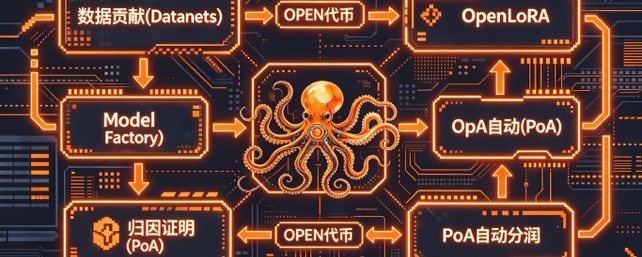
Recently, the attribution proof mechanism that OpenLedger is trying to build has caught my attention as someone who has been navigating the decentralized space for a long time. They use mathematical models to quantify the real contribution of each training data point to the final model output and attempt to turn these contributions into on-chain verifiable and liquid assets. This approach of truly assetizing data has its sincerity on a technical level, especially paired with OpenLoRA's modular design that supports shared underlying hardware for multiple models, allowing developers not to rebuild the entire environment from scratch each time, significantly lowering the entry barrier.

However, my experience over the years tells me that even the most cutting-edge architecture cannot escape the self-consistency of economic cycles. The supply pressure from the gradual release of early shares is objectively present. If there aren't enough real business scenarios in the ecosystem for developers to actively consume or stake tokens to hedge, pure conceptual hype is hard to sustain liquidity in the long run. I've stumbled in several similar projects in the past, so now when I look at anything, my first reaction is to check its actual usage data and token binding depth, rather than just listening to surface-level partnership news.
In the past two weeks, I've run several rounds of experiments on the testnet, and the modular architecture feels really good. You can break down data contributions, model fine-tuning, and inference services into relatively independent Lego blocks that can be assembled as needed, no longer held back by VRAM conflicts and version management like before. OpenLedger's flexibility allows me to focus more on the actual performance of the models rather than the tedious maintenance of infrastructure. Of course, lowering the barrier also means a stronger economic mechanism is needed to filter out low-quality noise; otherwise, in the long run, it could dilute the signal strength of the entire ecosystem, which I am currently monitoring.
I now take time every day to glance at the staking curve and call frequency on the testnet, just like I used to monitor the latency metrics of my own services; it has become a habit. This system has left me with a solid impression in terms of technical disassembly. It indeed addresses the old pain points of data rights and hardware sharing, and the modular approach makes scalability appear more promising. However, my attitude towards it remains cautiously optimistic after having taken a few hits; once the mainnet goes live, the real game-changer will be whether developers are willing to continuously invest tokens for high-quality datasets and model calls, rather than just stopping at the early incentive stage.
Overall, OpenLedger's direction is commendable, and the hands-on experience has exceeded my initial conservative expectations. However, whether the project can truly perform in the long run depends on real business throughput over time to validate it. At this stage, I choose to continue testing on a small scale, keeping a clear head and reducing impulsiveness. This is basically the instinctive self-protection method of a developer who has learned from the market time and again.