
Source: Wall Street Insight
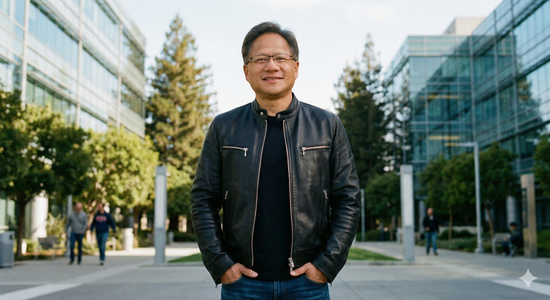
NVIDIA is gearing up to rewrite the power structure of the PC industry with a single chip.
On May 30, Wall Street Insight mentioned that the opening keynote of the Taipei ComputeX conference is fast approaching, and NVIDIA's official social account dropped a three-word teaser—'A new era of PC.'

The post also included two sets of geographical coordinates pointing to the Taipei Performing Arts Center, and both Microsoft Windows and Arm's official accounts released the same content that day.
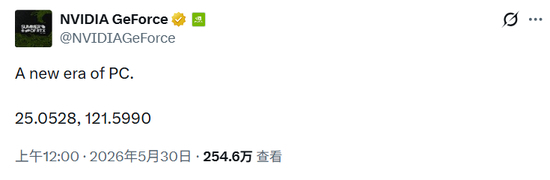
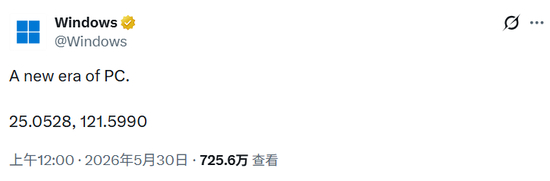
The rare three-way synergy is bringing a long-awaited suspense to the forefront: NVIDIA is about to announce its entry into the Windows PC processor market.
On the same day, Axios cited informed sources stating that the first batch of Windows computers featuring NVIDIA chips is expected to debut at both ComputeX and the Microsoft Build developer conference, with Microsoft's Surface brand and Dell among them.
Rumors about NVIDIA's Arm-based processors have been swirling for a while. Dell's CEO, Michael Dell, hinted in an interview in 2024 that there could be AI PCs featuring NVIDIA chips in the future.
For decades, NVIDIA has played the role of an independent GPU supplier in the PC supply chain, being 'invited in' by OEMs to complete a precise parts assembly task, yet having no authority over overall design.
Now, NVIDIA aims to integrate CPU, GPU, and AI units into a single SoC, directly supplying the 'heart' to OEMs like Dell and Lenovo, following Apple's vertical integration path with the M series, but targeting the entire Windows camp.
However, supply chain data shows that the real test for the market is just beginning.
N1X chip: a 'public secret' that has been circulating for nearly a year.
Speculation about this chip isn't anything new.
According to previous reports, manufacturers like Dell are developing laptop products equipped with the N1 and N1X chips.
According to VideoCardz, Lenovo has already been testing notebook prototypes using N1 and N1X chips earlier this year.
NVIDIA's CEO, Jensen Huang, previously confirmed that the company is developing the N1 chip, stating it belongs to the same technical lineage as the processors used in the DGX Spark mini workstation.
The latter is equipped with the GB10 super chip, integrating the Blackwell architecture GPU with a 20-core Arm CPU, currently sold to AI engineers at a price of $4699.
Currently circulating specifications indicate that the N1X may feature a 20-core CPU co-developed with MediaTek, a Blackwell architecture GPU with 6144 CUDA cores, on par with the desktop RTX 5070, and support for up to 128GB LPDDR5X unified memory architecture, allowing CPU and GPU to share calls.
This design philosophy is highly similar to Apple's M series chips and Qualcomm's Snapdragon X series.

Supply chain checks indicate that around 10 million units are expected to ship over two years, still within a niche market.
Notable Apple analyst Guo Mingqi's supply chain investigation indicates that devices based on the N1X chip are expected to ship around 10 million units over the next two years.
He pointed out that this still targets a niche market of professional users with local AI computing needs, and whether the shipment volume can increase depends on pricing strategy.
The more critical variable is whether the Windows operating system can genuinely deliver applications and workflows that can deeply leverage local AI computations.
Guo Mingqi also pointed out that the two hottest trends in the PC market in 2026 are largely unrelated to local AI computing.
The estimated shipment volume for the MacBook Neo model has been revised up by about 100%, from 5 million units to 10 million units. The driving forces are price, design, and ecosystem, not local AI computing.
The highly anticipated low-cost mini PC can run AI Agents 24/7, but its inference computations are still done in the cloud.
His conclusion is that, whether in terms of sales or market heat, there is currently no direct correlation with local AI computing.

Windows on Arm: from Qualcomm exclusivity to multi-party competition.
NVIDIA's entry will fundamentally change the competitive landscape for Windows on Arm.
Previously, Qualcomm's Snapdragon X series was the sole chip vendor licensed for the Windows Arm OS, enjoying a de facto exclusivity.
NVIDIA's involvement means that this exclusive licensing will officially end, ushering in true multi-party competition in the Windows Arm camp.
However, analysts from Current Strategies, including Carolina Milanesi, state that NVIDIA's entry is good news for the entire industry and may indirectly benefit Qualcomm as well.
She pointed out that although Qualcomm had significant advantages in battery performance, it has never managed to gain a notable market share in the PC market, partly due to developers and enterprises being unwilling to invest resources in a differentiated Windows version.
NVIDIA's entry may drive more developers to focus on the Windows on Arm ecosystem, thus maturing the overall platform, which Qualcomm could also benefit from indirectly.
This shift also carries Microsoft's strategic ambitions. Previously, Microsoft's first push for the AI PC concept 'Copilot+ PC' faced a series of setbacks, including the core feature Recall being delayed due to security concerns.
Now, Microsoft hopes to run AI Agents on local devices, and NVIDIA's entry as the hottest chip manufacturer globally provides new endorsement for this agenda.

The bottleneck for local AI computing is that true operating system support is the real barrier.
Guo Mingqi believes the real driver for a PC upgrade wave from local AI computing hinges on the operating system, not the chip itself.
He pointed out that the biggest advantage of local AI over cloud is the ability to deeply integrate user data and workflows across applications while safeguarding privacy, which relies on underlying support at the operating system level.
Currently, the AI functionalities in PC operating systems are still primarily adding AI features to first-party applications and loosely connecting workflows between applications.
Some applications, like speech-to-text, can effectively leverage local AI power, but it's still not enough to create significant upgrade demand.
Today, the mainstream way for PC users to utilize AI is still through browser access to cloud-based large model services or API calls to cloud vendors, with core computing still happening in the cloud.
The N1X can provide a competitive Windows option for AI professionals, matching Mac in local AI power and large memory, but achieving a true upgrade cycle still hinges on operating system support.

Beyond the chip's advantages, gaming scenarios still harbor risks.
Despite the optimism about the prospects for the N1X, potential technical constraints cannot be ignored.
Since the N1X uses Arm architecture, it must rely on an x86 emulation layer when running the decades-old x86 PC game library.
According to PCWorld analysis, the existing Prism emulation layer in Windows has been specifically optimized for Qualcomm chips, with some performance features only effective on Snapdragon SoCs.
This means that the N1X may face performance degradation in gaming scenarios, with some games potentially not running at all.
For products aimed primarily at optimizing AI performance and battery life, this limitation may not be a fatal flaw.
However, NVIDIA currently positions itself more as an AI company rather than a graphics company, and the core user group targeted by the N1X includes AI application developers and business users seeking lightweight battery life, distinctly separate from gamers.
The real market test will depend on the actual experience and pricing strategy after the first batch of N1X laptops hits the shelves.

It's not just about a single chip.
From a macro perspective, NVIDIA's entry into the PC processor market marks a crucial step in its transformation from a 'parts supplier' to a 'platform definers.'
In the past, NVIDIA participated in the PC supply chain as an independent GPU supplier, while the authority over the overall architecture remained with Intel, AMD, and OEMs.
By integrating CPU, GPU, and AI units into a single SoC, NVIDIA can directly provide a complete core computing platform to OEMs, fundamentally altering its position in the value chain.
Apple has already set a successful example with its Apple Silicon.
After Apple replaced Intel processors with its self-developed Arm architecture chips, Mac computers gained a clear edge in performance and battery life within the same price range, leading to a continuous rise in Mac's market share.
The Windows camp has always hoped to replicate this path, with Qualcomm's Snapdragon X series being the first attempt, while NVIDIA's N1X might represent the heaviest bet yet.
But the tech industry is never short of declarations for a 'new era.' Whether it can deliver will only be clear a year from now when consumers fire up the next-gen laptops.