

Recently, people have been asking me: with the market so chaotic, can small funds still enter?
Hearing this, I remember how anxious I was when I had 1400U back then—too afraid to open a contract, fearing that one mistake would wipe me out.
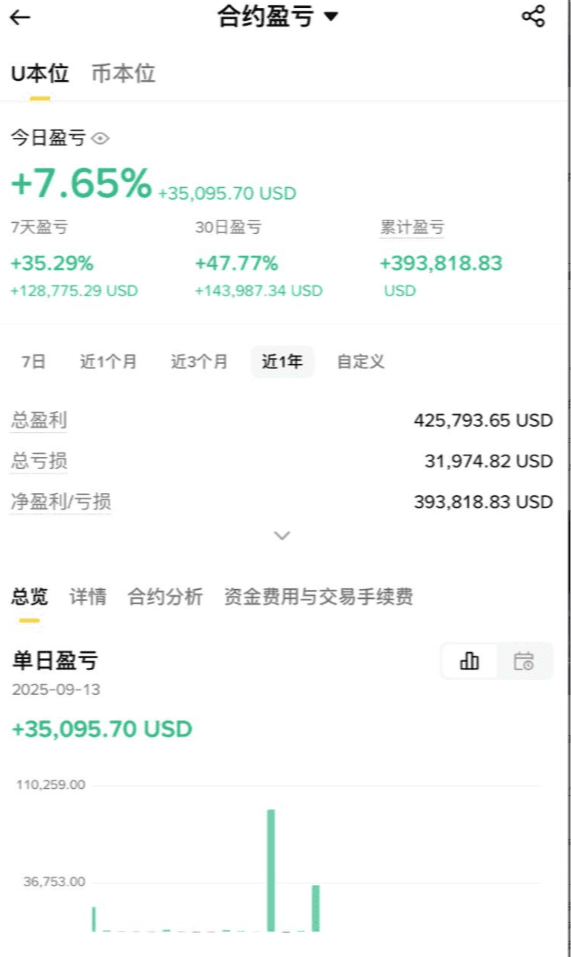
Who would have thought that this 1400U would roll to 28,000U in 45 days, a full 20 times increase.
01 Awakening: From blindly chasing prices to mastering the rhythm
At first, I was just like most people:
Full investment, chasing every hotspot
Tortured by market fluctuations to the point of questioning life
Lost direction in the midst of wild price swings
It wasn't until I stumbled several times that I realized: making money in trading has nothing to do with talent; the key is in controlling the rhythm and managing positions.
02 Core: The Logic and Execution of "Laddered Rollover"
This isn't about going all in; it's about the wisdom of compounding profits:
Initial stage:
With a principal of 1400 USDT, only 25% of the position was used in the first trade.
Lock in profits immediately at 8%, and transfer the profits to the next order.
The principal is always used as a "moat" and will never be touched lightly.
Advanced operations:
Set stop-loss and take-profit levels in advance for each order to avoid emotional interference.
Gradually increase position size after profits accumulate.
Let the snowball of compound interest grow bigger and bigger steadily.
While others fantasize about getting rich overnight, I pursue certainty in every transaction. This sense of security is more satisfying than short-term price surges.
03 Mindset: Sniper-like Trading Discipline
During the 1400U phase, I was like a sniper:
Never act if you're unsure; patiently wait for opportunities with high certainty.
Once the trend is confirmed, decisively follow the position and let the profits run.
Cut your losses immediately if you're going in the wrong direction; never fantasize about "waiting for a rebound."
Many people fail because they are unwilling to accept small losses, but I succeed precisely because I dare to admit my mistakes and exchange small costs for greater opportunities.
04 Practical Application: Detailed Explanation of the "Three-Stage Rolling Position Method"
A complete system proven in practice:
Phase 1: Fund Protection Period
Try small positions to accumulate initial profits.
Developing market intuition and trading discipline
Preserving the principal is the only goal
Phase Two: Profit Acceleration Period
Use accumulated profits to appropriately increase position size
Seize market trends and let profits run.
Balancing risk and return
Phase Three: The Period of Mental Stabilization
Develop your own trading rhythm
Overcome greed and fear
Achieve stable compound growth
Many of my friends who followed this method have earned several times their initial investment. But the most difficult part is mastering the "degree": when to increase position size and when to tighten defenses – this is the key to success or failure.
In this highly volatile market, surviving longer is more important than making money quickly.
Avoiding Pitfalls in CoinFold Leveraged Contracts: 4 Liquidation Traps and a 3-Step Safe Operation Guide
"10x leverage, a 10% increase doubles your money"—the allure of leveraged contracts, promising huge returns with minimal investment, has led countless retail investors to believe they can make a fortune quickly.
Money. However, since 2025, over 700,000 retail investors have been liquidated due to improper contract trading. One user used 50,000 USDT with 20x leverage to trade BTC, and was liquidated to zero after just one 5% fluctuation; others held onto losing positions against the trend, losing from 100,000 USDT to only 8,000 USDT. In reality, contracts are not a "gambling table," but a "risk amplifier." If beginners don't understand risk management, even the most accurate market predictions can become a "capital-harvesting machine."
Mastering methods to avoid four types of traps is essential to protecting your principal in contracts.
I. Four Fatal Traps in Contract Trading: Frequent High-Frequency Trading Pitfalls for Novices
The risks of contracts lie hidden in the "operational details." Many people only focus on "amplified returns" but overlook the fact that "risks are also amplified simultaneously." Four types of traps are most likely to lead to margin calls:
1. High-leverage "gambler's mentality": making quick money turns into losing everything.
The most common mistake beginners make is "blindly increasing leverage," thinking that "the higher the leverage, the more you earn," unaware that leverage is a double-edged sword.
—Amplify profits when profitable and losses when losing, even triggering "margin call" (losses exceeding principal, requiring repayment of platform debts).
Typical Case: In September 2025, retail investor Xiao Zhang, who had just started learning about futures contracts, heard that "20x leverage can quickly double your money," and used 30,000 USDT as principal.
Zhang opened a long position in BTC with 20x leverage. That same day, BTC dropped 5% due to negative news, and Zhang's account was instantly liquidated, losing all 30,000 USDT of his initial capital.
Due to a margin call, the user owes the platform 2000 USDT (some platforms require users to make up for losses incurred due to margin calls).
The deceptive logic: Daily price fluctuations in the cryptocurrency market often exceed 5%. With 10x leverage, a 5% fluctuation will result in liquidation; with 20x leverage, only 2.5% will trigger a liquidation.
Volatility can wipe out your principal. Novices who lack market judgment often find high leverage to be tantamount to "giving away money."
2. Holding onto losing positions against the trend due to wishful thinking: Small losses turn into huge losses.
Many people are unwilling to cut their losses after incurring losses, thinking that "the market will rebound" and adding to their positions with the mindset of "holding on until the rebound breaks even". As a result, they lose more and more money and eventually get wiped out.
Typical case: Retail investor Mr. Li opened a short position on ETH with 5x leverage. After ETH rose by 8%, Mr. Li's losses reached 40%, but he still felt that "the rise..."
"It's not moving anymore, it'll fall back down," he said, not only refusing to cut his losses but also adding 20,000 USDT to his position. Subsequently, ETH continued to rise by 10%, and Mr. Li's account was liquidated.
The total loss was 60,000 USDT. Originally, a 5% stop loss could have kept the loss within 3,000 USDT, but the loss was magnified tenfold due to holding onto the losing position.
Core misconceptions: In contract trading, "the market won't move as you expect," holding onto losing positions is essentially "betting your capital on market movements," and black swan events in cryptocurrency trading.
Frequent incidents (such as sudden policy changes or project failures) mean that a single extreme market condition can cause a person holding a losing position to lose all their principal.
3. Stop-loss and take-profit orders + "set to disable": Profits that should have been made weren't, and losses that should have been incurred exceeded expectations.
Beginners often overlook the "correct setting of profit-taking and stop-loss," either not setting them at all or setting them too extremely, resulting in "not taking profit when it should have, and not stopping loss when it should have."
Common mistakes:
Not setting stop-loss or take-profit orders: thinking that "I can manually monitor the market and operate", but missing market opportunities due to eating or sleeping, small profits turn into losses, and small losses turn into margin calls;
Setting the stop loss too wide: For example, if you use 5x leverage but set the stop loss at 10%, it seems to "give room for market fluctuations", but in reality, with 5x leverage, an 8% fluctuation will cause a margin call, making the stop loss ineffective.
Setting a profit target that is too greedy: wanting to earn 50% after already earning 20%, only to have the market reverse and the profits be given back, resulting in a loss.
A real lesson learned: A user opened a long position on SOL with 3x leverage, setting a take-profit of 15% and a stop-loss of 5%. When the market rose by 12%, the user thought it could reach 20% and manually canceled the take-profit. As a result, SOL suddenly dropped by 8%, triggering a margin call. The user could have made 4,500 USDT, but ended up losing all of their 20,000 USDT principal.
4. Blindly following orders and "following the crowd": Buying high and selling low turns you into a bagholder.
Novice traders often "chase trades based on market trends," going long when a coin rises by 10% and shorting when it falls by 10%, only to end up buying at the "market turning point" and becoming easy targets for market manipulators.
Typical scenario: BTC surges 15% on positive news. Retail investor Xiao Wang, seeing the "rapid rise," leverages 5x to go long. Immediately after opening the position, BTC retraces 8%, triggering his stop-loss. Xiao Wang then goes short, and BTC rebounds 5%, triggering another stop-loss. He loses all 15,000 USDT in one day, all due to "chasing highs and selling lows."
The deceptive logic: The "sharp rises and falls" in the futures market are mostly due to market manipulators pumping up or dumping prices. When novices chase the trend, the market is already nearing its end, and they encounter a reversal as soon as they enter the market, naturally resulting in frequent losses.
II. Three-Step Safe Operation Method: Even Beginners Can Control Contract Risk
Contracts aren't "too risky," but beginners must start by "controlling risk." Here are three steps to help you avoid the trap of margin calls:
Step 1: Control both leverage and position size to reduce risk at the source.
Leverage selection: Beginners should never exceed 3 times.
1-3x leverage is suitable for beginners (no margin call within 10% volatility), while leverage of 5x or higher is only suitable for investors with more than one year of contract trading experience.
For investors; if trading "short-term swings" (holding positions for 1-4 hours), leverage of 2-3 times can be used; for "long-term trend trades" (holding positions for 1-3 hours), leverage can be used.
(Days), use only 1-2 times leverage to avoid overnight risk.
Position control: No more than 5% of principal in a single transaction.
No matter how bullish you are on the market, the amount of a single position should not exceed 5% of your total assets. For example, if you have 100,000 USDT in principal, you should use a maximum of 5,000 USDT for each position. Even if your account is liquidated, you will only lose 5% and it will not affect your overall capital. It is strictly forbidden to "open a position with full leverage". Using full leverage is equivalent to "gambling with your life". One liquidation will wipe you out.
For example: With a principal of 50,000 USDT, using 2x leverage to open a long position in BTC, only 2,500 USDT of principal (5% of the position) is needed, corresponding to the margin...
1250U, BTC would need to drop 20% before liquidation, far exceeding daily volatility, making it a high-safety level.
Step Two: Scientifically Set Profit and Loss Stop-Loss Orders, Rejecting Manual Intervention
Stop-loss and take-profit orders are the "lifeline" of contracts. Beginners must set them scientifically according to "market fluctuations" and should not manually cancel them easily.
Stop-loss setting: 1-2 points lower than the leverage ratio.
Use "leverage ratio to determine stop-loss" – for 3x leverage, set a stop-loss of 3%-4% (with 3x leverage, a 5% fluctuation will result in a margin call; leave 1 point for buffer).
For small fluctuations, set a stop-loss order of 4%-5% for 2x leverage and 8%-10% for 1x leverage to avoid being mistakenly triggered by "small fluctuations".
Take profit setting: 1.5-2 times the stop loss.
Follow the principle of "profit-loss ratio ≥ 1.5:1"—if the stop-loss is set at 4%, the take-profit should be set at 6%-8%, ensuring that "one profitable trade should cover 1.5 losses".
"Losses" can eventually lead to positive returns; don't be greedy for "excess profits," close your position when you reach your profit target and secure your gains.
Key procedure: Immediately after opening an order, set a "take profit and stop loss" order, and use a "conditional order" (such as Binance's "take profit and stop loss order").
Avoid mistakes caused by manual monitoring; strictly prohibit "manually taking profits when making a small gain and holding onto losing positions"; strictly follow the rules.
Step 3: In judging market trends, "don't follow the crowd," only make "trades you are confident about."
Beginners should avoid chasing trends based on news or price increases. Only trade based on market conditions you understand. Three criteria will help you filter opportunities: 1. Analyze the trend: Only trade in line with the major trend.
First, determine the overall market trend (such as whether BTC is rising or falling on the weekly chart) before opening an order. If the weekly chart is rising, only go long; if the weekly chart is falling, only go short. Avoid "going against the trend" (going against the trend has a loss probability of over 70%). For example, if BTC is rising in the 50,000-60,000 USDT range on the weekly chart, only open long orders and do not go short.
Observe the signals: Wait for a "clear pullback" before entering the market.
Do not chase market trends that have already risen by more than 10%. Wait for a 3%-5% pullback before opening a position (e.g., after BTC rises by 10%, if it pulls back by 4%, confirm support before going long). Avoid chasing the high point. The same applies to downtrends; wait for a 3%-5% rebound before going short.
Pay attention to the time: Avoid "high volatility periods." Beginners should try to avoid "2-4 AM" (when trading is most active and volatile in European and American markets) and "one hour before major news releases" (such as the US market).
During periods such as Fed rate hikes and BTC ETF approvals, market conditions are prone to sudden reversals, leading to a high risk of margin calls.
III. Three essential mindset principles for beginners: More important than technique
In contract trading, mindset is more crucial than market judgment. Three principles will help you avoid "emotional trading":
Don't panic over small losses, and don't be greedy for small gains.
After a stop-loss order is triggered, do not rush to "recover" by increasing leverage to open a reverse order (e.g., after a long position is stopped out, do not immediately increase leverage to short). First, calmly analyze the market. After a profit is taken, do not be greedy for "making more money". Close the position according to the rules to avoid giving back profits.
Stop trading if you lose more than 10% in a single day.
If you experience 2-3 consecutive stop-loss orders within a day, resulting in a cumulative loss of over 10%, immediately stop trading and rest for 1-2 days to avoid "losing your composure and making reckless trades," which could lead to even greater losses.
"Don't touch cryptocurrencies you don't understand."
We only trade mainstream cryptocurrency contracts such as BTC, ETH, and SOL (high liquidity, low slippage, and easy market analysis), and we do not trade small-cap altcoin contracts (high volatility, slippage exceeding 5%, and even "flash crashes" that could intentionally trigger stop-loss orders).
2025 Real-world case study: Correct operation vs. incorrect operation
Wrong operation: Retail investor Xiao Zhao, with 50,000 USDT as principal, used 10x leverage to open a full long position in an altcoin without setting stop-loss or take-profit orders. When the market dropped by 5%, he was liquidated and lost all 50,000 USDT.
Correct operation: Retail investor Xiao Chen, with 50,000 USDT principal, used 2x leverage, opened a long position in BTC with 5% of his capital, set a stop loss of 4% and a take profit of 8%, made 3 trades within 1 week, 2 of which were profitable and 1 was a loss, netting a profit of 3,000 USDT, with an annualized return of over 30%.
Finally, a reminder: the core of contracts is "risk control," not "gambling."
For beginners, contracts are not a "tool for making quick money," but rather a "battlefield for practicing risk control." Many people believe that "contracts can..."
The idea of "quickly recovering losses" resulted in even greater losses because it ignored the fact that "leverage amplifies not only returns but also risks."
Remember: Long-term profitable contract traders in the cryptocurrency market are not "the people who judge market trends most accurately," but rather "the people who manage risk best."
Beginners should start with 1x leverage, 5% position size, and strict profit-taking and stop-loss orders. Once they are proficient, they can gradually increase the leverage to make real money in futures trading instead of becoming "little suckers" who get wiped out.
I'm Lao Wang, a seasoned veteran of multiple bull and bear markets, with extensive market experience across various financial sectors. Here, I cut through the fog of information to uncover the true market reality. Seize more opportunities to unlock wealth and discover truly valuable opportunities—don't miss out and regret it!
Crypto Futures Retail Investor Strategy Guide: 3 Types of Execution Deviations and 4 Practical Steps
Retail investors often make the mistake of "having a good strategy but failing to execute it correctly" when trading contracts: they stubbornly hold on even when the trend is clearly reversed, thinking "it will rebound soon"; they frequently open and close positions, and all the profits are eaten up by transaction fees; they forget to roll over their positions when the contracts expire, and are forced to close their positions at unfavorable points by the platform. Since 2025, more than 35% of contract losses have not been due to incorrect market judgments, but rather to "deviations in strategy execution".
Some people misjudged the trend when trading ETH contracts, stubbornly holding on for 15 days and losing all 80,000 USDT; others engaged in high-frequency trading for a month, making a profit of 5,000 USDT but paying 8,000 USDT in fees; still others forgot about the funding rate settlement for perpetual contracts, losing an extra 3,000 USDT overnight. In fact, these problems can be solved by "clearly defining..."
By combining "rules of conduct with tools" to address these issues and mastering emergency solutions for three types of deviations, strategies can be implemented without going astray.

I. Three Types of Strategy Execution Deviations: Scenarios Where Retail Investors Are Most Likely to "Fail," with Emergency Steps Included
Scenario 1: Misjudging the trend – stubbornly holding on despite clearly being wrong, the more you add to your position, the more you lose.
The key characteristic of this deviation is that retail investors, after opening a position, find that the market moves against their prediction (e.g., the price continues to fall after going long). Unwilling to accept the loss, they instead "add to their position to average down their cost," resulting in losses widening from 5% to 30%, or even margin calls. In April 2025, during the one-sided decline of BTC from 50,000 USDT to 42,000 USDT, over 8,000 retail investors who "stubbornly added to their positions" suffered an average loss of 45% of their principal, while those who cut their losses in time only lost 8%.
4 Steps to First Aid (Golden 30 Minutes):
First, identify the "trend reversal signal": Open the "4-hour candlestick chart + moving averages". If the price falls below the "20-day moving average" (short-term trend),...
If three consecutive candlesticks close below the moving average, or if the MACD indicator shows a "death cross" (red bars turning green bars), it is considered a "true trend".
This is a "trend reversal," not a short-term fluctuation.
Counterexample: Retail investor Lao Wang went long on BTC. After the price fell below the 20-day moving average, he thought it was "just a pullback" and added to his position twice. As a result, BTC continued to fall...
The price continued to fall by 15%, resulting in a margin call and the loss of all 60,000 USDT.
Calculate the "cost of holding a losing position": Use the formula "Additional loss from holding a losing position = (Current price - Opening price) × Position size × Leverage". If there is an additional loss...
If the loss exceeds 10% of the initial investment (e.g., if the initial investment is 20,000 USDT, the additional loss exceeds 2,000 USDT), stop the loss immediately without hesitation.
Stop-loss orders should be placed immediately, using market prices: When a true trend reverses, don't wait for the price to rebound to a certain level before setting a stop-loss order; use market prices directly.
Close the position (execute the trade immediately when the price reaches the target) to prevent further losses from falling prices;
The "trial position, not a large one" strategy: If a trend reversal is confirmed (e.g., previously long, now short), use "1% of total capital" initially.
Try a trial position and reverse it, then add to the position to 3% after a 5% profit. This avoids the risk of reversing the position and then going against the trend again (as seen in a case in 2025 where a retail investor immediately reversed their position after a stop-loss order).
I bought some, but then encountered a short-term rebound and lost another 10%.
Warning against incorrect trading: Adding leverage to average down after a trend reversal (e.g., using 10x leverage will double your losses; losses are projected to exceed 60% by 2025).
Retail investors who stubbornly endured margin calls all did this.
Scenario 2: High-frequency trading – earning less than the commission, all for nothing.
Bias characteristics: Retail investors believe that "the more frequently you trade, the more opportunities you have to make money," opening and closing positions more than 10 times a day, but they don't calculate "each trade..."
"Commission fees + slippage," and in the end, it turned out that "the profit was 5000U, but the commission fees were 8000U," a complete waste of time. (2025, a certain platform)
Data shows that among retail investors who engage in high-frequency trading (more than 10 times a day), 65% have "commissions exceeding profits," while only 35% manage to cover the commissions.
Three emergency steps (10 minutes after market close each day):
Calculate "True Profit = Total Profit - Total Fees - Total Slippage":
Transaction Fees: The platform will display the transaction fee for each transaction in the "Transaction Record" (e.g., 0.02% for opening a position, 0.02% for closing a position, etc.).
Total transaction fee rate: 0.04%
Slippage: Slippage = (Expected transaction price - Actual transaction price) × Position size (e.g., if 50,000 USDT is expected to be closed, but 49,900 USDT is actually traded, the slippage is 100 USDT);
Example: Retail investor Li makes 10 trades in a day, with a total profit of 3000 USDT, total transaction fees of 2500 USDT, and total slippage of 800 USDT. Actual profit =
3000-2500-800-300U (Actual loss):
Set a "trading frequency cap": The maximum number of trades is determined by calculating the "positive actual profit" value. For example, if the average actual profit per trade is 50U...
You can trade a maximum of 6 times per day (300U profit). If you trade more than 6 times, the transaction fees will eat up your profits.
Change "High Frequency to Swing Trading": Change "Intraday High Frequency" to "Swing Trading" (holding positions for 1-3 days), with swing trading occurring only 1-2 times per day.
Opening and closing positions will reduce transaction fees by over 70% (in 2025, a retail investor reduced their average daily transactions from 12 to 2, and their monthly transaction fee increased from 1.2).
The number of units (U) dropped from 10,000 to 2,000, and real profits turned from negative to positive.
Recommended tool: Use the platform's "trading calculator" (such as Binance's contract calculator), and enter the "opening position amount, leverage, and expected cost".
The system automatically calculates "commission + slippage" to determine in advance whether the transaction is worthwhile.
Scenario 3: Contract Expiration/Funding Rates – Forgot to Roll Over/Settle, Involuntary Losses
Deviation characteristics: Retail investors forget the expiration date when trading "deliverable contracts," resulting in automatic liquidation by the platform at unfavorable price points; they forget when trading "perpetual contracts."
The settlement time for funding rates is opposite to the direction of the position and the direction of the funding rate (e.g., if the funding rate is negative when going long, a fee must be paid to the short seller).
Losing thousands of yuan in one night. In September 2025, when a certain quarterly delivery contract expired, over 3,000 retail investors had their positions automatically liquidated because they forgot to roll over their contracts.
At a price point that is 5% lower than the market average, the average loss is 12,000 USDT.
3-Step First Aid (24 Hours Before Expiry):
Delivery Contracts: A "rollover plan" should be implemented 24 hours before expiration.
If the current position is profitable: manually close the position 12 hours in advance and then open a new contract for the next quarter (to avoid the slippage risk of automatic liquidation upon expiration):
If the current position is at a loss: 6 hours before expiration, determine if a reversal has occurred. If not, close the position early to stop loss; if there are signs of a reversal, open the next...
Use quarterly contracts in the same direction to avoid "market rebound after passive stop loss";
Case Study: Retail investor Zhang closed his BTC quarterly contract 12 hours before its expiration (profiting 3000 USDT), and then opened a new quarterly contract.
This avoids the 2% slippage (approximately 600 USDT loss) that would result in automatic liquidation upon expiration.
Perpetual Contracts: Check "Funding Rate Direction" one hour before 16:00 daily (the settlement time for funding rates on most platforms).
Positive funding rates: Earnings are earned by going long, while costs are incurred by going short (positions can continue to be held).
Negative funding rates: Long positions incur a fee rate, short positions generate a profit rate (if you hold a long position and the fee rate is less than -0.1%, it is recommended to close the position first and then open a new one after settlement).
(warehouse, to avoid high fees)
Set up "Multi-channel reminders": Set "Due/Settlement Reminders" in your phone's calendar, alarm clock, and platform app (e.g., 24 hours before due date).
(Remind me once every hour, 12 hours, and 1 hour) to avoid forgetting.

II. Four Strategies for Implementation: "Hard Rules" to Ensure Execution Stays on Track
Action 1: Use a "trading plan template" to fix the strategy and avoid making changes on the fly.
Fill out the template before each trading session to avoid "trading based on gut feeling." Template content:
Entry Instrument | Entry Direction (Long/Short) | Entry Rationale (Trend/Indicator) | Leverage | Stop Loss (Fixed 5%) | Take Profit (10%) | Hold
Position cycle (1-3 days): BTC Long (4-hour candlestick chart breaks through previous high of 52,000 USDT), 5x leverage, 49,400 USDT, 57,200 USDT; ETH Short (2-day chart, MACD)
Death cross, falling below 3 times the 20-day moving average (1980U1782U1 day)
Effect: In 2025, a retail investor used the template and his trading win rate increased from 42% to 58% because he "no longer changed his stop loss and take profit temporarily".
Action 2: Use the "commission warning line" to control trading frequency
Set the fee to "no more than 20% of the expected profit per transaction". For example, if you expect to earn 1000 USDT on this trade, the fee will be capped at 200 USDT.
If the price exceeds the limit, abandon the transaction.
Practical application: Enable "Transaction Fee Alert" in the platform's "Trading Settings". If the transaction fee exceeds the warning threshold before each position is opened, the system will automatically alert you.
The window provides a reminder to avoid impulsive transactions.
Action 3: Use a "trend-following tool" to verify the judgment, avoiding subjective interpretation.
Use the "Bollinger Bands indicator*" to help determine trends:
Price is trading above the upper Bollinger Band, indicating an uptrend; long positions are recommended.
Price is trading near the lower Bollinger Band, which is trending downwards: a downtrend is indicated, and short positions can be considered.
Prices are fluctuating around the middle Bollinger Band: Wait and see, do not open any positions;
Avoid: Forcibly opening positions when prices are oscillating around the middle band. In 2025, over 40% of invalid trades stemmed from "opening positions during oscillating markets".
Action 4: Calculate the percentage of commission fees weekly and adjust strategies accordingly.
Calculate the "percentage of commission to total profit" every Sunday evening:
If the percentage is less than 30%, the strategy is reasonable and should be continued.
If the ratio is 30%-50%: reduce trading frequency and optimize entry timing.
If the proportion is >50%: Suspend the current strategy and switch to swing trading (holding for 1-3 days):
Case Study: Retail investor Xiao Wang calculates the percentage of commissions charged each week and finds that it reaches 60% in a certain week. He immediately switches from high-frequency trading to swing trading. The following month's commission percentage...
Reduced to 20%, actual profits doubled.
III. Comparison of Execution Deviation Cases in 2025: Arbitrary Operations vs. Rule Execution
Scenario-dependent operation (40% loss), rule-followed (12% profit), incorrect trend judgment, stubbornly adding to the position 3 times, from a 5% loss to a 40% loss, margin call, MACD death cross stop loss, reversed position and made 8% profit, total loss 2%. High-frequency trading, 15 trades per day, profitable.
With an initial investment of 5000U and a commission of 8000U, the strategy was changed to two daily swing trades, resulting in a profit of 6000U. However, due to a commission of 1200U, the contract expired and was automatically closed because the trader forgot to roll over the position, incurring an additional loss of 5% (10,000U). Manually closing and rolling over the position 12 hours in advance resulted in a profit of 3000U.
Finally, a reminder: the core of profitable contracts lies in "strategy implementation = judgment + execution".
Retail investors often believe that "if you judge the market correctly, you can make money," but they overlook the fact that "if the execution is not done properly, even the most accurate judgment is useless." Problems such as stubbornly holding positions, high-frequency trading, and forgetting to rebalance positions are essentially due to "the lack of clear execution rules." Using templates to fix strategies, tools to control frequency, and reminders to avoid forgetting may seem "troublesome," but they can save you 80% of the trouble in contract trading.
Remember: The market doesn't lack "people who can predict the market correctly," it lacks "people who can execute the strategy." Making the execution of the rules a habit is more important than occasionally being right about the market.

Crypto Futures Position Management Secrets: Don't let all-in bets ruin your life!
Do you often encounter these frustrating situations: when you open a long position, the market seems to fall as if it has eyes; when you open a short position, the price soars like a rocket, causing you to be liquidated? Or do you always feel compelled to go all in, and your mentality crumbles at the slightest market fluctuation?
Actually, many times what you lack isn't trading skills, but rather crucial position management! Today I'm going to share four key strategies for managing your positions.
This is a highly practical position management method for futures contracts, especially suitable for beginners and investors with unstable mindsets. If you find it useful, remember to like and save it for later study!
Fixed Proportion Method – A "Safety Lock" for Beginners
The core logic of this method is very simple: allocate your margin according to a fixed ratio, never go all in, and always keep a reserve of funds for yourself, whether for averaging down or reversing your position.
Take the "half-margin rule" as an example; it's the easiest to learn. You only need to use half of your margin to open a position, and leave the other half untouched to deal with sudden market fluctuations. For instance, if you have 10,000 USDT in your account, you should only use a maximum of 5,000 USDT to open a position.
This way, even if the market falls, you still have funds to buy more shares and lower your average cost; even if you're unlucky and get liquidated, you won't lose everything and your account will be wiped out.
Pyramid averaging down strategy – a powerful tool for making money in trending markets.
This method is a powerful tool in trending markets. The core logic is to only add to your position when you are profitable, and the amount added should be smaller each time, like a pyramid with a large base and a small top.
The correct approach is as follows: When opening a position, use 50% of the funds. Once the price rises by 10%, add another 30% to the position.
If it rises another 10%, add another 20% to your position. This way, your cost basis will always be lower than the market price, and your profits will snowball.
A special reminder: never use a pyramid scheme to add to your position! Some retail investors like to start with small positions to test the waters, but after losing money, they not only refuse to stop but also...
Instead of consolidating their positions, some retail investors increase their leverage, believing this will recoup previous losses. This approach is suicidal and is one of the main reasons why retail investors suffer margin calls!
Martingale Strategy+ (Use with caution! High risk warning) – A double-edged sword of high risk and high reward.
The core logic of the Martingale strategy is to double down on your position after each loss, thinking that as long as there is a market pullback, you can make back all the previous losses.
However, everyone must be aware that the Martingale strategy is a ticking time bomb in trending markets, extremely prone to causing margin calls! It is only suitable for range-bound markets.
Play around with emotions, but you must set a stop-loss order.
I have an improved plan, which is to limit the maximum number of consecutive positions. For example, you can only double your position a maximum of 5 times, and you should also set a total stop-loss line. Once the loss reaches this line, you should stop the loss decisively and not add any more positions.
The Kelly Criterion—A "Precision Instrument" for Scientifically Calculating Warranty Positions
The Kelly Criterion is a great tool; it scientifically calculates the optimal position size for each trade based on win rate and odds, helping you achieve long-term compound growth.
The formula is: f = (bp - q) / b. Here, f represents the position size, b represents the odds, p represents the win rate, and q = 1 - p is the loss rate.
Failure rate.
For example, assuming your win rate is 60% and the odds are 1.5:1, then f = (1.5 × 0.6 - 0.4) / 1.5 = 33.3%. This means that you can only open a position of up to 33% in this trade.
Essential Risk Control Principles for Crypto Futures Contracts – The Golden Rules for Survival
In addition to the position management methods mentioned above, there are some risk control principles that must be adhered to, as these are crucial for survival!
Single trade loss should not exceed 2% of total capital: The loss of each trade should be controlled within 2% of the total capital. This way, even if you lose several times in a row, it will not have a significant impact on your capital.
Never use full leverage: Leverage is a double-edged sword. Used well, it can make you rich; used poorly, it can wipe you out instantly. Therefore, never impulsively use full leverage.
Always set a stop-loss order! Always set a stop-loss order! Always set a stop-loss order! : I'll say it three times because it's so important! A stop-loss order is your "safety net" in trading. When the market moves against your expectations, it can help you stop your losses in time and prevent them from escalating further.
Regular withdrawals: At CoinPark, you only truly earn money when you withdraw it to your own wallet. Therefore, regular withdrawals are a good habit; don't let your hard-earned profits slip away.
Summarize
Position management is like a trader's bulletproof vest. In the battlefield of CoinPark, full of risks and opportunities, survival is more important than how much money you make! Only by managing your positions well and controlling risks can you survive in this market in the long run and earn your own share of wealth.
In essence, playing the crypto market is a battle between retail investors and market makers. Without cutting-edge information and firsthand data, you're guaranteed to get fleeced! If you're interested in strategizing together and profiting from market manipulation, feel free to contact me. I welcome like-minded people in the crypto community to discuss this together!
There's a saying I wholeheartedly agree with: the boundaries of knowledge determine the boundaries of wealth; a person can only earn wealth within the boundaries of their knowledge.
A good mindset is crucial for cryptocurrency trading. Don't let your blood pressure spike during sharp drops, and don't get carried away during surges. Taking profits is paramount. Welcome to follow A-Xun; you can watch live trading sessions, learn and exchange ideas, and gain a clear understanding of market direction and strategies. Knowing the market's style in advance gives you more time to better manage it!
Ah Xun only does real-money trading. There are still spots available in the team, hurry up and join! $BTC