
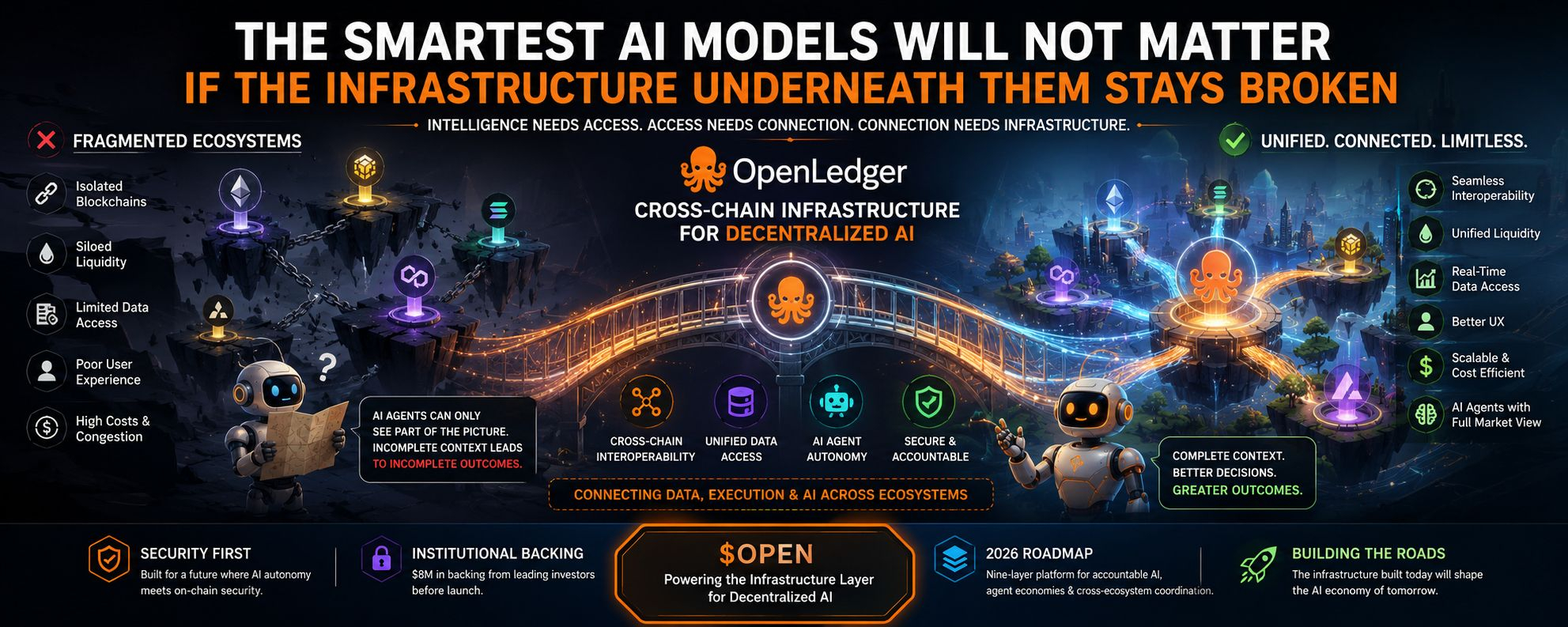
I want to tell you something that shifted how I think about decentralized AI entirely
For a long time I was obsessing over the same things everyone else was. Model performance. Benchmark scores. Which system could process more context faster. Bigger. Smarter. More capable. That was the entire conversation and I was fully inside it
Then I started asking a different question
What happens when AI becomes powerful enough to operate across entire digital ecosystems but the infrastructure underneath it remains completely fragmented
That question changed everything about which projects I pay attention to now
I have spent enough time moving assets between blockchain networks to know that fragmentation is not a theoretical problem. You feel it in a very concrete way. Your assets sit on one chain. Liquidity sits on another. The application you actually need exists somewhere else. Nothing is technically broken. Everything feels disconnected anyway. I remember thinking crypto solved dozens of coordination problems while quietly creating new ones. The technology improved and the user experience somehow got more complicated at the same time
That same thought came back to me while looking at how AI agents actually operate in decentralized environments
AI agents are genuinely impressive right now. They can monitor activity process information automate workflows analyze markets and execute actions with minimal human involvement. But there is a limitation hiding underneath all that intelligence that most people in the AI conversation are not talking about seriously enough
Most AI systems can only work with the environment they can actually access. And access in crypto is still fragmented by design
I keep coming back to one analogy that makes this concrete. Imagine asking a trader to understand the entire market while only allowing them to look at a single exchange. They might still make reasonable decisions. But their view of reality would be incomplete in ways that matter precisely when the stakes are highest. The same principle applies directly to AI agents operating on isolated blockchains. Intelligence matters. Access matters just as much
This is where OpenLedger's cross-chain infrastructure started appearing on my radar in a way I could not dismiss
The core idea is not simply moving assets between blockchains. That problem has been worked on for years with mixed results. The bigger idea is allowing data execution and AI-driven activity to move more freely across different ecosystems simultaneously. And honestly that feels increasingly necessary as AI agents become more autonomous and more capable of acting without waiting for human instruction
Blockchain history already gave us the answer to what happens when ecosystems compete without connecting. No single network became everything. Ethereum developed its strengths. Other ecosystems focused on privacy scalability enterprise adoption and specialized use cases. Instead of one dominant environment we ended up with a landscape of interconnected strengths and weaknesses. I suspect decentralized AI will evolve exactly the same way
Which means the future depends less on isolated ecosystems and more on the infrastructure connecting them
One thing I noticed that most AI conversations miss entirely is how much access to information matters alongside compute power. Compute gets all the attention because it is easy to measure and easy to market. But data lives everywhere. Liquidity lives everywhere. Users live everywhere. Yet most AI systems still experience only small portions of that reality. If an AI agent can access information across multiple ecosystems simultaneously its understanding becomes structurally broader. Instead of analyzing one isolated environment it can analyze relationships between environments. That changes how decisions get made and in markets broader context consistently produces better outcomes
Scalability becomes part of this conversation too and I want to be honest about why it matters practically
Anyone who has spent real time in crypto has watched what happens when activity surges. Networks congest. Costs rise. Execution slows down at exactly the moment you need it most. AI systems that depend on frequent interactions cannot afford that kind of bottleneck. As those systems become more autonomous relying entirely on one network starts feeling less like a design choice and more like a structural liability. Cross-chain infrastructure creates flexibility and flexibility becomes increasingly valuable as complexity grows
Now let me talk about the issue this conversation cannot avoid
Security
Every serious discussion about cross-chain infrastructure eventually arrives there and for good reason. The history of bridge exploits in crypto has been brutal and expensive. Billions of dollars lost to vulnerabilities that looked manageable until they were not. That history matters enormously when AI enters the equation. Autonomous systems executing actions across multiple networks create new efficiency opportunities and new attack surfaces simultaneously. The infrastructure connecting ecosystems must be reliable enough to support genuinely autonomous operation. Otherwise the efficiency gains are irrelevant because the risk of catastrophic failure outweighs them
This is why OpenLedger's long term significance depends on more than interoperability alone. The real challenge is balancing accessibility speed and security at the same time. That combination is genuinely hard to achieve. But it may be the only combination that matters for the future of decentralized AI
The $8 million institutional backing from serious investors before launch signals a team that understands infrastructure development takes longer than narrative cycles. The 2026 roadmap pointing toward a nine layer platform for accountable AI including data attribution agent economies and cross-ecosystem coordination reflects thinking about the full stack not just the most visible layer
What I keep returning to is something that sounds simple but carries significant weight
Everyone notices the model. Almost nobody notices the roads underneath it. Yet roads determine where movement is possible. Without them even the most advanced system eventually reaches a dead end and cannot move forward regardless of how intelligent it is
The projects building those roads right now are doing work that will matter more in three years than it does today
So let me leave you with the questions I am genuinely sitting with
Will the biggest winners in decentralized AI be the systems with the smartest models or the systems that connect fragmented environments into something that functions like a single coherent network
And as AI agents become increasingly autonomous will cross-chain interoperability be treated as a convenience or will it become a hard requirement for any system serious about operating at scale