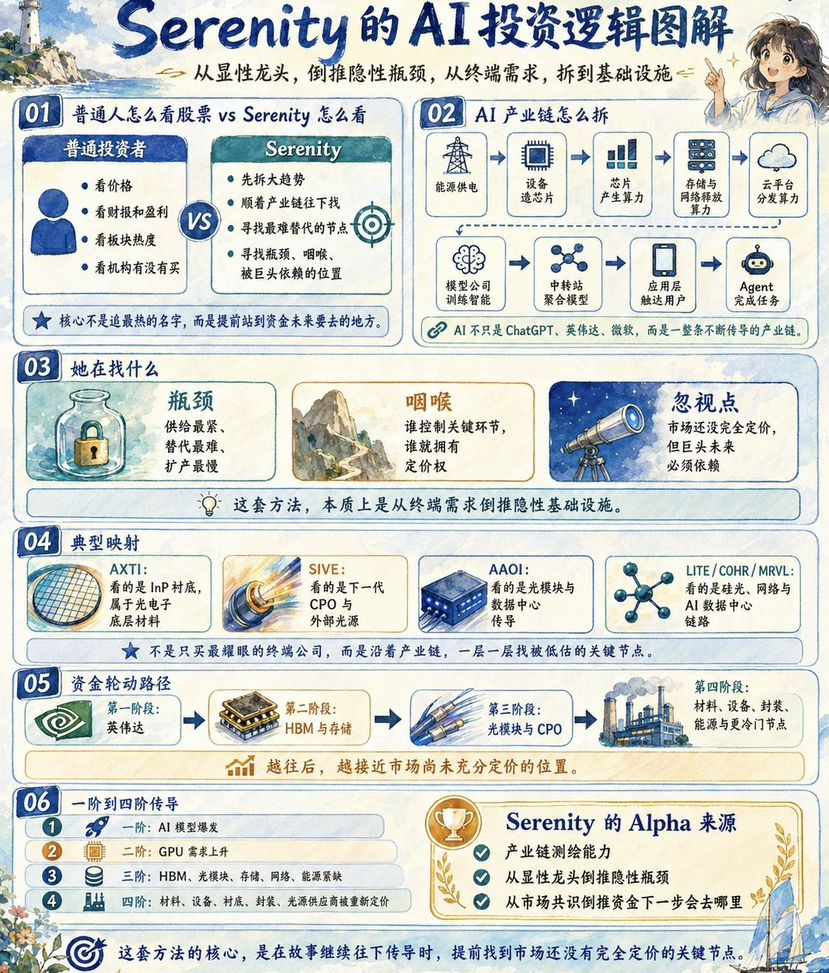

Regular folks buying stocks usually check the price, earnings reports, profitability, sector heat, and whether institutions are piling in.
Serenity's investment strategy involves dissecting the supply chain. First, break down a big trend, then pinpoint the key nodes that are hard to replace, easy to block others from accessing, and crucial for the big players.
After NVIDIA's surge, the real pros will continue to dissect: why does AI need GPUs, why do GPUs need HBM, why do data centers require optical modules, and as models grow larger, why do we need more storage, bandwidth, energy, packaging, and cooling?
I noticed something interesting back in early March: many big players started investing in nuclear power plants. The reason is simple—AI is starved for energy.
This is a classic downstream logic.
If you're bullish on AI, you can't just look at names like ChatGPT, Nvidia, or Microsoft. You need to keep dissecting the AI supply chain:
Energy supply, equipment for chip fabrication, chips generate computational power, storage and networks release that power, cloud platforms distribute the power, model companies train intelligence, aggregation stations consolidate models, and the application layer reaches users, with the Agent ultimately completing the task.
Serenity's investment logic is roughly like this. She looks down the supply chain layer by layer, identifying bottlenecks, choke points, and areas overlooked by the market, which could become the entry points for the next round of capital rotation.
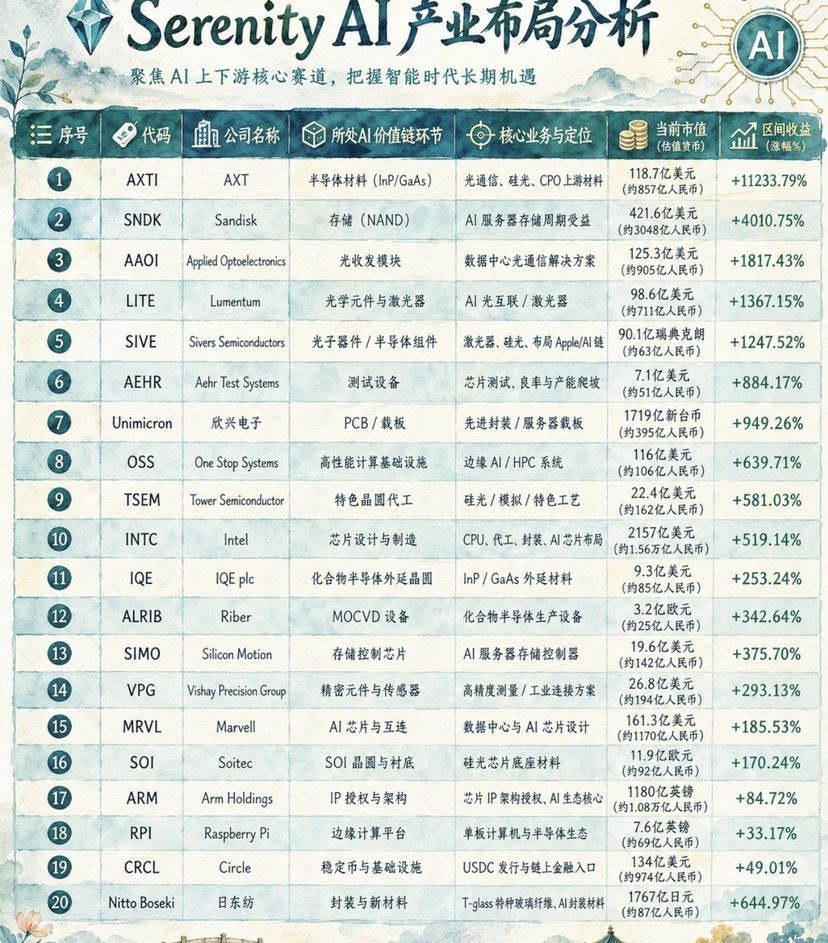
She's looking at AXTI for InP substrates, which are foundational materials in optoelectronics. She's looking at SIVE for the next-gen CPO and external light sources. She's watching AAOI, LITE, COHR, and MRVL, focusing on the flow between optical modules, silicon photonics, networks, and AI data centers.
The most valuable aspect of this approach is standing ahead of where capital is likely to flow in the future.
The first stage of the market is all about trading Nvidia, the second stage focuses on HBM and storage, the third stage is on optical modules and CPO, and it may continue to trickle down to materials, equipment, packaging, energy, and even more niche supply chain nodes.
The AI model explosion is the first stage. The rising demand for GPUs is the second stage. The shortage of HBM, optical modules, storage, network, and energy is the third stage. Going further down, certain materials, equipment, substrates, packaging, and light source suppliers being repriced is the fourth stage.
That's her logic. It's a key point in the narrative as the market hasn't fully priced it in yet.
What Serenity teaches best is this ability to map the supply chain, tracing back from end-user demand to infrastructure, from obvious leaders to hidden bottlenecks, and from market consensus to where capital will move next. That's her source of Alpha; I'm not sure if I'm right.