
On November 21, according to CME's "Fed Watch": the probability of the Federal Reserve cutting interest rates by 25 basis points in December is 39.6%, while the probability of maintaining the current rate is 60.4%. On that day, Federal Reserve Vice Chair and New York Fed President Williams stated that the Federal Reserve could cut rates in the "near future" without jeopardizing its inflation targets. Influenced by these remarks, the probability of a 25 basis point cut in December on Polymarket rose to 61%. Today, according to CME's "Fed Watch" data: the probability of the Federal Reserve cutting rates by 25 basis points in December has risen to 69.4%, while the probability of maintaining the current rate is 30.6%.
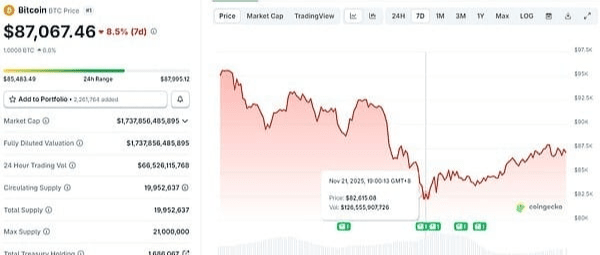
Before Williams' speech, the price of BTC had been continuously falling, even touching $82,000. After the interest rate cut remarks were made, the price of BTC began to slowly rise, reaching $87,067.46 at the time of writing.
White House economic advisor Hassett pointed out: The new leadership of the Federal Reserve may be expected to cut rates, and Trump may interview candidates for the Federal Reserve in the coming months. We may confirm the Federal Reserve chairperson around the New Year. The market is currently paying close attention to the Federal Reserve FOMC meeting.
I. Federal Reserve FOMC voting mechanism
The decision-making of the Federal Open Market Committee (FOMC) adopts a majority voting system, where each voting member has an equal vote. The committee consists of 12 voting members, divided into two parts: permanent voting members and rotating voting members.
All members of the board (up to seven);
President of the New York Federal Reserve Bank;
Among the remaining 11 Reserve Bank presidents, 4 will take turns serving for a term of one year.
The seven Reserve Bank presidents without voting rights will attend the Federal Open Market Committee meetings and participate in the committee discussions.
Voting mechanism
Majority vote decision: At the end of each two-day meeting, participants will vote on monetary policy proposals (e.g., whether to adjust the target range for the federal funds rate), and proposals that receive a majority vote will be adopted.
Consensus: Despite the voting mechanism, FOMC members usually engage in extensive discussions and negotiations to seek consensus to ensure that policy decisions have broad support, thereby conveying a consistent message to the market.
Dissent record: If a voting member disagrees with the final decision, their dissent will be formally recorded in the meeting minutes, showcasing the diversity of opinions within the committee.
Jeffrey Roach, Chief Economist at LPL Financial, stated: "In fact, committee members communicate closely between meetings, striving to reach consensus, but that does not guarantee that consensus will be reached."
Achieving consensus among all Federal Reserve members helps convey a consistent message to the market regarding the agreement of Federal Reserve officials on their actions. Disagreements in voting results may raise questions about whether the Federal Reserve believes its actions are correct and the motivations of its officials.
II. FOMC voting members and preference views for 2025

Permanent voting members (Federal Reserve Board members and New York Fed president)
Jerome H. Powell, Chair (Federal Reserve Board): Indecisive
On October 29, at the press conference following the Federal Reserve's decision to cut interest rates by 25 basis points, Powell stated that the rate cut may not necessarily continue into December as widely predicted. "Further rate cuts at the December meeting are not a done deal, far from it. There is significant disagreement among parties today. This shows that we have not yet made a decision on the rate trajectory for December." Powell acknowledged that the Federal Reserve is in a difficult position, with economic trends pulling monetary policy in opposite directions. "We are facing a situation where inflation is facing upward risks while employment is facing downward risks. We only have one tool… you can’t tackle both issues at the same time."
John C. Williams, Vice Chair (President of the New York Fed): Prefers interest rate cuts
Williams stated at a meeting of the Central Bank of Chile that U.S. interest rates could decrease without jeopardizing the Federal Reserve's inflation target while also helping to prevent a downturn in the job market. "I believe monetary policy is slightly tightening... Therefore, I think there is still room for further adjustments in the federal funds rate target range in the short term to bring the policy stance closer to a neutral range." Williams mentioned that the Federal Reserve needs to achieve its inflation target without taking excessive risks to the full employment goal.
Michelle W. Bowman, Federal Reserve Governor: Prefers interest rate cuts
Bowman stated after the Federal Open Market Committee (FOMC) decided to cut rates for the first time since 2025 in September: "Now is the time for the committee to take decisive and aggressive action to address the declining vitality and signs of weakness in the labor market. We may have already lagged behind in addressing the increasingly deteriorating labor market conditions."
Stephen I. Miran, Federal Reserve Governor: Prefers interest rate cuts
Miran clearly supports a rate cut in December and believes it is "very appropriate." On November 15, he emphasized that the data overall has been dovish since September, supporting the Federal Reserve's strengthening of its dovish stance. Earlier, he also proposed a rate cut of 50 basis points, at least 25 basis points. He believes that if economic data does not change significantly, continuing to cut rates is a "consistent and reasonable choice." Miran was appointed by Trump as the former chief economic advisor at the White House, and there are concerns about his independence—his radical stance has exacerbated divisions within the Federal Reserve.
Christopher J. Waller, Federal Reserve Governor: Prefers interest rate cuts
On November 17, Waller stated that he supports a further reduction of the U.S. key interest rate by 0.25 percentage points in December to help boost the weak U.S. labor market—and he doubts he will change his mind. Waller mentioned that based on surveys of consumers and businesses and his contacts with large employers, he is convinced that the labor market conditions have deteriorated. He pointed out that the key employment data, delayed due to a record 43-day government shutdown, is likely to show results contrary to this when released. "The labor market remains weak, close to stagnation." Meanwhile, inflation has not risen significantly in recent months. He stated that economic slowdown and high interest rates suppress consumer spending, which helps control inflation. "In light of signs of economic growth slowing, and the weak labor market potentially leading to moderate wage growth, I don’t see any factors that would lead to accelerated inflation."
Michael S. Barr, Federal Reserve Governor: Cautiously favors rate cuts
On November 20, Michael Barr stated: "I am concerned that the inflation rate is still around 3%, while our target is 2%. So we need to be cautious with monetary policy now because we want to ensure we achieve both aspects of our mission.
Lisa D. Cook, Federal Reserve Governor: Indecisive
Cook stated in an interview with the Brookings Institution in Washington: "Every meeting, I decide my monetary policy stance based on the latest data from various channels, changes in my expectations, and the balance of risks. Every meeting, including the one in December, is a live meeting."
Philip N. Jefferson, Federal Reserve Governor: Indecisive
On November 17, Jefferson pointed out: As the Federal Reserve relaxes its policy to a position that may halt progress on slowing inflation, it needs to "proceed slowly" on further rate cuts. "In recent months, I believe the balance of risks in the economy has shifted, with downward risks to employment increasing compared to upward risks to inflation, and the upward risks to inflation may have recently declined." Jefferson will be guided by data and adopt a "step-by-step meeting" approach to determine policy. "At this point, this is an especially prudent approach." Before the December Federal Reserve policy meeting, "it remains unclear how much official data we will see."#比特币波动性