
I don't know exactly when I started noticing it. Somewhere between watching another AI demo and reading another "future of work" thread that said nothing new. Something felt off. Like everyone was arguing about the wrong thing.
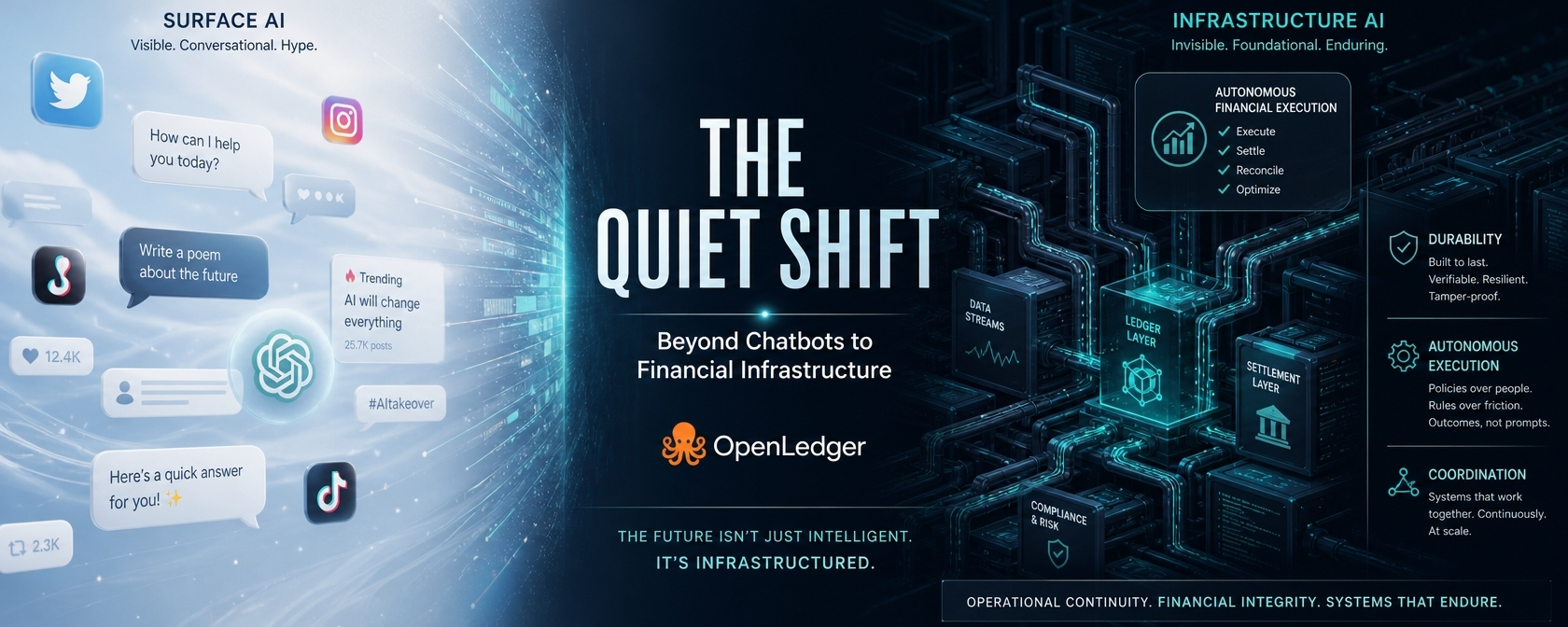
Most of the AI conversation right now is still stuck on the surface stuff. Which model sounds smarter. Which assistant is faster. Who won the week on social media. And I get it — that stuff is visible, it's easy to have opinions about, it makes for good content.
But I kept feeling like something heavier was being built somewhere that wasn't getting nearly enough attention.
Then I started paying closer attention to what OpenLedger is actually doing. And it took me a while to fully land on why it felt different. Not louder different. Quieter different. The kind of different that doesn't announce itself.
Here's what I mean.
There's a version of AI that lives on top of things. You open it, use it, close it. It helps you write something or summarize something or find something. Useful. Fine. Totally forgettable the moment the tab is closed.
And then there's a version that lives underneath things. That doesn't wait to be opened. That runs. Continuously. While markets move and data shifts and conditions change without warning. That version isn't a tool you use. It's more like... plumbing. You don't think about plumbing until it fails.
OpenLedger feels like it's building for that second version.
Trading agents. Autonomous execution. Coordination across financial environments that never actually pause. I'm not a finance guy deep in the weeds of this stuff but even from the outside, the stakes feel completely different than anything in the chatbot conversation. Like the tolerance for failure just dropped to somewhere near zero.
A social app going down for twenty minutes is an inconvenience. Maybe some tweets about it. People move on.
An autonomous system operating inside live financial infrastructure going down — or behaving inconsistently — that's a different category of problem entirely. And I think that's actually the point. The environments OpenLedger seems to be building toward don't forgive unreliability the way consumer apps do. Which means the infrastructure has to be built with a completely different level of seriousness from day one.
That's the part I keep coming back to.
Because honestly — and maybe this sounds obvious once you say it out loud — intelligence without stability is kind of useless at that level. It doesn't matter how good the reasoning is if the layer underneath it can't hold under real pressure. The smartest agent in the world running on fragile infrastructure is just a liability with good PR.
So while everyone else is racing to make AI sound smarter, feel smoother, respond faster — there's this whole other race happening around whether AI can actually be trusted to operate without supervision inside environments that demand it. That race is less visible. Less fun to tweet about. But it feels like the one that actually matters long term.
What gets me is how quietly this transition is happening. Like nobody sent out a memo. The $OPEN direction just sort of implies a future where the interesting question about AI isn't "how does it respond" but "how long can it hold without breaking." Durability as the real benchmark. Coordination quality as the thing people eventually start caring about more than cleverness.
I might be completely off on some of this. I'm working through it more than explaining it, if I'm being honest.
But something about OpenLedger building in that direction — toward operational continuity, toward financial infrastructure, toward systems expected to keep functioning in conditions that don't slow down for anyone — feels like it's pointing at something most people aren't looking at yet.
And usually the stuff nobody's looking at yet is exactly the stuff worth watching.
