


Core takeaway
Blockchain has moved from the fringes of finance and tech into the spotlight thanks to countless people turning an idea into a global phenomenon.
Real inclusive finance isn’t just handing out keys; it’s about breaking down the doors that block people.
From 300 million to 3 billion, we’re building not just a platform, but a financial infrastructure that belongs to everyone.
1. From the margins to the spotlight
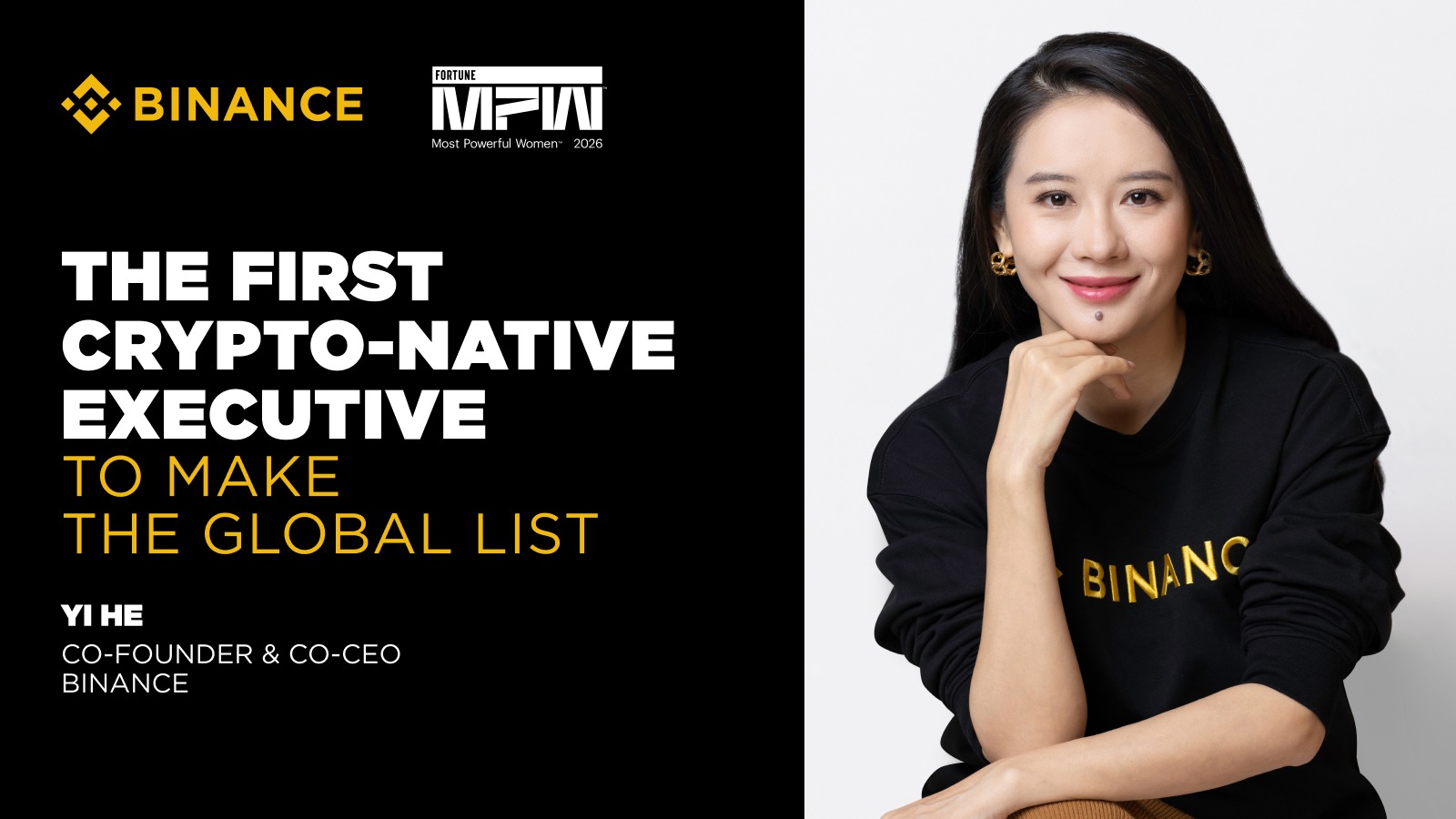
When I first learned I’d be selected for the (Fortune) "Most Powerful Women in Business" list, my first feeling was one of humility, and my second was the weight of responsibility.
This recognition carries my name, but it belongs to the Binance team, to Binance users, and to Satoshi, to every community member who turned this industry from an idea into a global wave.
A few years back, if a native crypto entrepreneur showed up on a list like this, it would have seemed unusual; but today, it feels more like our industry has gradually moved from the fringes of finance and tech into the spotlight. This isn't my 'achievement'; I just saw the wave coming, bravely hopped on my surfboard, and clumsily learned to ride it. This recognition represents another step in the long journey of the blockchain industry transitioning from niche geek players to everyday life. But the road is still long; we have to build and refine it day by day, and that's what we do every day.
I often call myself the 'Chief Customer Service Officer', and I really like that title. At Binance, everyone who enters management spends their first month on the front lines in customer service, and has to rotate back every quarter—I do the same. The logic is pretty straightforward: there are things you can't see from your office, but users are experiencing them every day.
Last year in Dubai, a young guy from Kenya stopped me on his way out. He sends his salary home to his mom through Binance every month. He didn't ask about blockchain architecture or token economics. He just wanted me to know how much faster his mom receives the money now and how much less has disappeared along the way. He doesn’t need to be 'educated' on what cryptocurrency is; he needs a product that works.
He's not an isolated case. Over the past five years, more than 34 million people have completed remittances through Binance Pay, totaling over $87 billion. Based on the World Bank's global average remittance fee of 6.36%, we've saved users over $5 billion—that’s money that hasn’t disappeared into the hands of intermediaries but has instead returned to family dinner tables, children’s tuition, and small business startup funds.
2. That door, we have to take down.
I was born in a small village in Sichuan, the kind of place that's hard to find on a map. When I was a kid, we would occasionally lose power, so I had to use a kerosene lamp to do my homework. The village girls would go to factories with someone else's ID before turning 16.
When I was nine, my father passed away, and my uncle told my mother, 'Why bother with so much education for a girl? Just save the money for your son to marry.' But my mother was incredibly resilient; she worked as a substitute teacher while farming, and somehow managed to support the whole family and send me to university.
Over the years, I've often been asked: why are you still working so hard when you've already achieved financial freedom? Honestly, not everyone has the chance to change the world, but I'm creating history. Since I'm here, why not give it a try? As the ancients said, 'When poor, cultivate oneself; when successful, help the world.'
In India's tier-two and tier-three cities, there’s a group of women aged 36 to 50. Their mothers never had their own bank accounts, and until a year ago, they didn't either. Over the past year, they've become one of our fastest-growing user groups. Those who weren’t being heard are quietly reclaiming their agency, their money, and their families' futures from outdated systems, entering a faster, more efficient, and lower-cost financial world. They are like me 12 years ago, pondering 'What is money?' This is more important than any grand narrative.
Over the years, Binance has done thousands of small things in rural areas of South Africa, Brazil, and India: scholarships, training, and basic financial literacy courses. They may be small, but they are happening one by one. I don’t like the term 'empowering women.' It sounds like someone holds the keys and decides whether to open the door for you. What I prefer is to dismantle that door so more people can walk in. They should decide for themselves what kind of person to become and what kind of life to live.
3. From 300 million to 3 billion.
Years ago when we said Binance aimed to serve a billion users, people thought we were dreaming. Today, we have over 300 million users, and a billion is no longer a distant dream. So this year, we've set our sights on 3 billion.
To be honest, before I said this, I wondered: is this number correct? Do we deserve it? But one thing I'm sure of is that if we don't set this target, no one else will do it for those 3 billion people.
3 billion is roughly the number of adults today who have yet to enter the formal financial system. This means what we need to do is no longer just run a cryptocurrency exchange, but build a financial infrastructure capable of supporting the daily lives of 3 billion people.
AI is reshaping productivity. But if productivity only belongs to a few companies, that’s not a revolution, it’s a new monopoly. Over the past year, we’ve gradually handed tools that were once only affordable by professional institutions to everyday users: allowing someone who doesn’t understand coding to use AI for decision optimization; enabling a first-time crypto user to ask their questions in plain language. Finance shouldn’t just be the language of a select few.
What blockchain aims to solve is another issue: ensuring that everyone using AI can receive their fair share of the value created by AI. Combining these two elements is what could support the path from 300 million to 3 billion.
Someone once said a simple truth: if you don't like this world, go change it. I’ve walked step by step from that small village in Sichuan to the county town, to the provincial capital, and to the world. I know better than anyone that the world you want is like Rome; it won't be built in a day.
So let’s get back to work, making incremental progress, as every effort counts.
—— He Yi, Co-founder and Co-CEO of Binance