


Key Takeaways:
Cheap tokens don't always signify promising crypto investments and often mislead investors.
The real value of an asset is determined by market cap, tokenomics, and fundamental indicators, not just the price per coin.
Investors should pay attention to the token's liquidity, demand, product, and the project team to assess its viability.
Investment traps such as scam tokens and pump and dump schemes are a common problem in the cheap cryptocurrency segment.
Rational analysis and critical thinking help distinguish promising assets from risky ones and avoid significant financial losses.

In this context, it is important to understand that the cheapness of an asset does not imply its growth potential or stability in the crypto market. In 2025, the volume of illegal transactions in the crypto ecosystem reached at least
The difference between the price of a single coin and the real valuation of the project
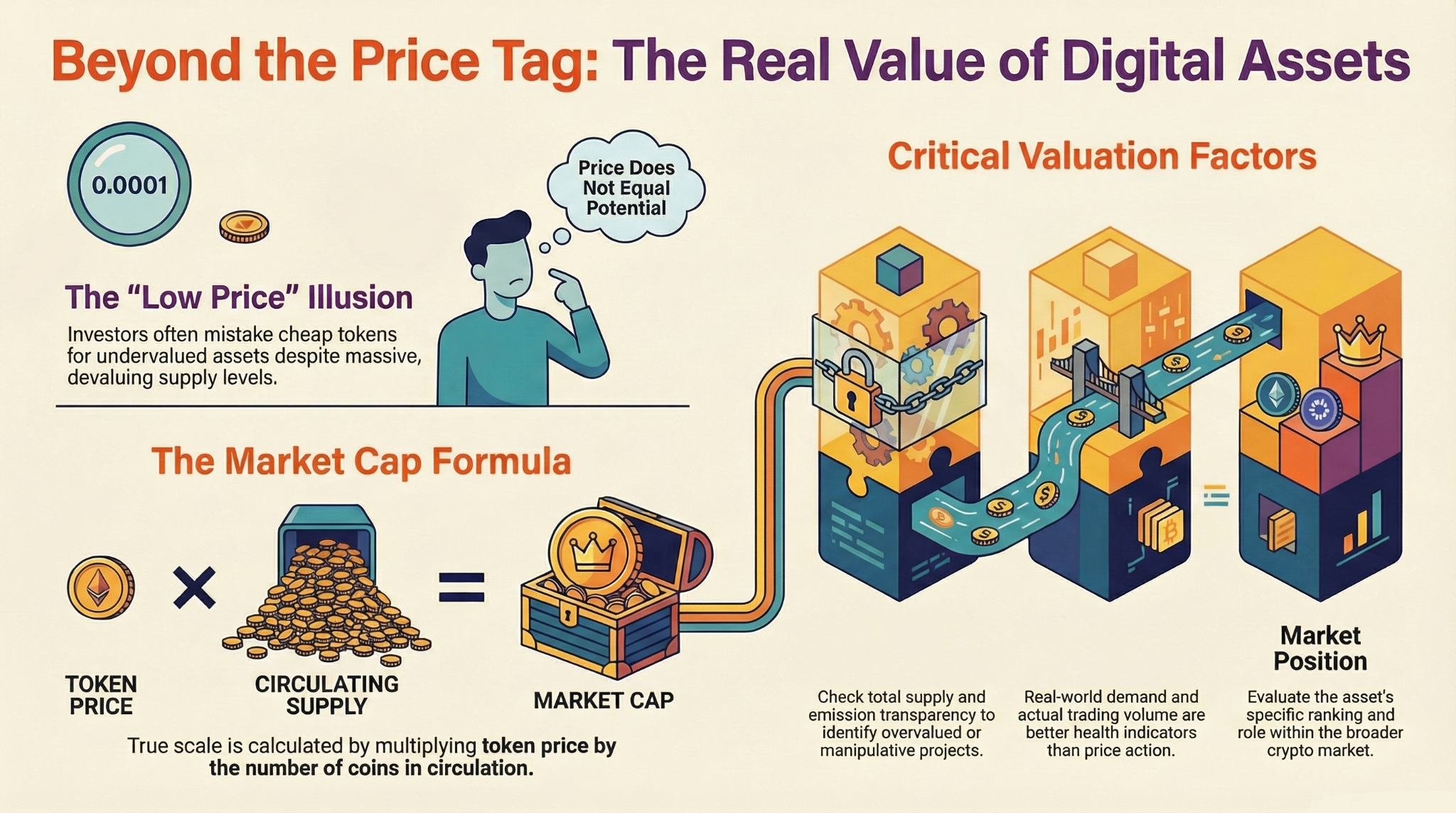
The difference between the price of a single coin and the real valuation of the project is critical for understanding any crypto investments. Often investors only look at the low price and assume that cheap tokens or cryptocurrencies have greater growth potential. However, the real value of an asset is determined not by price but by indicators such as market capitalization and the structure of tokenomics.
To understand how true valuation of a crypto project is formed, it is worth paying attention to the following factors:
Total supply and token circulation
Real demand and product usage
Transparent or manipulative token issuance
Actual token liquidity
Asset position in the crypto market
Market capitalization is calculated as the token price multiplied by the number of coins in circulation, and it reflects the real scale of the project, not the price of a single coin. At the same time,
Why 'cheap' doesn't mean 'promising'
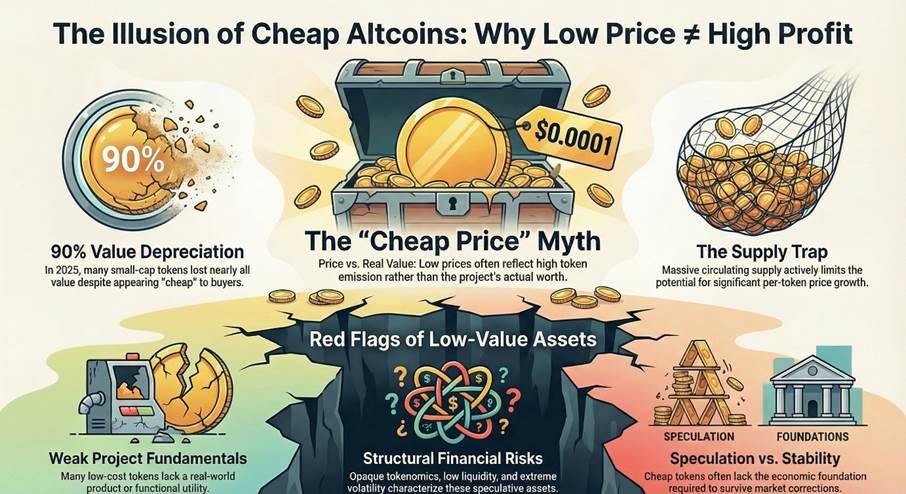
Many investors mistakenly believe that altcoins with low prices have greater growth potential than expensive assets. However, the price of an individual token is often a result of high token issuance rather than the real value of the project. Therefore, speculative assets with low prices may have a weak economic foundation. The following list explains why a low price does not guarantee success:
Large token supply reduces growth potential
Weak or opaque tokenomics
Low token liquidity
High volatility of cryptocurrencies
Lack of a real product or utility
As practice shows, even during market uptrends, many cheap assets do not demonstrate significant profits. For example, in 2025, some small tokens lost up to 90% of their value. A particularly notable case is the collapse of the Terra (LUNA) ecosystem, where the token appeared affordable for a wide range of investors for a long time, but due to issues with tokenomics and stabilization mechanisms, it lost nearly all its value in a very short period.
In May 2022, the algorithmic stablecoin TerraUSD (UST) lost its peg to the dollar, causing a rapid collapse of the entire ecosystem and hyperinflation of LUNA. As a result, investors faced massive losses. After the collapse, the project was relaunched as Terra 2.0, but despite attempts to recover, it never regained market trust and former positions. This proves that overvalued tokens may appear cheap but remain unprofitable. As a result, investors faced massive losses. This proves that overvalued tokens may appear cheap but remain unprofitable.
What to look for as an investor
Rational crypto investments require analyzing deeper indicators than just the token price. An investor must conduct fundamental analysis of the token, including the team, product, technologies, and the project's position in the market. It is especially important to consider token circulation, distribution mechanisms, and tokenomics to determine the real sustainability and potential of the asset.
Here are key criteria that help evaluate crypto projects:
Real market capitalization – the ratio of token price to the number of coins in circulation. It shows the project's scale and allows separating undervalued tokens from overvalued ones.
Transparent token issuance – it’s important to know how and when new tokens are released to assess inflation and devaluation risks.
Token liquidity level – high liquidity means ease of buying and selling without significantly impacting the price, which is critical to avoid speculative traps.
User activity and demand – indicate real product usage and trust in the project on the crypto market.
Long-term development strategy – having clear development plans and partnerships increases success chances and reduces risks of scam tokens or pump and dump schemes.
Market conditions also matter: as of March 2026, the total cryptocurrency market capitalization was $2.52 trillion. This means that competition among projects is very high, and only a fraction of them has real growth potential. Therefore, it’s essential to distinguish undervalued tokens from weak projects and avoid typical investment traps.
Typical traps of cheap tokens
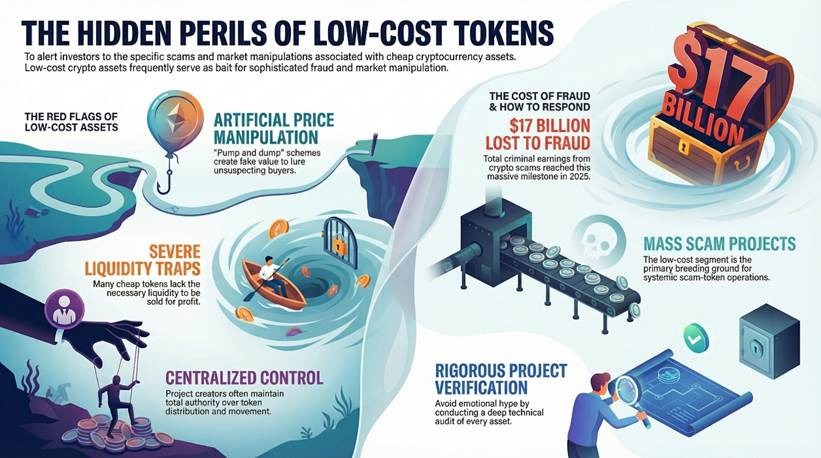
Investors often fall into investment traps associated with cheap assets. The most common of these are market manipulation and fraud. Scam tokens and pump and dump schemes are particularly dangerous. Here are the main risks to consider:
Artificial price inflation (pump and dump)
Lack of liquidity for selling
Fake profit promises
Centralized control of tokens
Massive fraudulent projects (scam tokens)
Statistics confirm the seriousness of the problem: in 2025, crypto frauds brought criminals around $17 billion. A prominent example of such schemes is $HAWK (2025): inspired by a viral internet meme, this token allowed insiders to control over 80% of the supply, leading to a drop of over 90% within hours after insider sales worth $1.3 million.
When a low price can actually be an opportunity
Despite all the risks for crypto investors, a low price can sometimes signal potentially profitable crypto investments. This is possible when crypto projects have a strong fundamental basis but are temporarily undervalued due to market conditions. In such cases, investors can find genuinely undervalued tokens rather than just cheap speculative assets. To better understand the differences between various types of assets, it’s advisable to compare them based on key characteristics:
Criterion | Promising assets | Cheap tokens | Risky / scam tokens |
Tokenomics | Transparent and balanced | Weak or unclear | Manipulative or hidden |
Token issuance | Limited | Excessive | Uncontrolled |
Product | Has real application | Often absent or raw | Absent |
Token liquidity | High | Low | Almost nonexistent |
Demand | Organic | Speculative | Artificially created |
The cryptocurrency market remains very unstable, and asset prices can change very quickly. Such volatility creates opportunities to buy promising tokens at a reduced price. For example, the Solana (SOL) asset experienced sharp drops in value during market crises but later managed to recover due to a strong technological foundation and ecosystem development.
At the same time, even under such conditions, it is necessary to conduct thorough fundamental analysis of the token to avoid investment traps and not confuse genuinely promising projects with overvalued assets.
Conclusions
Investing in cheap cryptocurrencies requires critical thinking and deep analysis. The token price alone does not reflect its real value or potential. That’s why it’s important to assess market capitalization, tokenomics, and other fundamental indicators. Overall, cheap tokens are often riskier than they appear at first glance. High volatility of cryptocurrencies, low liquidity, and widespread investment traps can lead to significant losses. A rational approach and analysis help distinguish promising assets from risky ones.
Follow us on social media Binance Ukraine: