

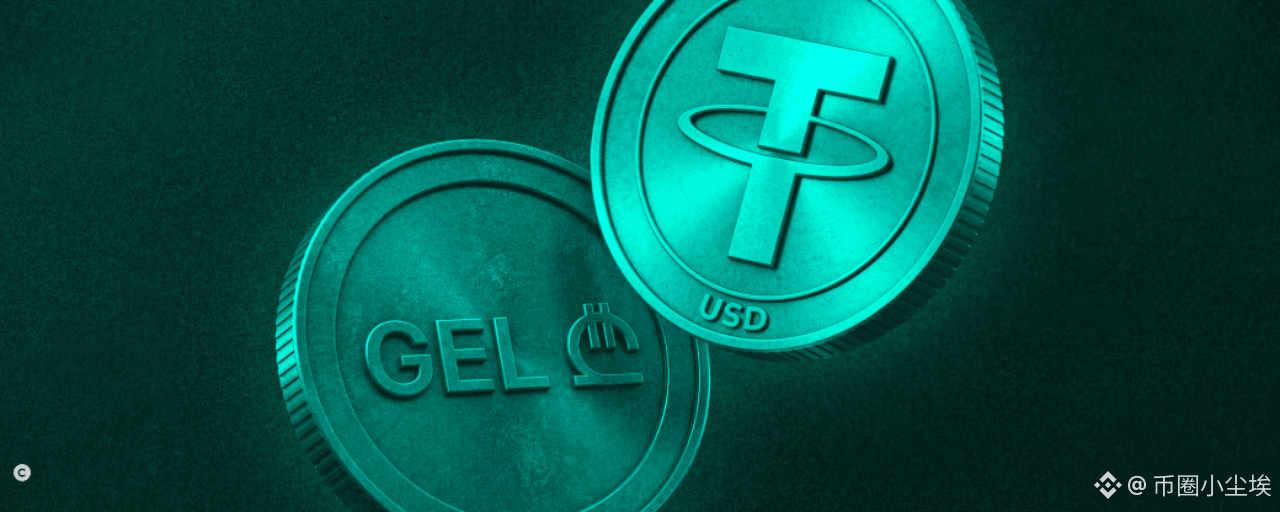

"Tether has rolled out the GEL stablecoin pegged to the Georgian Lari, backed by the government, positioning itself as a pioneer in the digitalization of national currencies. The stablecoin market has surged from the sidelines to a $322 billion infrastructure, with Tether's on-chain transaction volume even surpassing Visa. The Prime Minister of Georgia stated that this move is building a 'more transparent, digital financial future,' with the country ranking third globally in cryptocurrency adoption and a tripling of mining electricity consumption over three years."
Tether has launched a stablecoin pegged to the Georgian Lari (GEL₮), marking the latest push by the largest stablecoin issuer beyond its dollar-denominated core product.
Prefer the national currency
A stablecoin is a digital asset designed to maintain value by being pegged to reserve assets, most commonly fiat currencies such as the U.S. dollar. According to Coin Gecko, Tether issues USDT, the largest by market value; as of May 25, its market cap is about $189 billion.
In a statement dated May 25, the company said that GEL₮ is supported by the government of the Republic of the Black Sea and described it as “one of the joint efforts by the first to put the national currency directly onto the digital-asset track, based on a purpose-built stablecoin regulatory framework.”
Georgia’s Prime Minister Irakli Kobakhidze said that in describing the cooperation, the country “is laying the groundwork for a more connected, transparent, and digitally enabled financial world.”
From the sidelines to the center
According to DefiLlama data, stablecoins have grown from around $4 billion at the start of 2020 to $322 billion as of May 25. They have shifted from a fringe asset to an increasingly important component of the global payments infrastructure. They are used for payments, settlement, remittances, and cross-border transfers; because they are fast and cost less, they are increasingly becoming an alternative to traditional financial networks.
Tether says its 24-hour on-chain transfer volume often exceeds the processing volume of Visa and Mastercard, although analysts argue that the two measure different kinds of activity.
Circle’s narrower bet
Tether’s success with stablecoins in Georgia may be more successful than other attempts with non-U.S.-dollar tokens. Due to concerns around EU regulation of crypto assets (MiCA), its euro-based euro (EURO₮) has gradually been withdrawn, while the pound sterling-backed Pound₮ is inactive. In Mexico, MXN₮ has limited liquidity, and China’s CNH₮ has also exited circulation.
Its closest competitor, Circle, controls about 24% of the global stablecoin market, while Tether estimates 59%, but it has taken a different strategy with non-U.S.-dollar tokens.
Circle has moved away from small denominations, apart from the euro coin (a euro-backed digital asset). Its early compliance helped it secure roughly half of the euro stablecoin market when Tether’s euro (due to regulatory restrictions) was delisted by crypto exchanges.
GENIUS compatibility
Tether CEO Paolo Ardoino praised Georgia’s commitment to developing digital assets. “Georgia has taken action early, putting in place a serious regulatory framework for digital assets and stablecoins. This clarity provides a foundation for real innovation and adoption.”
In recent years, the country has established a comprehensive framework backed by the government and the National Bank of Georgia. The digital-asset framework is also designed to interoperate directly with U.S. stablecoin regulation passed in 2025 (the “Genius Bill”).
Mining boom, higher adoption
In Chainalysis’s population-adjusted 2025 Global Crypto Adoption Index, Georgia ranks third, behind Ukraine and Moldova, reflecting strong grassroots crypto activity relative to the country’s size. Its crypto-mining sector is rapidly expanding; according to data from Georgia’s National Energy and Water Supply Regulatory Commission, electricity consumption grew threefold in 2025, accounting for about 5% of national demand, even though leading countries aren’t represented in the current global computing-power rankings, which are led by the United States.