


Valuation reshaping: data and evaluation infrastructure become the valuation center of the embodied industry.
Author|Zhou Yue
Editor|Li Zi
The market logic of embodied intelligence is changing.
In the past two years, the industry discussing embodied intelligence has primarily focused on models and entities: whose 'brain' is stronger, whose humanoid robot is more human-like, and whose movements are more precise. These constitute the most intuitive capabilities of embodied intelligence.
This aligns with the evolutionary logic of emerging industries. At the start of each technology cycle, those first in the spotlight are often the companies closest to the users and the most imaginative. Just like in the early days of autonomous driving, the market initially focused on whole vehicles and Robotaxis; at the onset of large model explosions, capital first chased model and application companies. In the launch phase of embodied intelligence, models and entities first received high valuations, which is also a natural result of industrial development.
However, when the technology industry transitions from 'the lab' to 'scaling up', the market's pricing logic often converges to more foundational positions.
Autonomous driving has spawned Scale AI to support the data production system; in the era of large models, the company truly positioned in the industry's C position is NVIDIA, providing foundational computing infrastructure. The more technology moves towards large-scale application, the more the industry relies on the underlying infrastructure that can support continuous iteration across the entire sector.
As we enter 2026, embodied intelligence is also reaching this turning point: whether physical AI can achieve scalable landing no longer simply depends on model parameters, entity forms, or point capabilities, but rather on who can provide data and evaluation infrastructure that supports continuous feedback and learning for robots.
The capital market is keenly capturing this signal and beginning to reprice the foundational infrastructure segment of embodied intelligence.
Recently, Lightwheel Intelligent announced the completion of a new round of financing. This round was led by Ant Group; other notable state-owned, industrial, and financial institutions, including Jiantou Investment, Greater Bay Area Common Home Fund, Senma Fangdao Fund, Shandong Fuhong (managed by Industrial Fulian’s industry fund), Xinneng Investment, and Linxin Investment, also participated; at the same time, old shareholders such as 37 Interactive Entertainment, Guofang Innovation, Daohe Long-term Investment, and Ding Stone Asset Management also oversubscribed.
After this round of financing, Lightwheel Intelligent's valuation exceeded $2 billion, doubling in just two months. This figure not only refreshes the valuation record in the global embodied data and evaluation infrastructure field but also reshapes the valuation landscape of the physical AI data and evaluation infrastructure industry.
In the view of 'Kizhi Lightyear', the data and evaluation infrastructure of embodied intelligence is becoming a new valuation focal point in the industry.
Lightwheel Intelligent is at the core of the industry's focus.
1. The year of scaling embodied data,
Data and evaluation infrastructure are becoming the new value center.
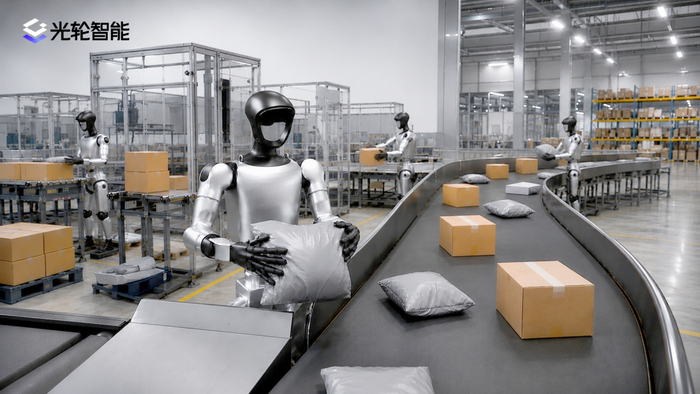
In the era of large language models, the most core infrastructure for the AI industry is computing power. GPU, CUDA, training clusters, inference services, and cloud infrastructure have supported the rapid explosion of AI over the past decade.
In contrast, the Scaling Law of physical AI does not only occur in parameters and computing power. It is gradually shifting from parameter scaling to scaling of data, environment, and feedback. Robots need to learn about the physical world; they need to handle forces, contacts, deformations, failures, and feedback, which is far more complex than just text and images. More importantly, the real physical world cannot be endlessly trial-and-error and cannot be reset at any time.
Therefore, for embodied intelligence to truly enter a scaling phase, the core issue is no longer just 'who can build robots first', but rather who can continuously provide data that is both scalable and high-quality, and can be validated through evaluation.
In the latter half of 2025, the modeling capabilities of the embodied enterprise Generalist broke through and brought the embodied data Scaling Law to the forefront. For the first time, it validated to the industry that the leap in robotic model capabilities comes not only from larger models but also from a continuous supply of high-quality data. Behind this lies a systematic demand for foundational data infrastructure after embodied intelligence enters the pre-training era.
Before this pattern was recognized by the market, Lightwheel Intelligent had already completed its forward-looking layout. The exploration of cutting-edge models like Generalist is also supported by its foundational infrastructure. Once Generalist clarified the industry direction, it was only natural that Lightwheel Intelligent became the first to meet the demand and push the industry into a scaling phase as an infrastructure company.
As we enter 2026, this judgment is shifting from model advancement to commercial validation. In the first quarter of this year, Lightwheel Intelligent's new orders reached 550 million yuan, with quarterly revenue exceeding last year's total, setting a record in the embodied data industry and accelerating the industry's entry into the 'year of scaling embodied data'.
These orders reflect two strong demands in the domestic and international markets: one is that embodied large model and world model teams enter a phase of continuous training, iteration, and evaluation; the other is that real industrial scenes in sectors such as industry, logistics, agriculture, home appliances, and automotive are starting to invest real money in robot training, validation, and deployment. Lightwheel Intelligent happens to stand at the intersection of these two demand curves.
Currently, Lightwheel Intelligent has built a complete closed loop: it can generate high-quality human and synthetic data to serve training and can conduct large-scale simulation evaluations around scenes, providing real feedback based on deployment. In the era of physical AI, model training, evaluation validation, and industrial deployment all rely on the same set of infrastructure for continuous learning and iteration.
This is also the underlying logic for the market to re-evaluate Lightwheel Intelligent. The repeated re-evaluation of NVIDIA in the era of large models is not just because of the GPU hardware itself, but because the computational foundation formed by GPU, CUDA, and training clusters has become a necessity for the entire industry expansion. As we enter the era of physical AI, a similar logic is migrating: for models and entities to continue to progress, there must be scalable data supply, reproducible evaluation systems, and real feedback closed-loop infrastructure. Lightwheel Intelligent is precisely providing the closed-loop infrastructure for physical AI data and evaluation. From this perspective, the fact that Ant Group led the investment, with several state-owned enterprises, industrial funds, and old shareholders following, is not only a recognition of Lightwheel Intelligent but also a clear signal that industrial capital is beginning to reassess the long-term value of physical AI infrastructure.
2. Human, simulation, and deployment full closed loop:
Lightwheel Intelligent has made physical AI data and evaluation into infrastructure.
Lightwheel Intelligent's core barrier lies not in hitting on a single data route but in positioning itself as the infrastructure for physical AI from the very beginning.
This is a set of physical AI data and evaluation infrastructure that spans training, evaluation, and deployment feedback. Its core capabilities are jointly constructed by the full-stack self-research three-in-one simulation kernel, human video data, and feedback from real deployments.
First, simulation.
The most core capability of Lightwheel Intelligent comes from the full-stack self-research simulation platform of 'solving-measuring-generating'. Solving is responsible for restoring forces, collisions, contacts, and deformations in the virtual environment, making the simulation physically credible; measuring brings real physical attributes such as materials, contacts, friction, and deformations into the system; generating scales these physical laws into a trainable, evaluable, and reusable simulation world.
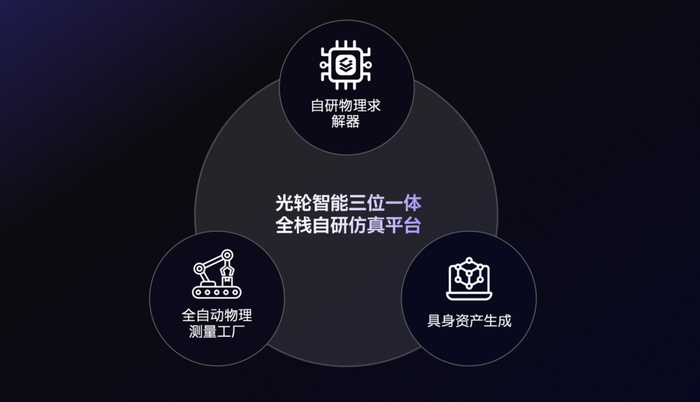
This is also the technical core of Lightwheel Intelligent's data and evaluation infrastructure.
In this system, simulation is the hub connecting data generation, model training, and capability evaluation: on one end, it exposes the model's capability boundaries in different tasks, environments, and physical interactions through simulation evaluations. Evaluation not only determines whether the model has actually improved but also dictates how the next round of data and training should evolve; on the other end, it expands real-world experiences into a large amount of trainable data. It judges model capability boundaries through simulation evaluations and defines the next round of data needs; at the same time, it automatically expands synthetic data from human videos, remote operations, and real scene task experiences into multi-scene, multi-disturbance, and multi-physical parameter simulation synthetic data.
Secondly, it is human video data.
For robots to enter the real world, they first need to understand how humans act in real environments: how to open doors, grasp, organize, assemble, and how to decompose steps, handle anomalies, and correct actions in complex tasks. Human video data provides not static samples but real-world operational experiences, task structures, and behavioral priors.
The outside world has easily understood Lightwheel Intelligent as a simulation company in the past, but this is not complete. In fact, Lightwheel Intelligent has already integrated human data and simulations into a closed-loop infrastructure, and it has the highest volume of human data delivery globally. Its human video data products cover over 25,000 environmental nodes and over 100,000 task types, with cumulative deliveries exceeding 1.5 million hours of high-quality human data. For model teams, this data not only allows models to 'see the world' but also helps models understand how humans complete tasks in the physical world.
Once again, it is about the feedback from real deployments.
Physical AI must ultimately return to the industrial scene.
Scene deployment is not the endpoint outside the loop but the most important feedback source within it. Real deployment exposes new task distributions, new failure modes, and new scene constraints, and this feedback returns to the data, simulation, and evaluation systems, becoming the basis for the next round of training and capability diagnosis.
Thus, Lightwheel forms a continuously evolving physical AI data and evaluation closed-loop infrastructure.
The simulation kernel ensures physical credibility, human data provides real experiences, simulation evaluations determine capability boundaries, and deployment feedback brings back real issues. The three are not simply parallel but continuously cycle, calibrate, and enhance within the same system. In other words, human data, simulation evaluations, and deployment feedback constitute the outer cycle; while the 'solving-measuring-generating' triad in simulation is the technical core that keeps this cycle running.
Human video data provides real-world human behavior and task experience; simulation then scales these experiences into synthetic data; evaluation judges model capability boundaries and points out the next round of data needs; real deployment brings the model back to the industrial scene, generating new failures, feedback, and task constraints; this feedback then flows back, driving the next round of data generation, simulation expansion, evaluation iteration, and real deployment. This core and outer cycle both point to one result: higher quality data and evaluation capabilities.
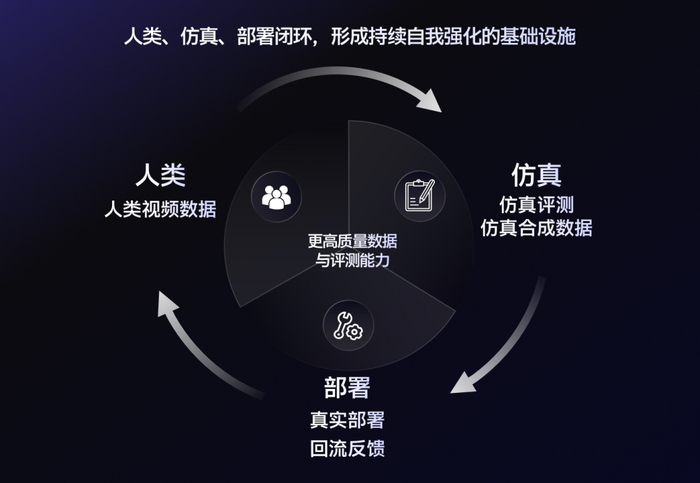
For top clients, choosing Lightwheel Intelligent is not just because it can deliver high-quality data but because this data comes from a set of continuously validated and improved infrastructure. Data quality, evaluation standards, and feedback closed loops are becoming the new core resources of the physical AI era. What Lightwheel Intelligent is doing is transforming these foundational capabilities from project-based delivery to infrastructure that can be repeatedly called upon, continuously evolved, and support iteration across the entire industry. The ultimate goal of Lightwheel Intelligent's human, simulation, and deployment full closed loop is not quantity but quality; not one-time delivery but higher quality and continuously evolving physical AI infrastructure.
3. From infrastructure to rule layer:
Lightwheel Intelligent is defining international standards for physical AI data, simulation, and evaluation.
When data, simulation, and evaluation capabilities are frequently reused by various industry parties, their methods, interfaces, and evaluation systems will begin to solidify into common industry standards.
If infrastructure solves whether 'the industry can run', then standards resolve whether 'the industry can run further on the same underlying order'. The next stage of competition in embodied intelligence is evolving from the output of point technical capabilities to the definition of industry ecosystem standards.
For physical AI to achieve industrial scaling, the industry must answer a series of foundational questions: How to define high-quality data? How to define high-quality simulation? How to define high-quality evaluation? How should models be trained, validated, and deployed, and how should deployment feedback re-enter the training system for continuous improvement?
Whoever can deeply engage in defining these issues will have a better chance of occupying a key position in the next stage of industrial evolution. Lightwheel Intelligent is participating in the construction of these foundational standards from three dimensions.
First, data quality standards.
For top model teams, what really matters is not 'more data' but scalable high-quality data; only high-quality data can continuously translate into improved model capabilities.
For Lightwheel Intelligent, high-quality data does not rely solely on collection but is formed in its 'internal and external dual-loop system': the outer layer is formed by human data, simulation evaluation, and deployment feedback, while the inner layer is a full-stack self-research simulation platform that integrates 'solving-measuring-generating'; thus, data quality is not only dependent on one-time collection or manual quality inspections, but can also be continuously verified and improved in generation, training, evaluation, deployment, and feedback.
This closed-loop capability directly translates into a core indicator—'data resale rate' (i.e., how many different clients can a unit hour of Lightwheel data be sold to). A high-quality dataset can continuously circulate and generate higher value across different clients, model stages, and task systems. The higher this indicator, the more stable the data quality, the stronger Lightwheel Intelligent's ability to define data, and the higher the quality and customer acceptance.
Yang Haibo, co-founder and president of Lightwheel Intelligent, introduced that in high-quality scenarios, the resale rate of its data has already exceeded 10 times. This indicator not only verifies the stability and customer acceptance of its data but is also one of the underlying supports for its new orders of 550 million yuan in the first quarter of 2026.
Second, simulation standards.
In 2026, Lightwheel Intelligent accepted a joint invitation from Google Deepmind, NVIDIA, and Disney Research to join the open-source GPU accelerated physics engine Newton as a core advisory member. Lightwheel Intelligent will play a leading role in key embodied simulation technology directions and work with NVIDIA, Google DeepMind, Disney Research, and the Toyota Research Institute to promote the next generation of open-source physical AI simulation standards.
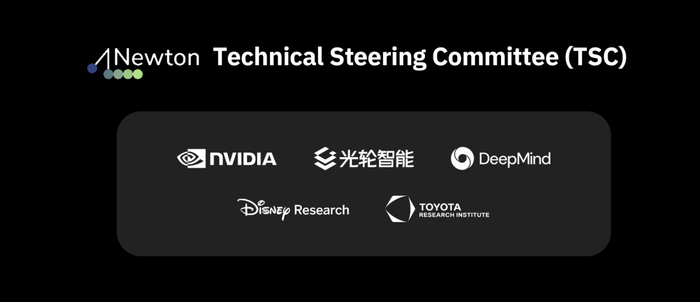
The emergence of Newton TSC marks the unification of global physical AI simulation infrastructure. In the past, GPU parallel computing, high-precision contact dynamics, complex mechanism solving, robotic learning ecology, and industrial-level verification have long been dispersed across different systems. Newton places these capabilities into the same open architecture, defining how the next generation of simulation systems should be designed, evolved, and adopted by global developers and industry scenarios.
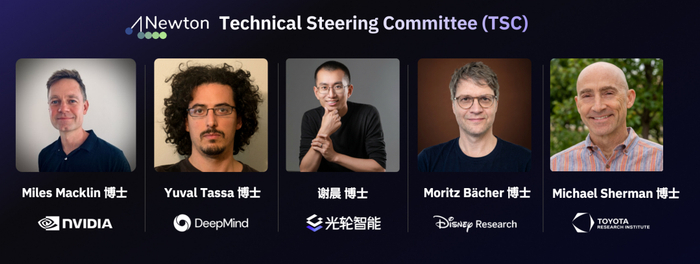
Among the five top simulation experts in Newton TSC, Dr. Miles Macklin, Dr. Yuval Tassa, Dr. Xie Chen, Dr. Moritz B?cher, and Dr. Michael Sherman respectively represent global core technical paths such as Warp simulation, MuJoCo simulation, SimReady defined based on the 'three-in-one', Kamino simulation, and Drake simulation.
Lightwheel Intelligent's entry into Newton means it is no longer just a participant in the global simulation ecosystem but is beginning to engage in the co-construction of rules for the next generation of physical AI simulation infrastructure. Meanwhile, in terms of the implementation of simulation infrastructure, Lightwheel Intelligent is also cooperating with Mo Er Threads on computing power, simulation platforms, and data evaluation capabilities to jointly create a domestically developed simulation synthetic data solution, deeply integrating domestic computing power and simulation to solidify the autonomous and controllable infrastructure for the development of embodied intelligence.
Third, evaluation standards.
In the evaluation ecosystem, Lightwheel Intelligent is jointly promoting the construction of evaluation frameworks such as Isaac Lab-Arena with NVIDIA, and its self-developed LeIsaac simulation platform has been included in Hugging Face's official documentation; ongoing evaluations and world generation collaborations are being carried out with leading global teams such as Tongyi Qianwen and World Labs; the core of these collaborations is not just co-building projects but pushing evaluations towards reproducible, comparable, and scalable industry standards.
At the level of standard organizations and testing evaluation systems, Lightwheel Intelligent has become the only private enterprise in the national first batch of embodied intelligence action plans in the data field, participating in the construction of high-quality datasets and the improvement of embodied intelligence data infrastructure, and jointly promoting standard system construction with the National Standardization Committee and relevant committees of the Ministry of Industry and Information Technology.
As of now, Lightwheel Intelligent has led or participated in the formulation of 20 relevant national and industry standards, covering key areas such as data quality, simulation platforms, and high-quality industrial datasets. Meanwhile, it has also cooperated with the National Robot Testing and Evaluation Center (headquarters) to jointly promote the construction of key infrastructure and industrial testing evaluation standards for embodied intelligence.
Lightwheel's role is changing. It is not just delivering data and evaluations to clients but is continuously solidifying its data quality, simulation capabilities, evaluation systems, and industry experience into common standards for the industry.
4. Data is not fuel:
Lightwheel Intelligent aims to create an educational system for physical AI.
As embodied intelligence moves from the lab to the real world, a fundamental question begins to emerge: How should robots learn?
Human cognition acquisition is a long-term, ongoing process. From basic education, higher education to lifelong learning, individuals not only need to absorb knowledge but also go through repeated attempts, iterations, and feedback and challenges from the outside.
Robots understanding the physical world also need to undergo such a process. This is the foundational logic of Lightwheel Intelligent: it is building a system to teach robots to learn continuously. Using human data to provide real demonstrations, providing a training environment through the simulation world, judging capability boundaries with the evaluation system, and then bringing new feedback back to the next round of training through real deployment.

This also explains why Lightwheel Intelligent's founder and CEO, Xie Chen, does not wish to view data simply as fuel.
Fuel is a consumable; the core lies in supply, price, and efficiency; education is a system engineering; at its essence, it is about learning, feedback, and evolution. Fuel answers 'Can machines run?', while education answers 'Can robots form cognition and continue to evolve?'. Ultimately, the ability to continuously learn will determine the long-term ceiling of robotic capabilities.
For this reason, Lightwheel Intelligent chooses to engage in both human data, simulation evaluation, and deployment feedback. Because true education must start with the end in mind, based on the real world that 'students' ultimately need to enter. Real industrial scenarios define the capabilities robots must have in the future, which in turn defines what they should learn today. Lightwheel places great emphasis on quality, feedback, review, and continuous improvement. Only in this way can it build a set of educational systems for physical AI. It tests not only the company's delivery capabilities but also its engineering reverence for technical capabilities, quality assurance, feedback mechanisms, and continuous improvement.
This is precisely the deep reason behind Lightwheel Intelligent's valuation doubling in the short term, refreshing the global valuation record again. Over the past decade, NVIDIA entered the heart of the AI industry because it defined and supported the computational infrastructure of the large model era; while Lightwheel Intelligent, not only due to its leading product technology capabilities and commercial landing capabilities, but mainly because it defined the data and evaluation infrastructure of the physical AI era.
Lightwheel has chosen a longer-term, more foundational, and closer path to the ultimate fate of the physical AI industry. With the opening of the year of scaling embodied intelligence in 2026, the value center of physical AI is also shifting further from models and entities to data, evaluation, and continuous learning infrastructure. Lightwheel Intelligent is taking an increasingly core position in this industrial paradigm shift.