
You can't manage what you can't measure. @OpenLedger measures everything and blockchain never forgets.
I spent last week talking to a compliance officer at a financial firm, and she said something that stuck: "We use AI models to make decisions on credit, loans, people's lives. When I ask vendors how they work, I get a PowerPoint and a promise." That's where we actually are with AI oversight. We built systems that influence billions in decisions. The auditing mechanisms haven't caught up.
The problem isn't that regulators don't care. It's that they can't verify what they're supposed to oversee. A model developer can tell you their AI is fair, explainable, unbiased. But how do you check? You'd need access to training data, the exact weights at each stage, every preprocessing decision, the validation metrics under different conditions. Most companies won't share that. Some can't the data might be sensitive. Others don't have the infrastructure to surface it. The result is a trust gap measured in billions of dollars and impossible to quantify.
The EU's AI Act requires companies to prove their models are compliant. They're asking for transparency that doesn't exist yet at scale. When I looked at the regulatory landscape, what struck me was how concrete the demand had become. This isn't philosophical anymore. Regulators are asking specific questions: Can you prove the training data wasn't biased? Can you show us when the model's performance degraded? Can you trace every decision back to its inputs? The answer from most AI teams is still no.
Blockchain matters here in a way it didn't before. It doesn't make AI more accurate or faster. What it does is create an audit trail that can't be rewritten. Every training step, every data sample, every validation check gets recorded with a timestamp. A regulator, an auditor, a third party can verify it independently. It's not theater. It's the foundation.
Think about model training. You start with data. It gets cleaned, normalized, maybe augmented. Features get selected. The model trains over thousands of iterations. Weights shift. Metrics get recorded. Then validation. Then deployment. At any point, something can introduce bias, reduce fairness, or hide flaws. Regulators want one thing: proof that none of that happened in ways that matter.
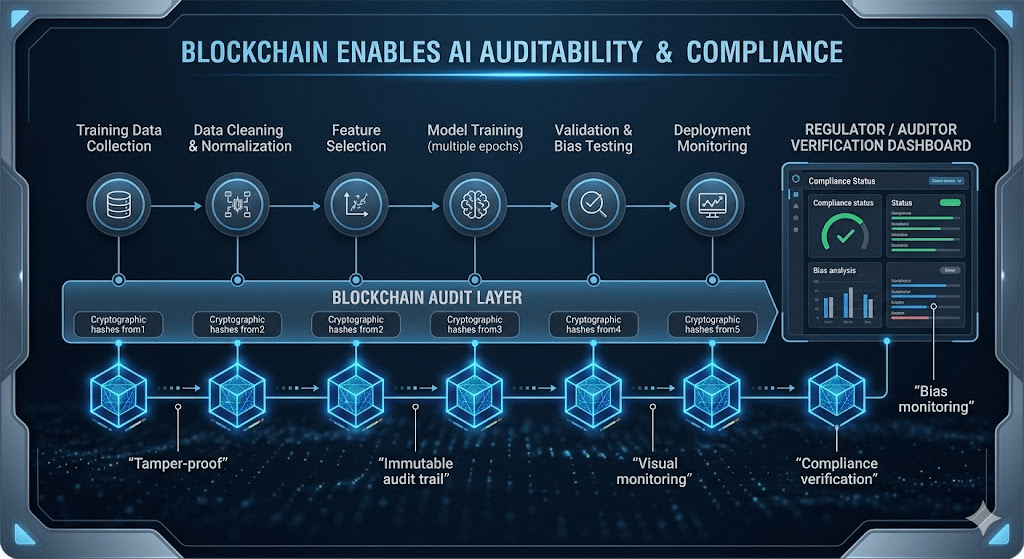
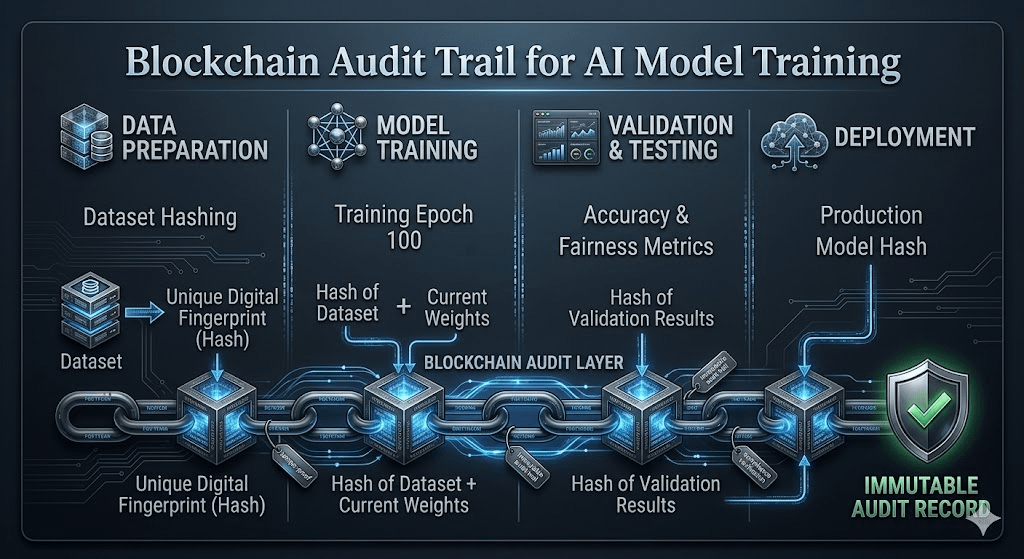
A blockchain audit trail records cryptographic hashes (digital fingerprints) at each stage. You hash the training dataset. You hash the model weights after each epoch. You hash the validation results. Each hash links to the previous one. The chain is tamper-evident. If someone changes the training data or edits performance metrics afterward, the chain breaks. A regulator looking at your ledger sees it immediately.
The difference from a database is decentralization. If you keep audit records in your own system, you control them. A regulator has to trust your infrastructure, your security, your motives. With blockchain, the company doesn't own the record. It's distributed across a network. Multiple parties verify the same chain independently. That matters.
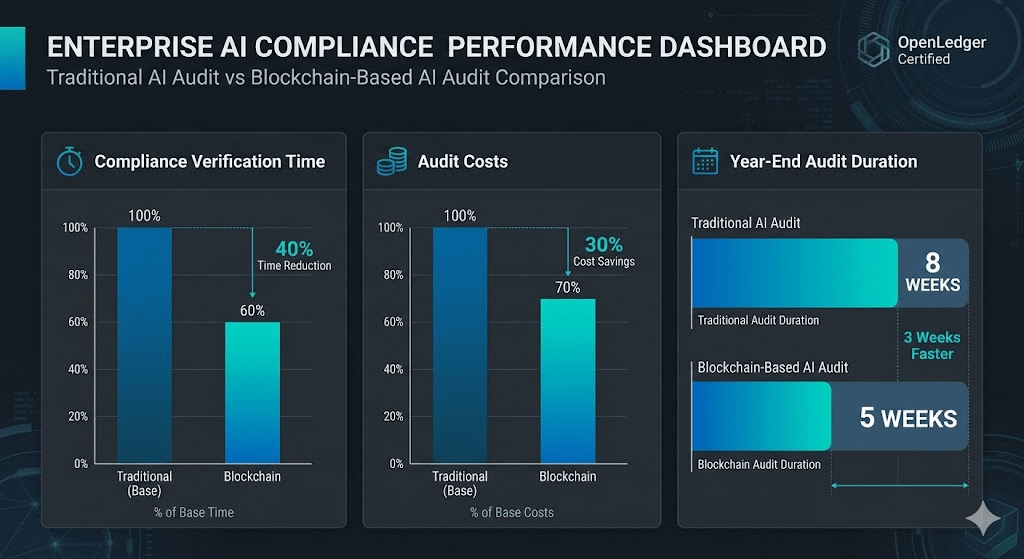
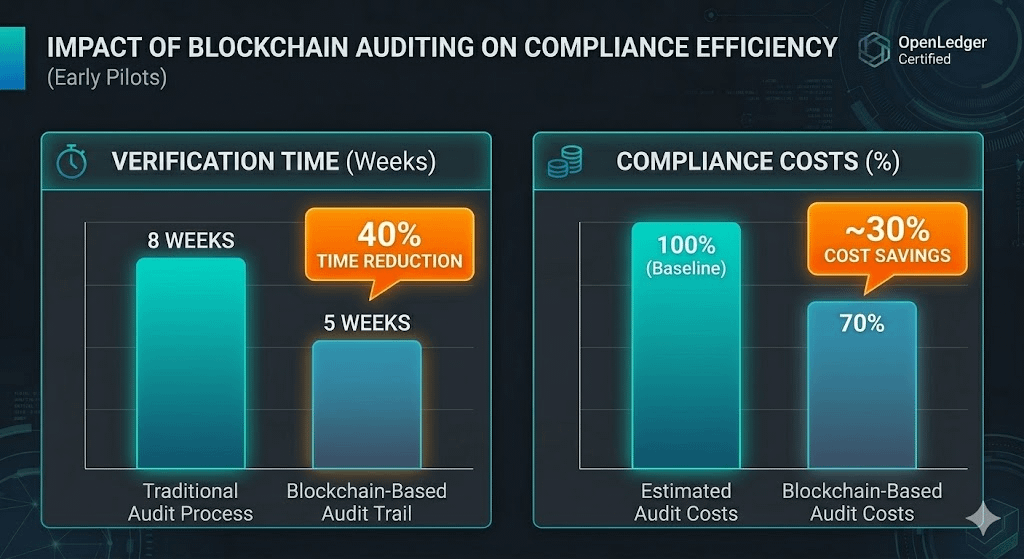
The numbers on this are real. Early pilots in financial services show blockchain-based audit records cut compliance verification time by about 40 percent and audit costs by roughly 30 percent. Why? Auditors don't have to request data, wait for responses, validate formats, cross-check sources manually. The chain provides everything in a format that's already verified. One institution cut their year-end audit from 8 weeks to 5
Real friction shows up when you try to record something actually useful. Raw model weights are enormous. A language model has billions of parameters. You can't hash and store all that on-chain. So you hash compressed representations. You store the data separately and record the hashes. The system is only as trustworthy as the hash function and the storage where the artifacts live. Better than nothing. Not perfect.
Another pressure is building. As AI gets woven into hiring, credit, healthcare, the legal liability for bad outcomes rises. If a model makes biased decisions and gets sued, the company needs to prove it took reasonable steps to audit and validate. Courts will start asking whether companies kept verifiable audit trails. In that environment, a blockchain record becomes defensible. Not having one becomes risky.
Good infrastructure doesn't announce itself. Specialized platforms are emerging to handle the specific requirements. They build abstractions so data scientists don't think about blockchain mechanics. You push model artifacts and metrics into an API. It handles the hashing, the chain, the verification. The developer experience feels normal. Underneath, every step is recorded and verified.
What's changing is the texture of trust. Not a sudden flip to total transparency. A shift toward steady, earned accountability through verifiable records. Regulators see better visibility. Companies get legal cover. Auditors work faster. The record is immutable and distributed, so the system becomes harder to game.
There are counterarguments worth taking seriously. A company that wants to hide something can do it upstream. Don't record certain steps. Manipulate the data before it gets hashed. Keep multiple versions of training runs and submit only the favorable one. Blockchain doesn't solve human dishonesty. It makes dishonesty harder to hide at scale. That matters. It's not absolute protection.
The other risk is immutability itself. If you record something and it turns out wrong, you can't erase it. You're permanently documenting every mistake, every failed experiment, every model that didn't work. Some companies won't want that level of transparency, especially early when many experiments fail.
The momentum is real though. Enterprises are moving because regulators are pushing, liability is rising, and the cost of audit trails is dropping. The question isn't whether blockchain-based AI auditing happens. It's whether it becomes default or stays a compliance tool for premium clients.
Here's what stays with me: We built AI faster than the mechanisms to oversee it. For years that was fine because the stakes felt abstract. Now they're concrete. Hiring decisions. Credit decisions. Healthcare outcomes. The gap between what we can build and what we can verify has become a liability. Blockchain-based audit trails don't close that gap entirely. But they shift the economics. They make transparency cheaper than opacity.
That's the quiet revolution. Not a technology that makes AI better. A technology that makes it verifiable. In a world where trust is the constraint, that's enough.
@OpenLedger $OPEN #OpenLedger