
In the indicators on the necklace that measures market sentiment, PSIP (Profit Supply Percentage) has always been regarded as an important benchmark for observing investor optimism and panic. We previously mentioned that when the 7-day moving average of PSIP falls below 70%, it often means the market has completed the initial pressure of the bear phase following the bull phase and may welcome a technical rebound after a passive release of sentiment.
However, from recent discussions, it seems that investors are no longer focusing on short-term rebounds but rather concentrating on a more critical question: If PSIP falls below the 50% deep bear threshold, where will the Bitcoin price approximately be? This is also the most attractive layout phase in the history of major cycles.
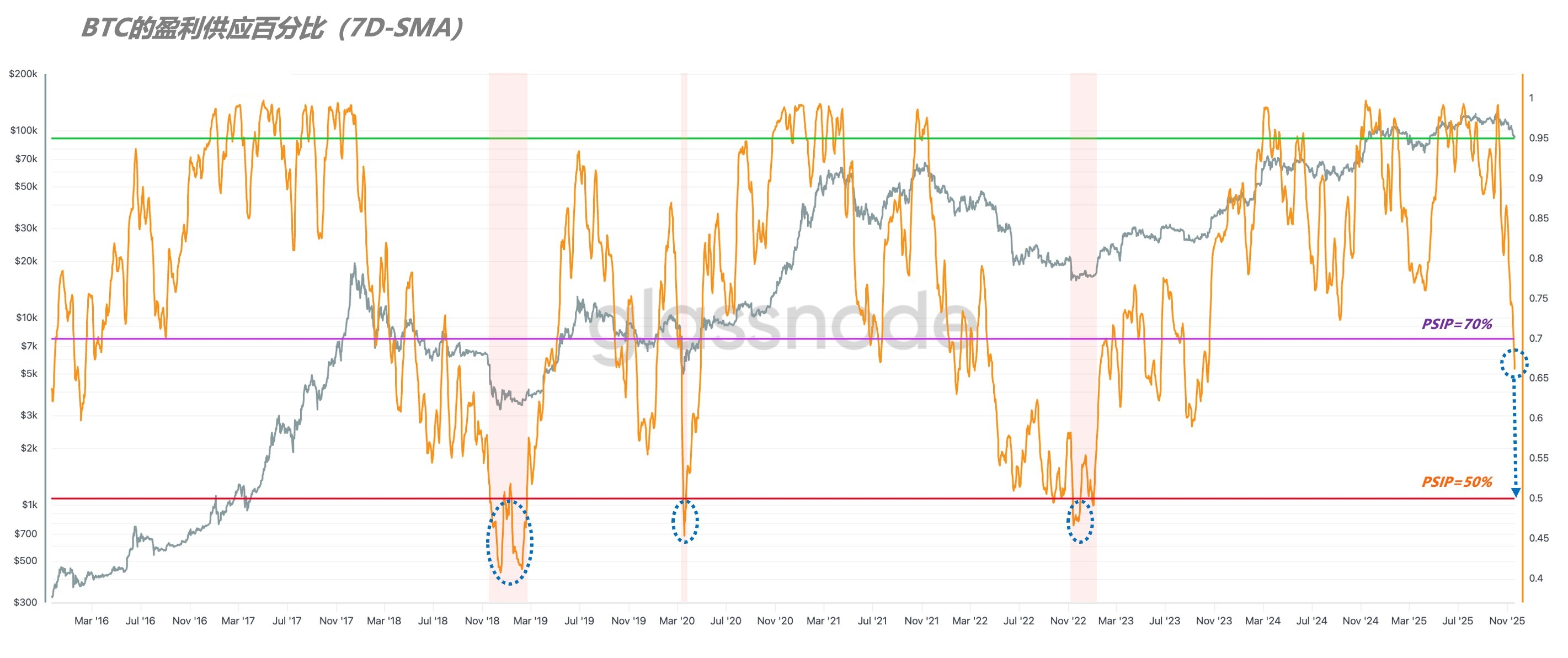
(Figure 1)
The chart shows that when PSIP is below 50%, it often means that profit-taking has been fully squeezed, and market sentiment has entered a deeply pessimistic zone. These time points almost correspond to highly cost-effective long-term buying opportunities.
Prices that cannot be backtracked, but a rough range can be speculated.
Theoretically, the Bitcoin price corresponding to PSIP cannot be backtracked statically. The reason is that during the price decline, the active selling of low-cost chips continuously changes the ratio of profit to loss, making the change in PSIP a dynamic process. However, if we conduct a scenario simulation in a static manner, we can still derive a rough range for reference.
Currently, the price of Bitcoin is approximately 92,000 USD. According to URPD data, there are about 6.7 million Bitcoins in a loss position to the right of this price, accounting for about 33% of the circulation. Assuming that low zone chips do not sell at all during the decline, if the price falls back to 59,000 USD, approximately 9.744 million Bitcoins will enter the loss zone, corresponding to a PSIP drop to about 50%.
A more realistic situation: a deep bear zone may appear ahead of time.
Of course, the above scenario is overly idealistic. In the real market, once prices fall, low-cost chips will also face panic selling, causing the number of loss-making chips to continue to rise.
Therefore, a more likely scenario is:
When Bitcoin falls into the 60,000-70,000 USD range, PSIP has already touched around 50%, and the market subsequently enters a deep bear phase.
From a long-term perspective, if the price of Bitcoin indeed falls into this range, then both from the profit-loss ratio and historical win rate, it will have extremely high strategic allocation value. In other words, investors expect to make large position layouts in the 60,000-70,000 USD range, and this strategy is almost impeccable from a data logic standpoint.#加密市场回调