


#openledger $OPEN
Feeling bullish on OpenLedger right now…
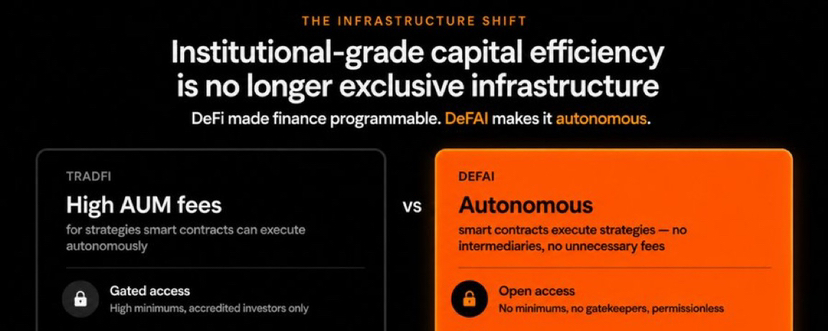
* TradFi built trillion-dollar businesses around charging AUM fees just to manage capital strategies.
Now smart contracts can execute those same strategies autonomously on-chain.
The intermediary era is getting replaced in real time.
For decades, access to sophisticated yield strategies was locked behind institutions.
You needed:
• fund managers
• private banking relationships
• large capital
• trust in centralized operators
Retail users were mostly exit liquidity while institutions captured the best opportunities first.
Then DeFi changed the foundation.
Capital became programmable.
Instead of relying on paperwork, brokers, and slow banking rails, liquidity could move through transparent smart contracts.
Yield generation became composable, permissionless, and global.
Anyone with a wallet could participate.
But DeFi still had friction.
Users still needed to:
• manually bridge assets
• monitor APYs
• rebalance positions
• manage risk exposure
• optimize across protocols
The infrastructure became open, but the execution layer still required expertise and constant attention.
That’s where DeFAI enters.
DeFAI is not just “AI + crypto.”
It’s the evolution from programmable finance to self-executing finance.
Instead of users actively managing strategies, intelligent on-chain systems can now:
• allocate capital
• rebalance automatically
• optimize yield routes
• react to market conditions
• manage risk parameters in real time
Without relying on traditional fund managers.
TradFi monetized information asymmetry.
DeFAI compresses that edge.
The same institutional-grade strategies once hidden behind hedge funds and wealth management firms are becoming open infrastructure accessible to anyone.
No minimum net worth.
No gatekeepers.
No geographic restrictions.
Just transparent execution on-chain.
This changes the economics of finance completely.
If autonomous systems can optimize yield more efficiently than human-managed funds, then high AUM fees become harder to justify.
Why pay massive management fees for slow execution when autonomous protocols can operate 24/7 with transparent logic?
The value stack shifts from:
“who controls access”
to
“who builds the best infrastructure.”
And this is bigger than yield farming.
Self-executing capital opens the door for:
• autonomous treasury management
• AI-driven market making
• intelligent liquidity routing
• automated hedging systems
• dynamic collateral management
• fully autonomous on-chain funds
Finance starts behaving more like software than institutions.
The most important part?
Open infrastructure compounds faster than closed systems.
Every new protocol, liquidity layer, oracle, and AI coordination framework strengthens the entire ecosystem.
TradFi scales through permission.
DeFi scales through composability.
DeFAI scales through autonomous coordination.
We’re moving from:
• manual finance
→ programmable finance
→ autonomous finance
That transition will redefine how capital moves globally.
The biggest shift isn’t just decentralization.
It’s removing the dependency on intermediaries altogether.
The future of finance may not be banks managing users.
It may be autonomous systems managing capital transparently on-chain while humans simply define goals and risk preferences.
Institutional-grade execution is becoming a public good.
And most people still haven’t realized how massive that shift is.