

Warning. Binance products are limited to certain countries and to certain users. This content is not intended for restricted users/countries.
Main conclusions:
Options are often used as a hedge against adverse price movements in an underlying asset.
When trading options, you need to take into account several parameters that affect the price of an option.
Time to expiration, price of the underlying asset, and price volatility are the three main variables an options trader should consider.
Options trading can sometimes be intimidating for traders, especially beginners. The seemingly complex mechanisms and jargon make this area inaccessible to many retail investors. In addition to knowing the technical aspects of trading, options traders must understand how certain parameters affect option prices.

The variables traders face when trading options are different from those involved in trading the futures and spot markets. There are three main variables that are important to an options trader: time to expiration, price of the underlying asset, and price volatility.
1. Time until expiration
Options are often used as a hedge against adverse price movements in an underlying asset and can be considered a form of insurance. As with all types of insurance, you either pay a one-time premium or make regular payments. Insurance premiums are based on several factors such as duration of coverage, health risk of the insured and others. In this regard, options are structured similarly.
In the options market, there are various predetermined contract expiration dates, and these expiration dates directly affect the option premium. For example, a 1-day call option on BTC would cost around 150 USDT, while a 1-week call option on BTC might cost 1,000 USDT. In other words, the longer the duration, the higher the price.
On Binance Options you can find options with expiration dates of the day, week, month or quarter.
2. Underlying asset price and execution price
The second parameter that affects the price of an option is the price of its underlying asset and the strike price or exercise price. The relationship between these two prices directly affects the option premium.
For example, when the price of BTC rises, BTC call options should increase in value, and conversely, BTC put options should decrease in value. Likewise, if the price of BTC falls, the value of put options will increase, and the value of call options will decrease.
This relationship between an option's strike price and the current price of its underlying asset is also known as “moneyness.” In options trading, terms such as in-the-money, out-of-the-money, and at-the-money are used to refer to the moneyness of options.
For example, a call option is a loss-maker if its strike price is higher than the price of the underlying asset. Conversely, a call option is profitable if its strike price is lower than the price of the underlying asset. A zero option is one whose strike price is the same as the price of its underlying asset.
For clarity, let’s imagine that the price of Bitcoin is $7,000. The monetary value of the BTC option will be determined as follows:
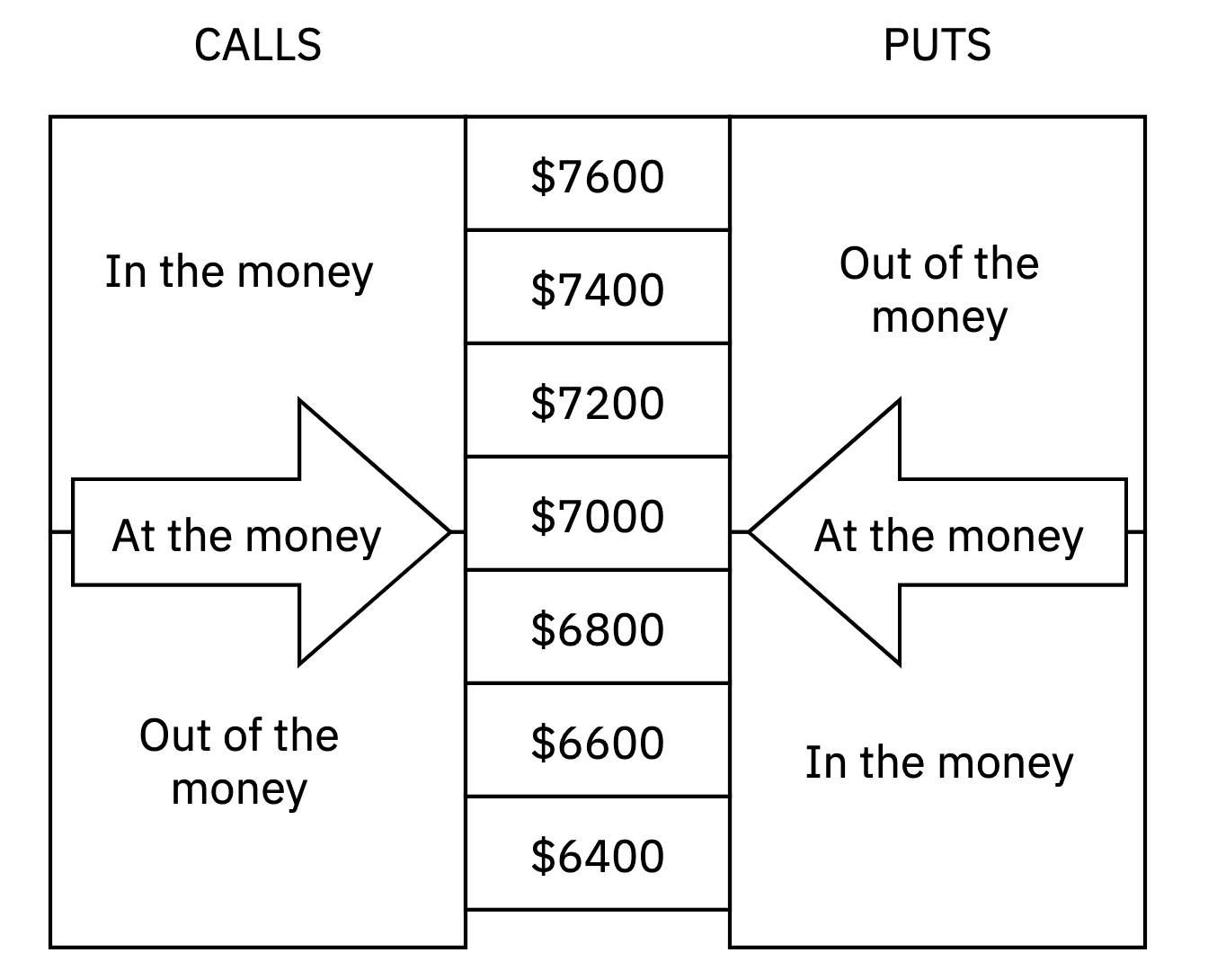
The option premium depends on the value of the contract. A losing call option is priced cheaper than a winning call option or a call option because it has the potential to be worthless at expiration. Obviously, the most expensive option is the profit option.
3. Volatility
The third factor that influences option pricing is volatility, or the amount of fluctuation in the price of the underlying asset. The higher the volatility, the greater the price fluctuations, and, accordingly, the higher the risk for the investor who owns the underlying asset.
Volatility plays an important role in option pricing. If there is higher risk involved, options will be more expensive because option sellers will demand a larger premium as insurance.
During periods when the price of an asset exhibits high volatility, the corresponding options will be expensive. Conversely, options will be cheap, or at least less expensive, if the underlying asset exhibits low price volatility.
Conclusion
While options are complex financial instruments, the variables that affect their price are generally well known and relatively simple. Perhaps the only exception is volatility, which is not so easy to estimate. But once you understand the basic principles of pricing, you will find that options are quite versatile and can serve as a hedge against adverse price movements.
For more information on options trading on Binance, check out the following articles:
(Blog) Cryptocurrency futures and options: how are they different?
(Blog) How to start trading options on Binance
(Support) Binance Futures Products and Features Overview
(FAQ) What is Binance Options
...and other frequently asked questions about Binance Futures.

Risk warning. Digital asset prices may be volatile. The value of the funds invested may go up and down. You may not get your invested funds back. You are solely responsible for your investment decisions. Binance is not responsible for your possible losses. Futures trading in particular is subject to high market risk and price volatility. If there is a sudden price change, there is a chance that your entire margin balance will be liquidated. Past performance is no guarantee of future performance. Before entering into a transaction, you should make an independent assessment of the appropriateness of the transaction, taking into account your own objectives and circumstances, including the risks and potential rewards. If necessary, contact your advisor. This information should not be considered financial or investment advice. Find out more about how to protect yourself in the Responsible Trading section. Additional information is available in the Terms of Use and Risk Disclosure.