


It's not that I'm enthusiastic about cryptocurrency trading, but rather about making money, about striving to improve the living standards of myself and my family!
There are only a few ways to make money in this world:
1. Starting a company during a time of overcapacity, overshadowed by a pandemic, and rampant competition is akin to seeking death.
2. Starting a small food stall as an individual seller is possible, but good locations are hard to rent, and poor locations have no business, the street.
Being a mobile vendor is possible, but are you sure you can handle the days of eating outdoors and living with grease all over you?
3. The self-media entrepreneurship is fiercely competitive, with more self-media vying for attention than there is attention to be had. While those big influencers may seem glamorous, the hardships behind the scenes are cold.
Only I know the truth. For example, I answer questions from the bottom of my heart, but I can't get a few perfunctory likes in return.
4. Going to work is certainly not a problem; it's like having a tall (boss) figure to shield you from a crisis. However, working only provides you with a salary and can only give you financial security.
Rich? I can't give that. Of course, if you're a tech expert, highly educated, or a top salesperson, then it's possible.
However, 99% of the world's population is not like that.
In 2017, I had just entered the cryptocurrency world. A friend took me to the Web3* Summit, saying a big shot would be there. I initially wanted to observe discreetly, but seeing his...
Leng Zhenyan, however, gritted his teeth and tried to talk. After a few rounds of drinks, he finally opened up.
2012: Earning my first pot of gold through arbitrage trading.
Initially, he was a complete novice. He heard from a friend that "Bitcoin can make money," so he started arbitrage trading. At that time, the price of BTC existed both domestically and internationally.
He initially relied on buying low and selling high, multiplying his initial investment several times over in just a few months. However, the market is volatile, arbitrage opportunities rapidly shrank, and tightening policies forced him to exit the market.
The 2013 crash made it one of the companies that got fleeced.
"Back then, I thought Bitcoin would only go up," he said with a wry smile. A crash in 2013 halved his assets in an instant. Disillusioned with the market, he sold off his holdings at a loss and switched to other businesses.
He returned to the cryptocurrency market in 2017 and doubled his wealth.
Years later, his friend excitedly told him, "The BTC you sold is now worth 100,000 each." This time, he decided to stop being a speculator.
Instead, he delved into the industry, researching blockchain, participating in primary market investments, and accurately betting on several DeFi+ projects, ultimately profiting during the 2018 bear market.
He successfully cashed out before the market opened, earning a nine-figure sum.
Social mobility requires courage and choice.
After that dinner, he became my boss and brought me into Web3.
Looking back, if I hadn't proactively learned how to talk, I might have missed this opportunity. Many people get stage fright when facing industry leaders, but...
Upward socializing is not about ingratiating yourself, but about daring to speak up and show your value.
Web3 is a world of both opportunities and risks. By proactively seizing every opportunity, you may be able to rewrite your own story.
After the bull market ended in 2021, my account balance was approximately 20 million RMB.
I put down 4 million yuan as a down payment to buy a house in Shenzhen (I transferred my household registration to Shenzhen after graduation, and after paying social security for three years, I was eligible to buy a house), 2 million yuan worth of units.
Currently used for daily expenses, the remaining 6 million is left in the exchange.
To summarize my strengths:
1. Have a good mentor or senior to guide you!
2. The principal is relatively large, with a continuous cash flow to replenish it.
3. Appropriate entry timing and actual exit points.
4. Only trade when there is high certainty, reducing the frequency of trades.
Making money in the currency market involves trading within cycles. Factors such as entry timing, entry and exit points, project selection, position sizing, and principal all affect your profitability.
Today, I'm sharing some valuable tips, which are worth 60 million. I hope they can help you.
Many people who trade contracts choose to use their entire capital from the start, for a simple reason: to withstand volatility and avoid being liquidated.
The problem is that going all in is not a shield for misusing your position size.
If you were to go all in with 10x leverage, and a market downturn occurred, you wouldn't just lose less; you'd wipe out your entire account.
I've seen many people who think going all-in is safe, and once they have 5,000 in their account, they dare to bet 4,800 USDT at once to gamble on short-term trades.
As a result, the entire account was liquidated shortly afterward, without even a moment to react.
You need to understand that going all in is to give you a little more breathing room, not a reason to risk your life for market volatility.
With the same 10x leverage, some people cut their losses and retreat after a small loss, while others stubbornly hold on to their accounts until they are wiped out.
Why? The difference lies in position allocation.
For a simple example:
If you have $1000 in your account, and you only use $100 to open a 50x leverage position, even if you make a mistake, you can stop the loss in time. The rest of your money can still be saved.
But if you directly deposit 900U, even if you only use 10x leverage, a market fluctuation could wipe out your entire account.
So stop asking about the safety of leverage; you should be thinking about how much capital you used in this trade, whether you set a stop-loss order, and whether you can afford to lose if you go against the trend.
I still use full margin trading when I trade contracts, but there are a few strict rules:
Each order shall not exceed 20% of the total account balance.
• Set a stop-loss order and limit losses to no more than 3% of your principal.
• Avoid reckless trading in volatile areas and do not increase your positions due to momentary emotional impulses.
If you want to survive in a contract, you don't do it by avoiding risk, but by managing risk.
Going all in doesn't mean you have to go all in at once, but rather that you have more flexibility to deal with volatility.
What you lack is not effort, nor opportunity, but someone who can help you consistently profit in this market.
If your account is currently stagnant and you're hesitant to trade, it means you haven't found a trading style that truly suits you. The market is still...
Go on, the space is still opening up, the only thing missing might be whether you have someone by your side who can help you stay calm and collected.
If you're tired of stuck in the same place, it's time to talk. Not everyone can go from 15,000 to 120,000, but if you dare to take that step, I can help you try.
Welcome like-minded people in the crypto community to discuss this together!
There's a very simple way to trade cryptocurrencies that will keep you "profiting forever."
First, step 1: Add the coins that have appeared on the gainers list within the last 11 days to your watchlist. However, please note that coins that have experienced a drop of more than three days need to be sorted out.
Except, so that the capital can escape.
Step 2: Open the candlestick chart and only look at the individual coins with a monthly MACD golden cross.
Step 3: Open the daily candlestick chart. Here, we only look at the 60-day moving average. As long as the price pulls back to the vicinity of the 60-day moving average and a candlestick with increased volume appears...
From now on, I'll invest heavily. #Blockchain
Step 4: After entering the market, use the 60-day moving average as a standard. Hold the position when it's above the moving average and sell when it's below.
If you keep trading cryptocurrencies like this, earning a million is achievable.
First trick: The wealth code of three ten-fold coins
1. The math is simple: 10,000 × 10 = 100,000 → 100,000 × 10 = 1,000,000 → 1,000,000 × 10 = 10,000,000
2. Key points of practical operation:
Different strategies are needed for each stage (small funds require boldness to win, large funds require stability).
The hardest part isn't finding the coin, it's holding onto it after making five times the initial investment without selling.
Remember: 90% of the profits come from that final, frenzied surge.
The second tip: The correct way to roll over positions
The three core elements:
1. Wait: Only act after a sharp drop and subsequent sideways movement; get on board immediately when the price breaks out.
2. Stability: Always use only 10% of your capital; 10x leverage equals 1x actual risk.
3. Ruthless: Immediately use profits to add to positions; a 50% market move can yield a 20-fold return.
Pitfalls you must know:
• Stop-loss orders should be executed like a machine (cut losses immediately when the price drops to 2%).
Never short sell during a bull market (it's like giving money to the big players).
Big money comes from waiting, not from frequent trading.
My practical experience:
Last year, I used a principal of 50,000:
Earned 200,000 in the first wave of the market within 3 weeks.
The second wave of the market surged to 1 million in two months.
Secrets to success:
95% of the time is spent waiting
·5% of the time for a full-force attack
People are still making money from cryptocurrencies. Once they have an epiphany about cryptocurrency trading, it's like they've been given a cheat code!
Here's a trading strategy I've found to be very effective recently, with a 90% win rate! I started with 200,000 at the end of last year and it's now 20 million – easy money!
Easily achieve 100x profits (suitable for everyone)
I've summarized the essence of the "Pyramid" averaging-down trading method. If you master it, using this method to trade cryptocurrencies will guarantee your account balance.
30 times! Today I've specially compiled some valuable information to share with those who have green cards. Please save this!
You may have heard of the pyramiding trading strategy, which can double or even triple your profits in a single trade.
Of course, improper use of this strategy can also lead to the risk of liquidation.
This is the topic I want to share with you today: how to use this strategy to increase potential profits.
For those new to this strategy, it's essential to first understand its principles and then explore how to incorporate it into your own trading style.
What is pyramid averaging?
Pyramiding refers to adding funds to a profitable position. If the market moves in the direction of your trade, it indicates that your trade has been profitable.
The decision was correct; the pyramid averaging strategy is well-suited to this timing, helping to further increase profit potential while reducing risk.
Dangerous passage.
This is also the most attractive part of pyramid averaging; if used properly, you don't even face any additional risk. In other words, when...
When a trade is in your favor, this strategy actually mitigates risk.
The following is the basic idea behind pyramid averaging:
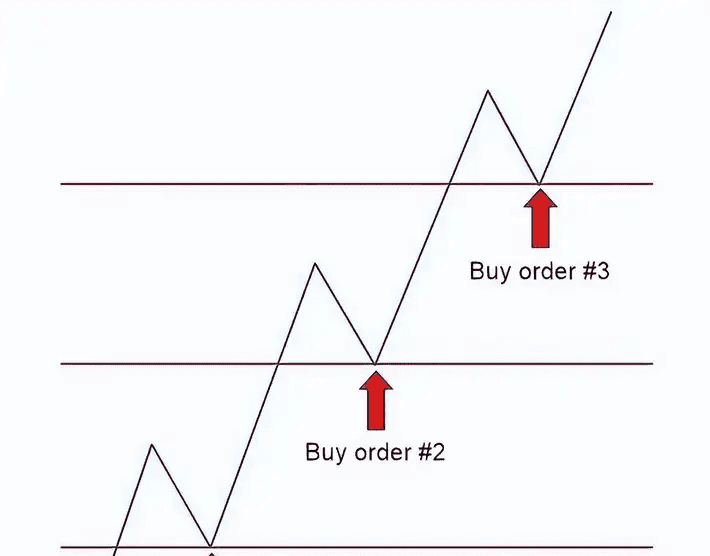
In the chart above, the market exhibits both higher highs and higher lows within a clear upward trend, forming a perfect stepped upward pattern.
It is ideal for adding funds to profitable positions.
The first time the market retests a former resistance level that has now become support, it presents an opportunity to place volume buy orders. Later, a second and third buy order appeared.
Single opportunity.
Remember that a strong market trend and a breakout of each key price level are important conditions for pyramiding positions.
Pyramid averaging strategy: How to double or even triple profits?
The key to successfully implementing pyramid averaging is maintaining a reasonable risk-reward ratio.
Your risk should never exceed half of the potential risk. For example, if your profit target is 200 points, your stop-loss must be less than 100 points.
The risk-reward ratio remains at 1:2.
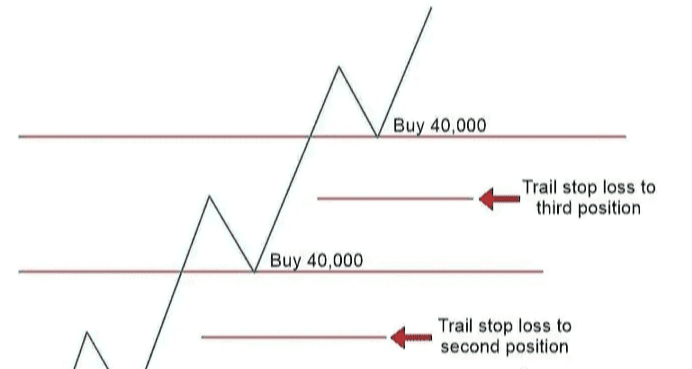
Assuming an account has $20,000, each time the price retests a key price level, we buy 40,000 units, or 4 mini lots.
Each position has a different profit target, but the stop loss is always only 100 points. Assuming the trend is consistently upward:
The market breaks through a resistance level and then retests it as a new support level. You find a bullish pinbar and buy.
40,000 units, the risk is 2%;
You decide to let the deal change naturally;
The market broke through the second resistance level and then retested it as a new support level.
You find that the market is still rising, so you decide to buy another 40,000 units and move your stop loss below the second position.
The market broke through the new resistance level for the third time and then retested it.
Because of the strong market momentum, you decide to buy another 40,000 units, still moving your stop loss to below the third position level.
So you've accumulated a significant position, and you find your risk has reached 120,000 units. But is that really the case? The position size is indeed...
Despite the large profit margin, the actual risk is not that high; the worst-case scenario is that you only make a 6% profit.
In the best-case scenario, you'd make a 24% profit. Is that even possible? Let me do the math and see.
The logic behind pyramid averaging down trading
Using the same example as above, but with the potential risks and profit scenarios marked for each instance:
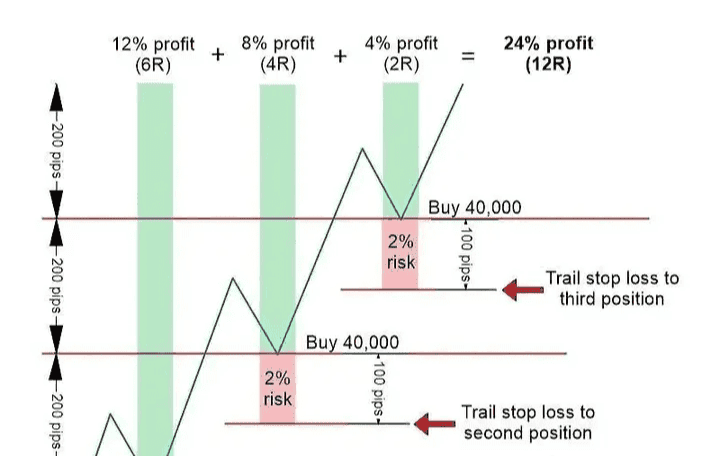
With a strong market rally, your first trade could yield up to 12% profit. Adding subsequent trades that increase your position further could further boost your gains.
Your profits can generate up to 24% of your earnings.
First order of 40,000 units:
The worst-case scenario is a loss of 2%.
The best-case scenario is a 12% profit.
The second order of 40,000 units:
The worst-case scenario is breaking even (a 2% profit on the first trade, but a 2% loss on the second trade).
The best-case scenario is a 20% profit (12% profit on the first trade, but 8% profit on the second trade).
The third and fourth transactions total 40,000 units:
The worst-case scenario is a 6% profit (6% profit on the first trade, 2% profit on the second trade, but a 2% loss on the third trade).
The best possible outcome is a 24% profit (12% profit on the first trade, 8% profit on the second trade, and 4% profit on the third trade).
The calculations above show that the worst-case scenario is a loss of 2%, while the best-case scenario is a profit of 24%.
牿浯
Pyramiding can be a very advantageous trading strategy. However, it's not without its drawbacks and shouldn't be overused. If you...
If you've already tried adding to your position multiple times in the past month, then you may not yet have fully grasped the opportunity to use it.
Every trading strategy has its applicable scenarios, and seizing such opportunities is key to success. Even if pyramid averaging is a good strategy,
However, you must not be too greedy when trading.
Here are some key points to remember when using pyramid averaging:
• Use the pyramid averaging strategy only in strongly trending markets.
Before entering a trade, be sure to define support and resistance levels.
Before entering the market, you should plan where to take profits and exit.
Who maintained a reasonable risk-reward ratio from beginning to end?
• After each additional position is added, a trailing stop-loss order is placed based on the new position size to mitigate risk.
Keep it simple; maintain a consistent size when adding to your position.
Don't be greedy; always stick to your trading plan.
How can individual investors survive in the market?
First, cryptocurrency trading requires understanding the market environment and overall market trends; you must abandon the mindset of focusing on individual coins rather than the overall market. Following the trend is key; you must understand...
You make money because the market is strong; you lose money because you're stubborn.
Don't hold or trade cryptocurrency 24/7, 365 days a year. Bull markets are okay, but bear markets are absolutely not. Go to cash when you should.
In terms of positions, hold cash when necessary and exit the market when appropriate, keeping pace with market trends. Focus on swing trading and trend following; avoid frequent chasing of highs and lows for short-term gains.
1. Buy
The timing of buying is crucial. Don't buy at the top or sell at the bottom; only intervene when the trend is established.
2. Sell
The timing of exiting is equally crucial. Don't be greedy for the last bit of profit, don't take chances, and take profits when you can.
3. Stop loss
Stop-loss is an art, not a ruthless one. Set a stop-loss point and strictly adhere to it to prevent small mistakes from becoming big ones.
4. Take profit
Taking profits is a wise move; it means not blindly chasing the highest point, but locking in profits in a timely manner once the expected return is achieved.
5. Patience
Patience is key. Avoid frequent trading, don't blindly follow trends, and wait for the best opportunity.
6. Discipline
Discipline is ironclad; one must not be swayed by emotions, must not deviate from the trading plan, and must adhere to the rules.
7. Information
Information is the wings; we pay attention to market dynamics, capture policy trends, and understand industry changes.
8. Mindset
Mindset is fundamental; do not be elated or saddened by temporary rises and falls, but remain calm and rational.
9. Learning
Learning is the source; we must continuously enrich ourselves, improve our analytical skills, and adapt to market changes.
10. Risk Control
Risk control is paramount. Do not borrow money to speculate on cryptocurrencies, do not heavily invest in a single currency, and diversify your risk.
In the crypto world, it's essentially a battle between retail investors and market makers. If you lack cutting-edge information and firsthand data, you'll only get fleeced! If you're interested in investing together and profiting from the market makers, contact me! Follow Lao Wang for live trading sessions, real-time learning, and clear market direction and strategies. Knowing the market's style in advance gives you time to better manage it!