
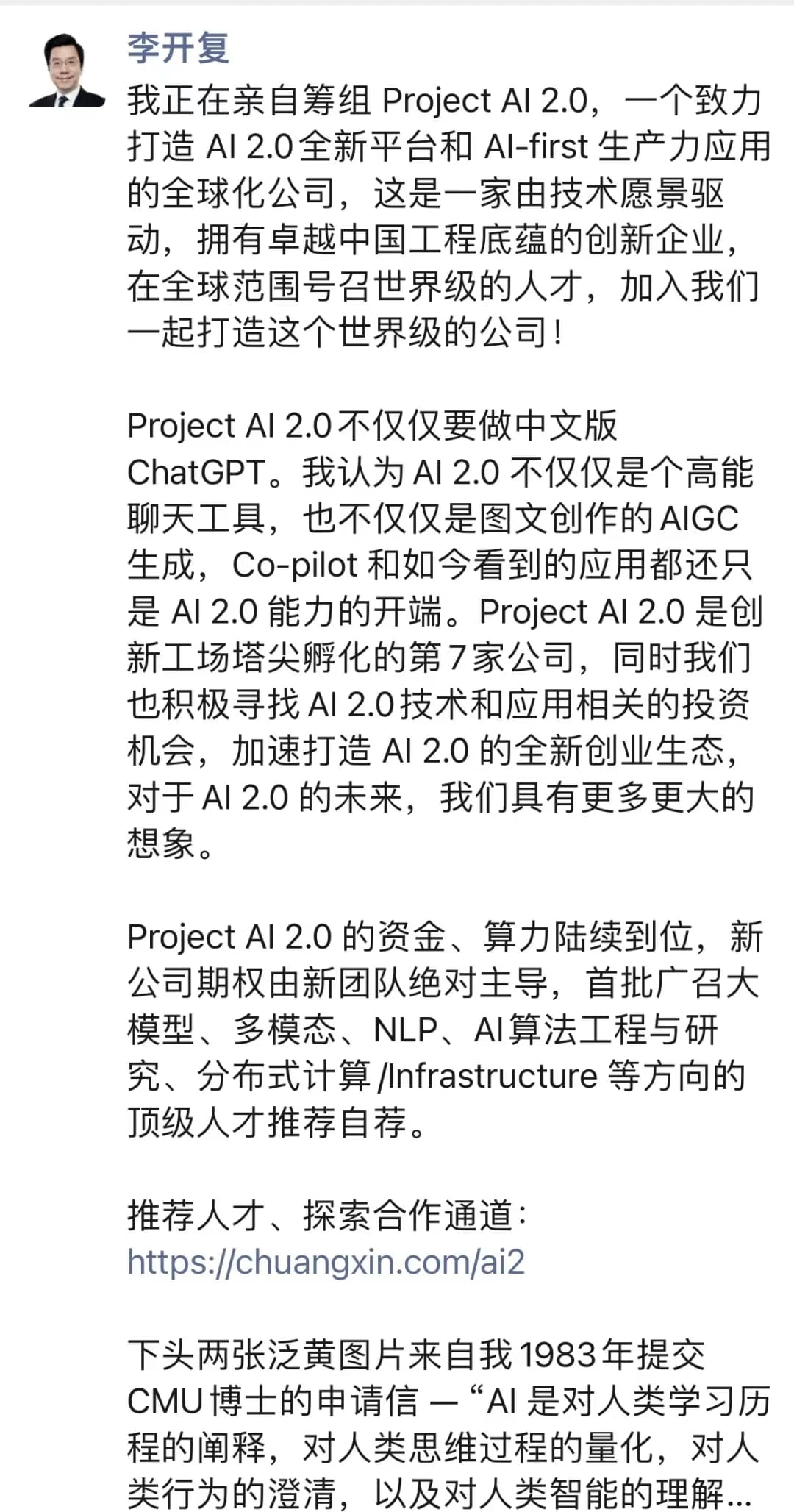
On March 19, Kai-Fu Lee, chairman and CEO of Innovation Works, announced on WeChat Moments that he was setting up a new company called "Project Al 2.0", an innovative project aimed at exploring AI 2.0.
At present, the most eye-catching position on the homepage of Sinovation Ventures' official website is two "calls for heroes", one of which is to recruit technical personnel and researchers with AI big model, NLP, Multi-modality and other capabilities. The other is to recruit partners with AI 2.0 related technologies, scenarios, computing power, and investment interests.
Kai-Fu Lee said in a post on WeChat Moments that AI 2.0 is not just a high-energy chat tool, not just AIGC generation for graphic creation, Co-pilot (Microsoft's latest Office software supported by chatGPT) and the applications we see today are just the beginning of AI 2.0's capabilities. He has more and bigger imaginations for the future of AI 2.0.
Kai-Fu Lee has always been the godfather of China's artificial intelligence field (hereinafter referred to as AI). His "manifesto" may be a sign that the "public discussion" of the AI industry has reached its peak.
The "Godfather" of Chinese AI, who has been engaged in entrepreneurship and popularizing AI for more than ten years
Kai-Fu Lee should be the most active investor and KOL in China's AI field. In the past few years, Innovation Works, including Lee's own work, and its external activities have almost all revolved around AI.
It is no exaggeration to define Kai-Fu Lee as the godfather of AI in China.
For example, the Microsoft Research China (later renamed Microsoft Research Asia) he founded carried out many important research projects. One of the most famous research results is the development of China's artificial intelligence speech recognition technology. And this institute later gave birth to a large number of leaders in China's AI field.
In 2009, Kai-Fu Lee founded Sinovation Ventures, which became one of the most famous startup incubators in China. He invested in many well-known companies in the AI field, among which AInnovation, an enterprise-level AI solution provider, was listed on the Hong Kong Stock Exchange and was known as the first AI+ production stock.
Kai-Fu Lee not only devotes himself to AI entrepreneurship, but also constantly shares his understanding of AI. For example, in 2017, he launched the audio course "Kai-Fu Lee Talks about AI: Ten Artificial Intelligence Science Lessons" on Himalaya. He even wrote two books, "AI·Future" (2018) and "AI Future in Progress" (2022). Among them, "AI·Future" was published in 2018, depicting the appearance of the new world of AI in Kai-Fu Lee's eyes, the impact of AI on society in the future, and people's coping strategies in the AI era.
At various summits and innovation factory activities, he often shares his views on AI. The four major waves of AI development, AI will replace nearly half of jobs within 15 years, China will surpass the United States in AI, and AI will affect our lives. These thoughts and views always arouse extensive media coverage and have indeed had an important impact on the development of AI in China.
In fact, Kai-Fu Lee's combination of AI investment, finding ways to monetize AI technology, and popularizing AI has been very effective, successfully shaping the image of China's AI godfather. But no matter how he promotes AI, in the past few years, the public's enthusiasm for AI discussions has been limited, even in the entrepreneurial field.
It was not until November 30, 2022 that chatGPT was released, and on March 15, 2023, chatGPT4 was born. In just 5 months, the AI field was completely ignited.
This must have surprised Kai-Fu Lee. Like Wang Huiwen of Meituan, he has now joined the AI battlefield more radically by posting a "startup manifesto" in his circle of friends.
The most "experienced" people in the AI field are also "excited". Is AI about to move from the unrealistic "beautiful imagination" in the early stage to the next stage that focuses more on practicality?
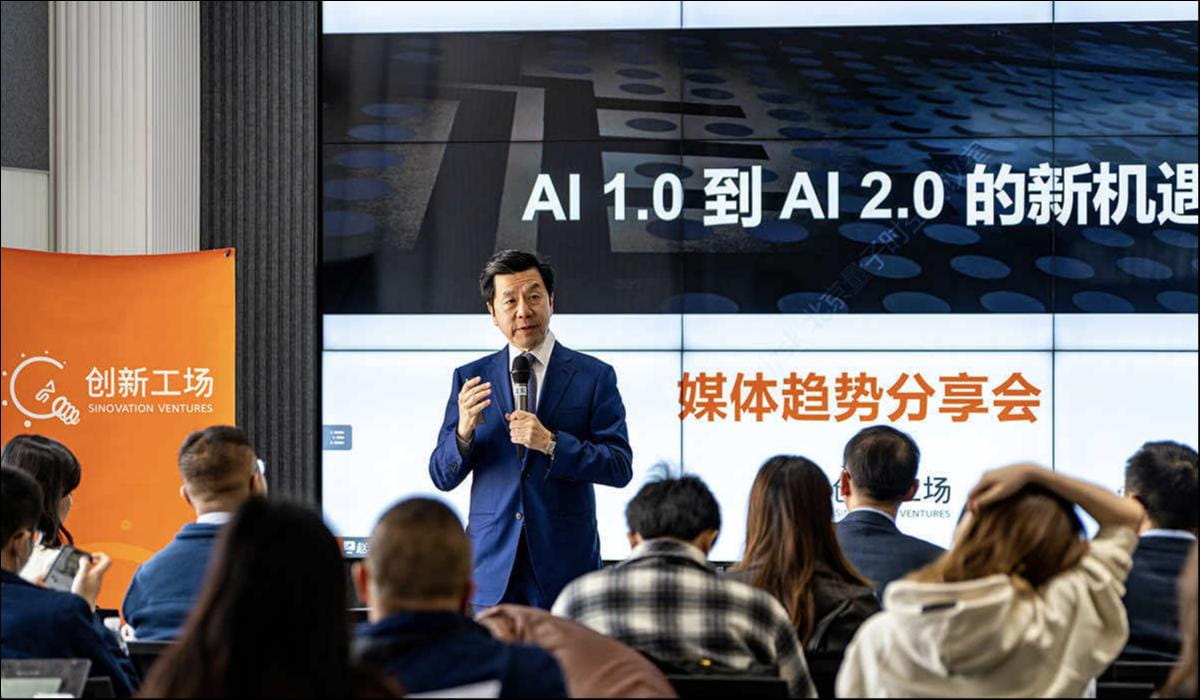
Kai-Fu Lee's recent views on AI
We have sorted out some of Kai-Fu Lee's recent views, which may show how Lee, as a first-line investor and entrepreneur, thinks about AI. What else does he see besides the excitement?
The "end of humanity" theory caused by ChatGPT has become a hot topic. I believe that AI is not only a product of scientific and technological progress, but also a powerful tool to help mankind progress, develop and improve themselves. The final results of each industrial revolution also tell us the best answer to the "trolley problem": technology is neutral, and its use depends entirely on the user himself. On the one hand, we need to make the public more aware of the short-term pain and long-term benefits brought about by AI; on the other hand, we need to work together to prepare for the future and actively respond. Only in this way can we gradually cultivate a responsible and rigorous attitude in the process of embracing AI technological advances such as ChatGPT, so that AI can truly be "Tech for Good" to benefit mankind. ——Kai-Fu Lee's Weibo
I have analyzed the three major shortcomings of AI, and even by 2042, AI may still not be able to fully master these capabilities. First, creativity. AI does not have the ability to create, conceive, and plan strategically. It cannot choose its own goals, cannot conceive across fields, cannot think creatively, and it is difficult to have common sense that is self-evident to humans. Second, empathy. AI does not have a sense of "empathy" such as "sympathy" and "care", and cannot achieve real interaction with humans in terms of emotions, and cannot bring care to others. Third, dexterity. AI and robotics technology cannot complete some precise and complex physical tasks, such as dexterous hand-eye collaboration. In addition, AI also has difficulty coping well with unknown or unstructured spaces. ——"AI Future in Progress"
AI has reached the turning point from 1.0 to 2.0. AI 2.0 will bring about a platform-based transformation, giving rise to the development and commercialization of a new generation of AI 2.0 applications. To become a platform, the first thing to do is to reduce the cost of developing applications. Just like electricity is a great invention, but without the power grid, can microwave ovens, ovens, and electric cars be invented? No, the power grid is the platform. AI 1.0 is electricity, and AI 2.0 is the power grid. ——"New Opportunities from AI 1.0 to AI 2.0" Trend Sharing Session
Sinovation Ventures focuses on three main areas: AI 2.0 intelligent applications, AI 2.0 platforms, and AI infrastructure. Prediction: The potential size of this market is hard to grasp, and it will be between all software and all human efforts. —— "New Opportunities from AI 1.0 to AI 2.0" Trend Sharing Session
In the next 20 years, today's simple and repetitive jobs will undoubtedly be replaced by robots and AI to a large extent. It is difficult for human capabilities to be fully surpassed by AI within 20 years. For example, managers, scientists, novelists, and artists, these jobs require greater creativity and complexity, and AI cannot easily replace them! ——Yang Lan's exclusive interview with Kai-Fu Lee and Chen Qiufan
We criticize AI so much, will humans do better? Will humans be less biased than AI? Actually not. Israel conducted an experiment in which the judge's verdict before lunch was harsher than after lunch, which means that his mood affected fairness. Human bias is very serious, and people will hide and refuse to admit their bias. AI is an objective, fair, transparent, and data-based field, so we have greater hope to make AI a low-bias decision maker, far less biased than humans. ——Kai-Fu Lee talks with Tencent Cloud: Technical people need more imagination of scenarios