


To be honest, I've written several articles about the @OpenLedger mechanism before, but I’ve always been "talking" about it without really "doing" it.
Last week, I decided to seriously give it a shot.
I整理了一批金融分析类的标注文本,大概200条,试着往 OpenLedger 的 Datanets 提交。
Before I hit submit, I went back and took a hard look at the data contribution section of the whitepaper—page 11, about Datanets' data aggregation mechanism. Each piece of data that comes in gets scored with a credit score C(D), and the calculation involves quality weights and the accuracy of input tag pairs.
The batch of data I submitted, due to its clear sourcing background, format specifications, and consistent annotation logic, falls into the higher quality range among the same batch.
And then it's just waiting.
What are we waiting for? For the model to be called.
This is the most counterintuitive part of the entire mechanism: your data contribution isn't settled upon submission; it starts generating value the moment the model is used. Inference occurs, and the system runs the influence function I(di, y) = α · F(di, y) in real-time, calculating how much weight your data contributed to this output, and only then will the corresponding share be allocated to you.
On page 10 of the whitepaper, there's a specific calculation example: total costs for a single inference are 1.14 OPN, and after the platform fee, the net yield is 0.64 OPN, which is proportionally divided among the model provider, stakers, and data contributors. A data provider with a 25% contribution weight receives 0.032 OPN.
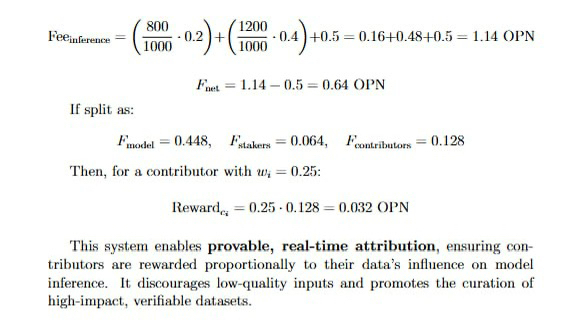
The individual numbers are small, I know. But the meaning of this mechanism is: as long as the model is still being called, contributors continually receive shares, not just a one-off.
This is completely different from my previous experience in data annotation work.
Previously, it was: organize the data, receive a fixed payment, and then which model that batch of data went into, how many times it was used, and how much money it helped that model earn had nothing to do with me.
OpenLedger is trying to reconnect this broken chain. Data isn't a one-time commodity; it's a blockchain asset that can generate ongoing yield.
I have some real confusions during the process, and I'm writing them down for reference.
First, I currently cannot independently verify the computation of the influence function. I can see the share allocated to me, but the calculation process behind 'why this weight' remains a black box for ordinary users. The whitepaper states that a DataInf approximation algorithm (ICLR 2024) is used, which is academically backed, but 'approximation' itself implies it's not exact. I'm unsure if there's a sufficiently clear arbitration mechanism in place when attribution values become contentious.
Second, the current volume of inference calls determines the actual scale of contributors' earnings. If the utilization of the on-chain AI model hasn't ramped up yet, even high-quality data will yield very little inference fees. This isn't a design issue; it's an ecosystem scale issue — it takes time.
Third, the specific standards for data quality scoring are currently limited in granularity for ordinary contributors to understand. I have a general idea that 'standard format, clear sourcing' will score points, but the detailed scoring weights are opaque to users.
These three confusions don't change my decision to continue participating, but I feel it's necessary to lay them out plainly.
Whether a project is good or not isn't determined by what others say; it's based on your own real experience after running it yourself.
I plan to continue following up and will make further judgments once there's clearer progress on the on-chain inference volume data.
Holding $OPEN , continuing to observe.