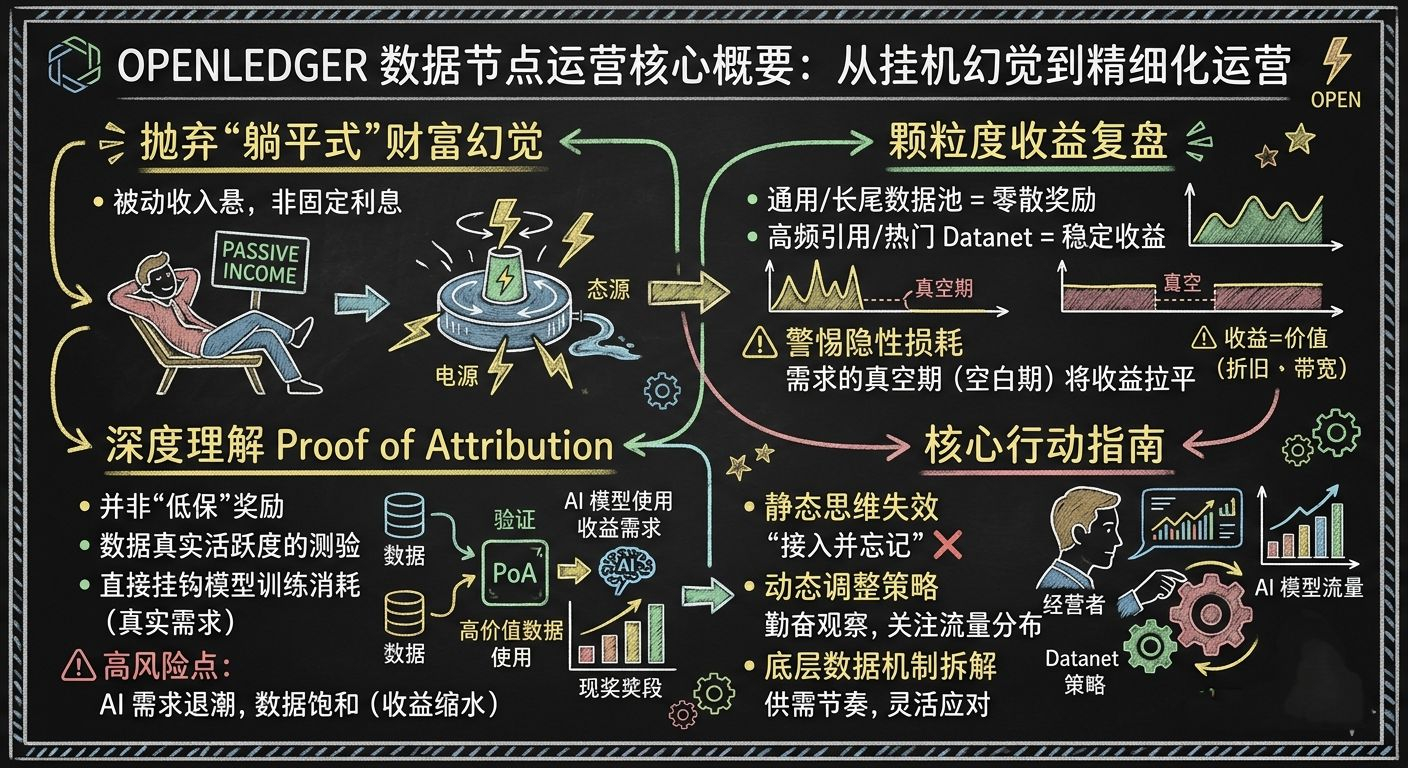
Recently, I ramped up my setup with a few more rigs to dive into the @OpenLedger ecosystem. I've done a deep dive into the granular returns from Datanet during this period, and honestly, my mindset is much steadier now than when I first entered the scene. A lot of folks simplify AI data nodes way too much, thinking that just by running their rigs and having $OPEN in their accounts, the rewards will roll in automatically. This kind of passive wealth illusion is really just a daydream for many newcomers.
I went through some of my earlier interactions and realized that simply chasing uptime by connecting to those long-tail, niche data pools has led to fragmented rewards that, after deducting electricity and network losses, yield an almost shocking ROI. Many are blinded by the hype of so-called airdrops, forgetting that this low-quality data has no bargaining power within the AI training context. At best, it just adds some useless load to the protocol. To truly build a sustainable return model in OpenLedger, the key is understanding data assetization. You have to realize that nodes are not just physical terminals; they are dynamic data gateways that require fine-tuning. I found that the nodes that consistently generate returns all align perfectly with the current mainstream model training demands of Datanet. There’s a huge cognitive gap here: most people only look at the current APY, ignoring the fact that AI training compute demands fluctuate in steps. If you haven’t set up your data caching before the peak demand, your bandwidth and storage are largely just spinning their wheels.
Now, let’s discuss the highly anticipated incentive mechanism of #OpenLedger . After long-term observation, I’ve come to understand that so-called profit distribution is essentially the ecosystem's real-time pricing for high-value data sets. If your data doesn’t directly hit the critical paths for fine-tuning large models or enhancing retrieval generation, then no matter how long your node is online, the reward mechanisms will filter it out using algorithmic weights.
To put it bluntly, in the $OPEN lane, static configuration strategies are completely outdated. The future profit margins will belong to those who truly treat their nodes as data factories and operate them with precision. Remember, OpenLedger rewards aren’t based on your device's uptime; they’re based on your judgment and execution as a data supplier in this wave of AI transformation.
I went through some of my earlier interactions and realized that simply chasing uptime by connecting to those long-tail, niche data pools has led to fragmented rewards that, after deducting electricity and network losses, yield an almost shocking ROI. Many are blinded by the hype of so-called airdrops, forgetting that this low-quality data has no bargaining power within the AI training context. At best, it just adds some useless load to the protocol. To truly build a sustainable return model in OpenLedger, the key is understanding data assetization. You have to realize that nodes are not just physical terminals; they are dynamic data gateways that require fine-tuning. I found that the nodes that consistently generate returns all align perfectly with the current mainstream model training demands of Datanet. There’s a huge cognitive gap here: most people only look at the current APY, ignoring the fact that AI training compute demands fluctuate in steps. If you haven’t set up your data caching before the peak demand, your bandwidth and storage are largely just spinning their wheels.
Now, let’s discuss the highly anticipated incentive mechanism of #OpenLedger . After long-term observation, I’ve come to understand that so-called profit distribution is essentially the ecosystem's real-time pricing for high-value data sets. If your data doesn’t directly hit the critical paths for fine-tuning large models or enhancing retrieval generation, then no matter how long your node is online, the reward mechanisms will filter it out using algorithmic weights.
To put it bluntly, in the $OPEN lane, static configuration strategies are completely outdated. The future profit margins will belong to those who truly treat their nodes as data factories and operate them with precision. Remember, OpenLedger rewards aren’t based on your device's uptime; they’re based on your judgment and execution as a data supplier in this wave of AI transformation.