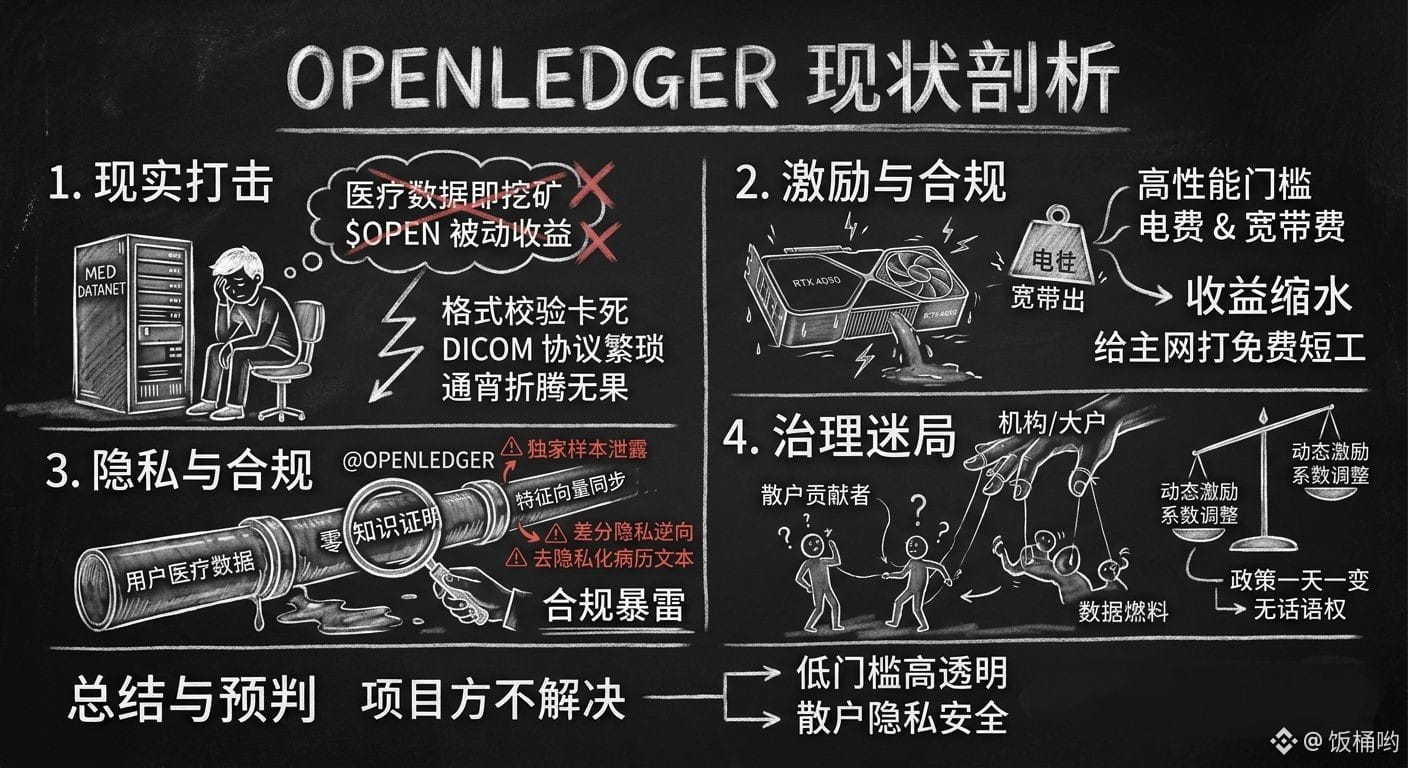
A couple of days ago, I saw everyone in the square hyping up the AI medical imaging annotation platform at @OpenLedger . In a moment of impulse, I uploaded the stash of dermatopathology slide datasets my studio had saved up to Med DataNet. The result? I spent the entire night wrestling with it, getting stuck on the format validation step, nearly losing my mind over that convoluted DICOM conversion protocol and label alignment logic.
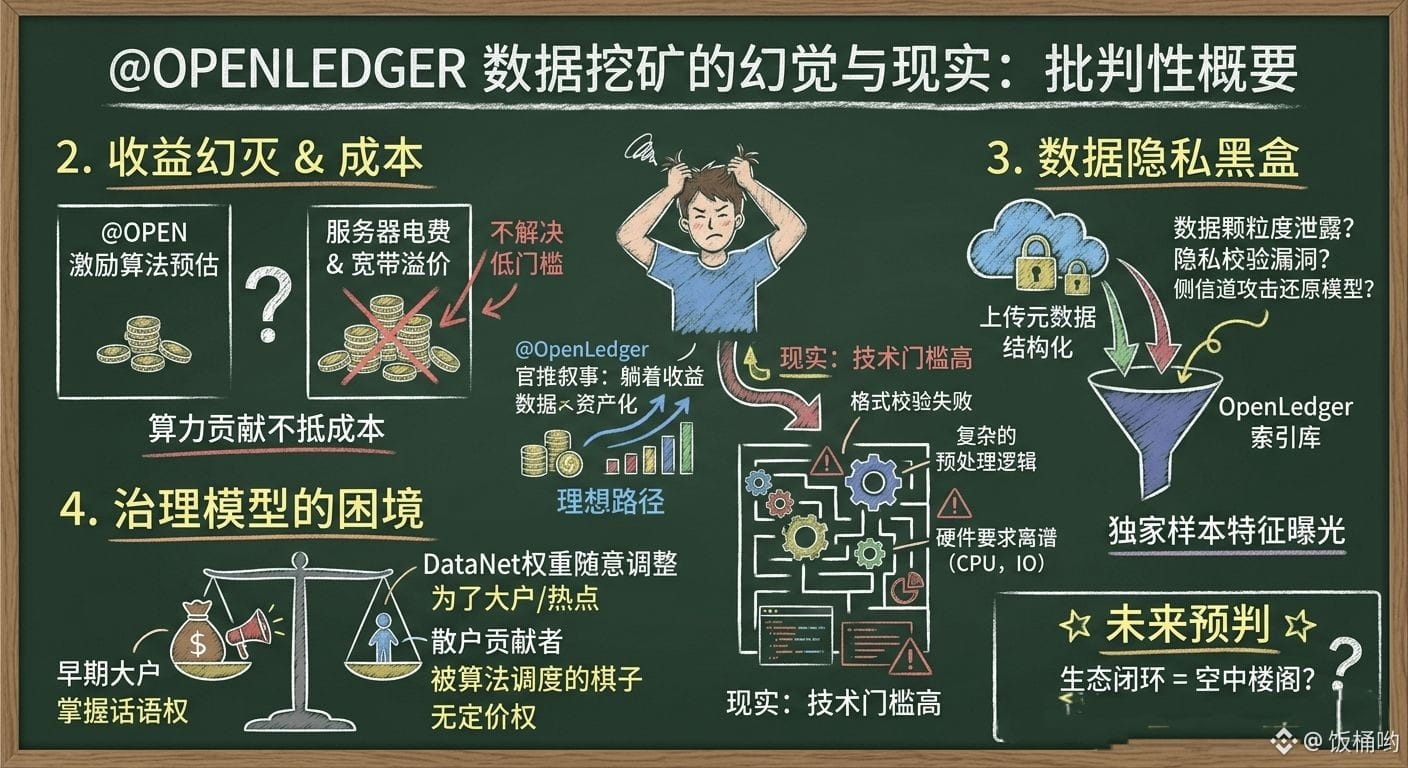
I admit, I got all hyped up by their grand narrative of medical data as a mining opportunity, fantasizing that uploading my hidden assets would yield passive income of $OPEN . But when it came time to deploy the validation node, reality slapped me in the face. They call this low-barrier co-construction in the official docs, but the requirements for VRAM and network bandwidth throughput are downright terrifying. I ran my top-notch 4090 workstation for three days, and based on their latest dynamic incentive formula, after deducting the full-time electricity bills and commercial broadband fees, the meager amount of $OPEN I got wouldn't even cover a cup of coffee. I was just doing free labor for the mainnet.
What freaks me out more than the shrinking returns is the bottomless pit of data rights and compliance issues. @OpenLedger keeps bragging about their zero-knowledge proofs and homomorphic encryption tech, claiming they can make data usable but not visible. But in practice, to get the higher-tier incentive weights, you have to bundle and sync the data feature vectors with de-identified medical records. Even though they say medical data is decentralized and stored anonymously, who can guarantee that the routing nodes at the retrieval layer won't be hacked through differential privacy reverse engineering? Once exclusive samples leak, who's left holding the bag? Us digital miners who provided the data in the first place? #OpenLedger
What's even more disheartening is the current community governance vibe around $OPEN . Policies change daily, and us retail traders have no right to know what's going on, let alone any say in it. Put simply, we're just fuel being repeatedly harvested by the whales' algorithms. I've completely had my illusions shattered. Whether @OpenLedger is genuinely disrupting the way AI production materials are distributed or just using the guise of decentralized AI to create a new round of traffic hype is no longer up for debate. I'll leave it at that: if the project team doesn't take retail traders' privacy and income transparency seriously, relying solely on a few big players flipping tokens in the community, this so-called Web3+AI narrative will ultimately just be a mirage.
I admit, I got all hyped up by their grand narrative of medical data as a mining opportunity, fantasizing that uploading my hidden assets would yield passive income of $OPEN . But when it came time to deploy the validation node, reality slapped me in the face. They call this low-barrier co-construction in the official docs, but the requirements for VRAM and network bandwidth throughput are downright terrifying. I ran my top-notch 4090 workstation for three days, and based on their latest dynamic incentive formula, after deducting the full-time electricity bills and commercial broadband fees, the meager amount of $OPEN I got wouldn't even cover a cup of coffee. I was just doing free labor for the mainnet.
What freaks me out more than the shrinking returns is the bottomless pit of data rights and compliance issues. @OpenLedger keeps bragging about their zero-knowledge proofs and homomorphic encryption tech, claiming they can make data usable but not visible. But in practice, to get the higher-tier incentive weights, you have to bundle and sync the data feature vectors with de-identified medical records. Even though they say medical data is decentralized and stored anonymously, who can guarantee that the routing nodes at the retrieval layer won't be hacked through differential privacy reverse engineering? Once exclusive samples leak, who's left holding the bag? Us digital miners who provided the data in the first place? #OpenLedger
What's even more disheartening is the current community governance vibe around $OPEN . Policies change daily, and us retail traders have no right to know what's going on, let alone any say in it. Put simply, we're just fuel being repeatedly harvested by the whales' algorithms. I've completely had my illusions shattered. Whether @OpenLedger is genuinely disrupting the way AI production materials are distributed or just using the guise of decentralized AI to create a new round of traffic hype is no longer up for debate. I'll leave it at that: if the project team doesn't take retail traders' privacy and income transparency seriously, relying solely on a few big players flipping tokens in the community, this so-called Web3+AI narrative will ultimately just be a mirage.