

On May 13th, Alibaba released its Q4 and full-year financial report for FY2026, delivering impressive numbers: Alibaba Cloud's external commercialization revenue accelerated to a 40% growth, with AI-related product revenue surpassing 30% for the first time. Quarterly revenue hit 8.971 billion yuan, with an annualized revenue exceeding 35.8 billion yuan. Alibaba's CEO, Wu Yongming, clearly stated that Alibaba's full-stack AI technology investment has 'officially crossed the initial cultivation stage and entered a positive scale commercialization return cycle.'
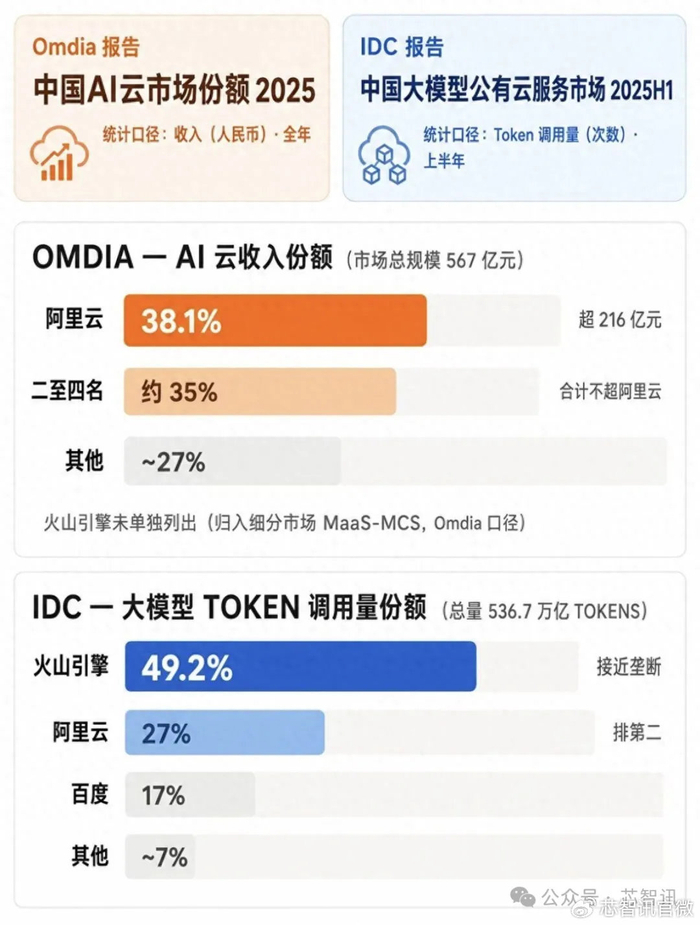
The hype from the earnings report hasn't faded yet. On May 19th, international market research firm Omdia released a report (China AI Cloud Market Share 2025), projecting that the total scale of China's AI cloud market will reach 56.7 billion yuan by 2025, with Alibaba Cloud leading at a 38.1% market share, surpassing the combined shares of the second to fourth places. Alibaba Cloud announced: 'We are number one in China's AI cloud market.'
Volcano Engine is also not to be outdone, with IDC data showing that by 2025, the token call volume of large models on China's public cloud will reach 1.944 trillion tokens, up 16 times, with Volcano Engine holding the top spot at 49.5% market share.
One is about 'who sells more', and the other is about 'who gets used more'. Two 'firsts', with Omdia counting AI IaaS and MaaS revenue in RMB, while IDC tracks the token usage of large model public cloud services. The former asks 'who made the money', while the latter asks 'who gets called often'. So, who is the real number one?
Leading in traffic doesn’t equal leading in revenue.
While Volcano Engine leads in call volume, the credibility of that figure is questionable. The token call volume itself has a 'fluffy' issue—an Agent application might consume hundreds of thousands of tokens for a single task, and multimodal models consume several times more tokens than pure text models. High call volume does not equal many users, nor does it equal many commercial scenarios. A lot of calls might come from a few large clients, and with ByteDance’s unlimited funding backing Volcano Engine, whether this low-cost strategy can sustain its share depends on customer loyalty.
Revenue first doesn’t equal AI first.
Alibaba Cloud's 'first' is based on real revenue, but the Omdia report merges AI IaaS and MaaS stats, with IaaS taking up the bulk—China's AI IaaS total scale reaches 39.2 billion yuan, accounting for 69% of the overall market. This means Alibaba Cloud holds a 38.1% share, largely from existing clients' incremental computing power purchases in the AI era, and a significant portion of non-domestic computing power may not all be new model services. Breaking the 30% mark in AI revenue is a good thing, but there's still a long way to go for a comprehensive lead as 'AI number one'. More importantly, leading in revenue doesn’t mean leading in contributions. If cloud vendors' ultimate goal is just to sell computing power and tokens, then AI truly becomes a traffic business. But clearly, it shouldn't be that way.
Let’s take a look at the other players, each with their own paths.
In fact, in the AI race, cloud vendors can’t copy each other’s homework. Those who can’t claim the top spot are heading towards clear differentiation.
Baidu is one of the earliest internet companies in China to enter the AI space, with deep technical accumulation ranging from autonomous driving to the Wenxin large model. However, at the recent Baidu Create Conference, Li Yanhong first proposed a new metric for the AI era—Daily Active Agents (DAA), arguing that tokens only represent costs and investments, while DAA measures 'how many Agents are working for humans and delivering results'. The centerpiece of the conference was no longer the Wenxin large model, but the universal intelligent agent DuMate, as Baidu Smart Cloud was fully upgraded to a new full-stack AI cloud for large-scale intelligent agent applications. While there are forward-looking technical layouts, it hasn’t sparked the widespread industry discussion expected. The exploration of technology by pioneers deserves respect, but Baidu is still on the road from technological leadership to commercial leadership, and needs to keep pushing.
Huawei Cloud is also not in the spotlight. The short-term turbulence from organizational adjustments and anxiety over computing power under chip sanctions seem to be lagging behind competitors. They can only rely on years of accumulated experience in the industry to tackle hard problems in complex sectors like healthcare, finance, and manufacturing. Recently, at the Chinese Medical Association's Pathology Annual Conference held in Xi'an, Huawei Cloud finally showcased its 'Industry AI Dream Factory' smart pathology solution, which has expanded from Ruijin Hospital to cover county and district hospitals in Handan and Guizhou, achieving large-scale implementation. However, relying solely on domestic computing power remains a hurdle for Huawei Cloud, but that resilience is commendable.
Tencent Cloud hasn’t participated in this 'first' battle, but has also made frequent moves recently. The report released on May 7 (China Office Intelligent Agent Platform Market Research Report 2026) indicates that Tencent WorkBuddy ranks first in monthly visits among domestic PC-based AI native office intelligent agents. The 27-year-old chief scientist Yao Shunyu led the technical reconstruction of the Mixed Yuan 3 Preview, completing the fundamental model rebuild in three months, achieving a 'smart yet economical' performance balance using the MoE architecture. Tencent is taking a path of 'integrating AI into its own ecosystem', avoiding price wars, and instead focusing on deep cultivation within its product matrix.
The AI race is not a single track; each has its own strategy. Alibaba Cloud competes on ecosystem and scale, Volcano Engine on penetration and cost-effectiveness, Baidu bets on Agents to reconstruct AI metrics, Tencent Cloud focuses on product integration, and Huawei Cloud dives deep into industries. Whose route is more correct? There may not be a standard answer. Looking through the phenomena to the essence: leading in traffic doesn’t equal leading in revenue, leading in revenue doesn’t equal leading in AI, and leading in AI doesn’t equal leading in contributions. Ultimately, the market will reward players who have not only scale but also substantial value.
The story of China's AI cloud is just beginning.