

In the BSC ecosystem, what truly transcends market cycles isn't just the hype or calls, but verifiable mathematical rules. Recently, a set of interconnected projects has been quietly brewing: the underlying protocol REBC 2.0 is responsible for 'how to issue tokens and how to price them,' while the blockchain game Rune Abyss is in charge of 'how to consume and how to create deflation.' Both share a single token, $REBC, embedding 'zero inflation and strong scarcity' from the ground up into their code.
1. REBC 2.0: Let the curves speak, and prevent the pool from 'shearing sheep.'
REBC 2.0 is deployed on the BNB Chain, with its core being a reversible adaptive hybrid Bonding Curve. Its standout feature is: it rejects the 'free-riding' in the secondary market.
It introduces a Ledger Hook similar to Uniswap V4:
Before each secondary market Swap, the contract compares the 'curve-end Mint preview price' and the 'current spot price in the pool'.
Once the pool price is significantly below the curve expectation (essentially giving users a free arbitrage opportunity), the system will dynamically increase LP fees to close the 'cheap channel', forcing the market to follow the curve.
Combined with segmented exponential curves:
1.0%–80% supply: Price precisely pegged to a 5000x calculation range, current circulation is 21.70%, with 58.30% to go to reach the 80% milestone.
2. After 80%: The curve slope actively slows down to avoid liquidity gaps later on.
Plus, reserves are completely isolated:
3. Curve Reserve: Exclusively used for redemption, 100% repayment of minted tokens.
4. LP Treasury: Exclusively used for PancakeSwap V4 injection, liquidity only increases.
Mechanically, it puts a stop to long-standing issues like 'insolvency' and 'pool divergence' all at once.
II. Rune Abyss: Making 'zero inflation' a hard constraint
Rune Abyss is a MVP blockchain game running on BSC, but its economic model is anything but 'toy-like'.
1. Total token supply: 1 billion $REBC, fair launch, no pre-mining.
2. Core rules: zero inflation, pure USDT internal market, 100% material crafting destruction.
3. Hard cap scarcity: Total number of characters locked at 6000, not a single one more.
The player cycle is very clear:
Consume REBC for card draws → Team up to farm dungeons for materials → Materials + REBC to craft high-tier characters (all destroyed) → Free trading on USDT internal market.
Card draw prices will also increase in a stepped manner over time: starting at 50,000 $REBC per draw, increasing by 10% for every 1000 draws completed. Characters are divided into 5 tiers, with the highest tier 'Legendary Adventurer' having only a 1% chance, battle power 150–199, becoming more difficult to obtain as you progress.
All consumption leaves circulation for real: card draws, stamina purchases, crafting materials, no backflow, no 'left hand to right hand'.
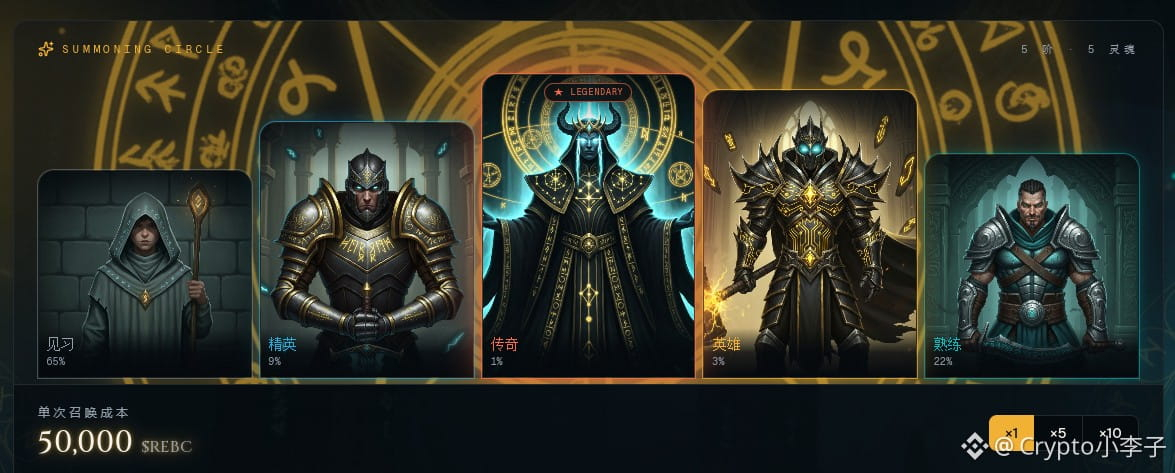
III. Underlying + Applications: A deflationary closed loop
The most noteworthy aspect of these two projects is their complementarity rather than competing against each other:
1. REBC 2.0 uses curve guarantees: The issuance, pricing, and redemption of $REBC are entirely controlled by math, unshackled from short-term speculation.
2. Rune Abyss uses gaming guarantees: $REBC has real, continuous, irreversible consumption scenarios.
The result is: on one side is algorithmic support, and on the other is application destruction, jointly sustaining a deflationary ecosystem that does not rely on 'new investors'.
IV. Participation methods
REBC 2.0:
Official website: https://www.rebc.xyz
Connect wallet → Enter referral code (rewards available) → Mint 0.1–5 BNB to participate in curve release.
Rune Abyss:
Official website: https://www.runeas.xyz
Directly use $REBC for card draws, team-ups, crafting, and experience zero inflation in the internal market.