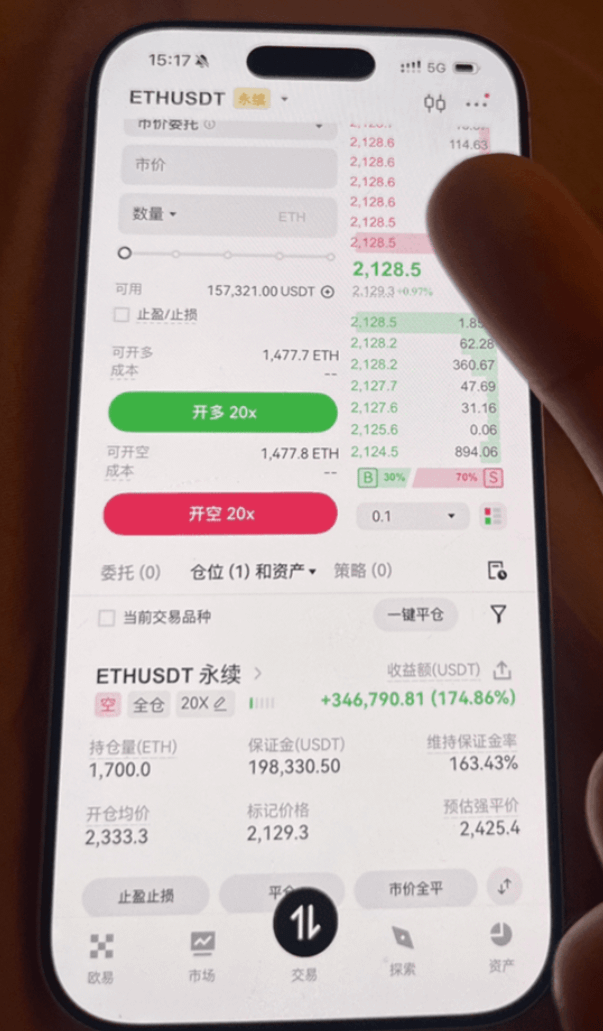
I just got a voice message from my buddy in Guangdong, and when I listened, his voice was shaking: "I went all in, so why did I still get wrecked?"
Checking the records: with a 10,000U account, he took 9,500U, went all in with 10x leverage, and didn’t set a stop-loss. The market retraced just 3%, and he went to zero.
A lot of people think "going all in = I can hold on," but going all in is a double-edged sword—if used right, it can handle volatility, but if used wrong, it leads to faster losses.
1. Why do you always get wrecked when you go all in?
The key to getting liquidated isn’t the leverage multiplier; it’s the position size.
Take a 1,000U account for example:
· If you open a 900U position with 10x leverage, a 5% reverse move will wreck you;
· But if you only open 100U at the same 10x, it would take a 50% move to get liquidated.
My buddy put in 95% of his capital, and even with 10x leverage, he couldn’t withstand the slightest volatility.
2. Want to go all in but avoid liquidation? I strictly follow these 3 principles, and I haven’t been wrecked in half a year while doubling my capital.
1. Don’t risk more than 20% of your total funds on a single trade.
For example, with a 10,000U account, only use 2,000U at a time. Even if you get the direction wrong and hit a 10% stop-loss, you’d only lose 200U, which doesn’t hurt your principal.
2. Keep individual losses strictly under 3%.
For instance, if you open 2,000U at 10x, calculate that your stop-loss should be a maximum of 1.5%, so your loss would only be 300U, exactly 3% of your total capital.
3. Don’t open positions during sideways markets, and don’t add to winning trades.
Only enter when there’s a clear trend breakout; during consolidation, absolutely don’t make random moves; once you’re in, never chase the position mid-trade to avoid emotional interference.
3. The real use of going all in: don’t bet on direction; leave enough buffer.
Going all in is designed to give you more breathing room during volatility, unlike going position by position where one hit can take you out.
But the core principle is: light positions for trial and strict risk control.
There was a follower who kept getting wrecked every month, but after using the "20% position + 3% stop-loss" method, he grew his 5,000U to 8,000U in three months.
He said: "Going all in is about stability, not betting bigger."
In conclusion:
Going all in or position trading are just tools; making money doesn’t depend on the tools, but on your position management.
Those who can manage their positions are the ones who survive and make profits in this market.
Still, remember: a lone sail doesn’t journey far; it’s hard to grow a forest alone. Many crypto traders have perished; only those destined will cross paths with Ge.