


Key Takeaways
Real circulating volume provides a clearer perspective on token liquidity, helping to differentiate between the surface-disclosed circulating supply and the actual tradable supply in the market.
When the real circulating volume is low, if the market can't fully grasp the underlying supply dynamics, price discovery, volatility, and valuation metrics like market cap and FDV can get distorted.
Therefore, combining real circulating volume analysis with token economic model review, on-chain data, and unlocking schedules can help users assess token launches and market behavior more comprehensively and thoroughly.

Binance Research previously published a report (Low Circulation, High FDV: How the Crypto Market Got Here?) since then, the community has continuously observed that some projects launch with relatively low real circulation. This is not necessarily negative in all cases, but low real circulation can lead to unnatural price discovery, higher volatility, and potentially misleading market cap or fully diluted valuation performance.
This article will explain what real circulation is, why it matters, and how users and project teams can approach token launches with higher transparency and awareness.
What is real circulation?
Real circulation refers to the portion of the token supply that is truly available for active trading in the public market.
In traditional financial markets, this is similar to the concept of free-floating shares or publicly traded shares, which are available for public trading after excluding restricted shares, insider holdings, and strategic holdings. In the crypto market, a similar distinction may exist between the tokens counted in circulating supply and those that are actually tradable.
While the disclosed circulating supply reflects the nominal supply in circulation, real circulation reflects the actual tradable supply. The greater the gap between the two, the higher the likelihood that the token’s real liquidity is overestimated.
Real circulation is better understood as an estimate rather than an exact formula. When assessing how much supply is truly available for active trading, users can consider factors such as locked supply, vesting arrangements, tokens held by the treasury or project team, staking participation, and holder concentration.
In practice, observable market balances can also serve as a rough reference:
Estimate of real circulation ≈ DEX liquidity pool balance + CEX balances
This is not a perfect measure, as exchange balances, liquidity pools, treasury wallets, staking contracts, and long-term holder behaviors can change over time. However, it can still help users better distinguish between the superficially disclosed circulating supply and the portion truly available for active trading.
Low real circulation may occur in the following situations:
a large portion of supply is held by insiders, foundations, treasury wallets, or long-term holders
a significant part of circulating supply is used for liquidity provision arrangements
staking, vesting periods, ecological lockups, or airdrop plans reduce the freely tradable tokens
liquidity is concentrated in a few exchanges or liquidity pools
a few whales control most of the available circulating supply with minimal trading
Low real circulation itself is not necessarily negative. It may reflect early token distribution arrangements, long-term incentive alignment, staking participation, or treasury strategies. However, when it is accompanied by limited disclosures, concentrated holdings, high FDV, or significant upcoming unlocks, it can become an important risk factor for users to consider.
Impacts of low real circulation environments
To better visualize this, imagine a simplified illustrative scenario: early trading of a token occurs in an environment with thin real circulation. In such a case, even a modest buy order might significantly pump the price, thus inflating the implied market cap or fully diluted valuation (FDV). However, if subsequent broader demand does not materialize, or if later token unlocks significantly increase circulating supply, prices may experience pullbacks as liquidity expands. Below we will further dissect the impacts of low circulation environments.
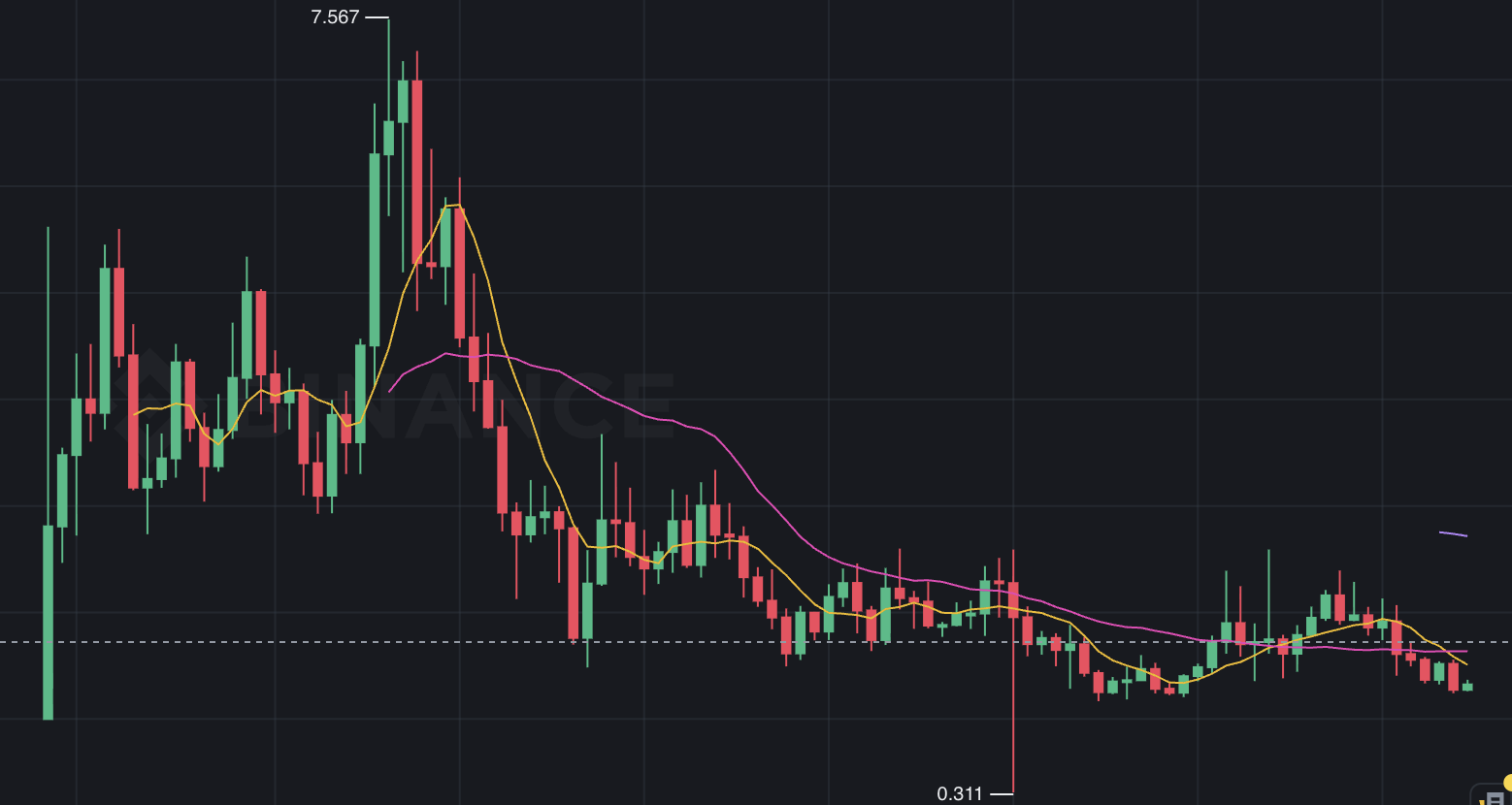
Illustrative case: when real circulation is thin, early price movements may be more volatile and harder to reflect widespread market demand; as supply expands, there may be risks of price pullbacks.
unnatural price discovery
Fair price discovery relies on broad market participation, ample tradable supply, and transparent information.
When only a small portion of supply is actively traded, prices may not fully reflect overall market demand. Instead, price formation may be influenced by a few wallets, concentrated liquidity, liquidity support from specific participants, or listing-related factors.
In a low real circulation environment, even modest buy orders can significantly pump prices and derive larger FDVs in the absence of broad market validation.
higher volatility
low real circulation can also lead to higher volatility. When the tradable supply is limited, relatively small orders can disproportionately impact the price.
This often results in wider spreads, higher slippage, more drastic price swings, and a stronger reaction to news, market sentiment, or unlocking events. As a result, users find it harder to distinguish between sustained demand and price changes driven by short-term liquidity.
misleading market cap performance
Market cap and FDV are useful reference metrics, but when prices are formed based on thin real circulation, the information content of these metrics may diminish.
For example, a small buy order can pump the token price, which then simultaneously inflates the market cap calculated based on circulating supply and the FDV based on total supply. In this case, the apparent valuation may overestimate actual capital inflow or market depth. Therefore, market cap and FDV should be interpreted alongside real circulation, liquidity depth, holder concentration, and upcoming unlocking plans.
token unlocking risk
When low real circulation is caused by locked supply, future unlocks become a key factor to watch.
Potential selling pressure may come from early investors, team allocations, treasury wallets, or token release plans. In some cases, even if tokens have not truly entered circulation, market expectations of unlocks can still affect prices, especially when related disclosures are limited or unclear.
How do users assess low real circulation?
Users should not rely solely on apparent market cap, FDV, or short-term price performance. A more comprehensive assessment can include:
reviewing the project's tokenomics model, token allocation table, vesting schedule, and unlocking timetable
comparing the circulating supply disclosed by the project with real circulation metrics, such as exchange balances, DEX liquidity pool balances, on-chain wallet distribution, and holder concentration
assessing whether supply is concentrated in a few wallets, exchanges, or liquidity pools
keeping an eye on significant token inflows to exchanges, as this may impact short-term liquidity and price dynamics
utilizing third-party data platforms to better understand wallet distribution, token flow, and concentration risk
referring to project disclosures, whitepapers, Binance Research materials, and other publicly available information
As always, users should conduct their own research. Tokenomics can be complex, and no single metric can fully reflect the quality or risk of a token launch.
Advice for project teams
For project teams, clearer disclosures can help market participants better understand the underlying supply dynamics behind the tokens. Therefore, projects could consider increasing transparency around initial circulating supply, real circulation assumptions, token distribution, vesting schedules, treasury token counts, liquidity arrangements, staking participation, and airdrop structures.
Transparency does not mean all projects should adopt the same circulating structure. Different projects may implement varying token designs based on their development stage, community structure, and ecological needs.
However, when users can clearly distinguish between freely tradable supply and tokens that are locked, staked, bound for liquidity, or reserved, they can better assess valuation, liquidity, and potential future supply pressure, enabling them to make more informed decisions.
Conclusion
Real circulation is a crucial factor in evaluating token launches and secondary market behavior.
While low real circulation is not necessarily negative in itself, when accompanied by high FDV, limited disclosures, concentrated supply, or significant future unlocks, it can weaken price discovery and increase market risk.
Ultimately, more transparent tokenomics benefit both sides of the market. For users, understanding real circulation helps make more informed decisions; for project teams, higher transparency and more prudent circulation designs help build credibility, support more sustainable price discovery, and drive healthier token markets.