

I remember sitting in a noisy tea stall one evening, watching a guy argue with his friend about AI. One of them said, “Bro, AI will replace everyone.” The other laughed and said, “Then who gets paid when AI learns from us?”
That question stayed with me longer than I expected.
Because if you think about it, today’s AI economy feels strangely incomplete. People upload photos, write reviews, create tutorials, label datasets, and leave digital footprints everywhere. Models learn from all of it. Companies profit from it. Yet most contributors never know when their data helped train something valuable.
That was the moment OpenLedger clicked for me.
Not as another AI token. Not even as another blockchain story. More like an attempt to answer an uncomfortable question: what if data contributors, model builders, and AI agents could finally participate in the same economy instead of existing in separate silos?
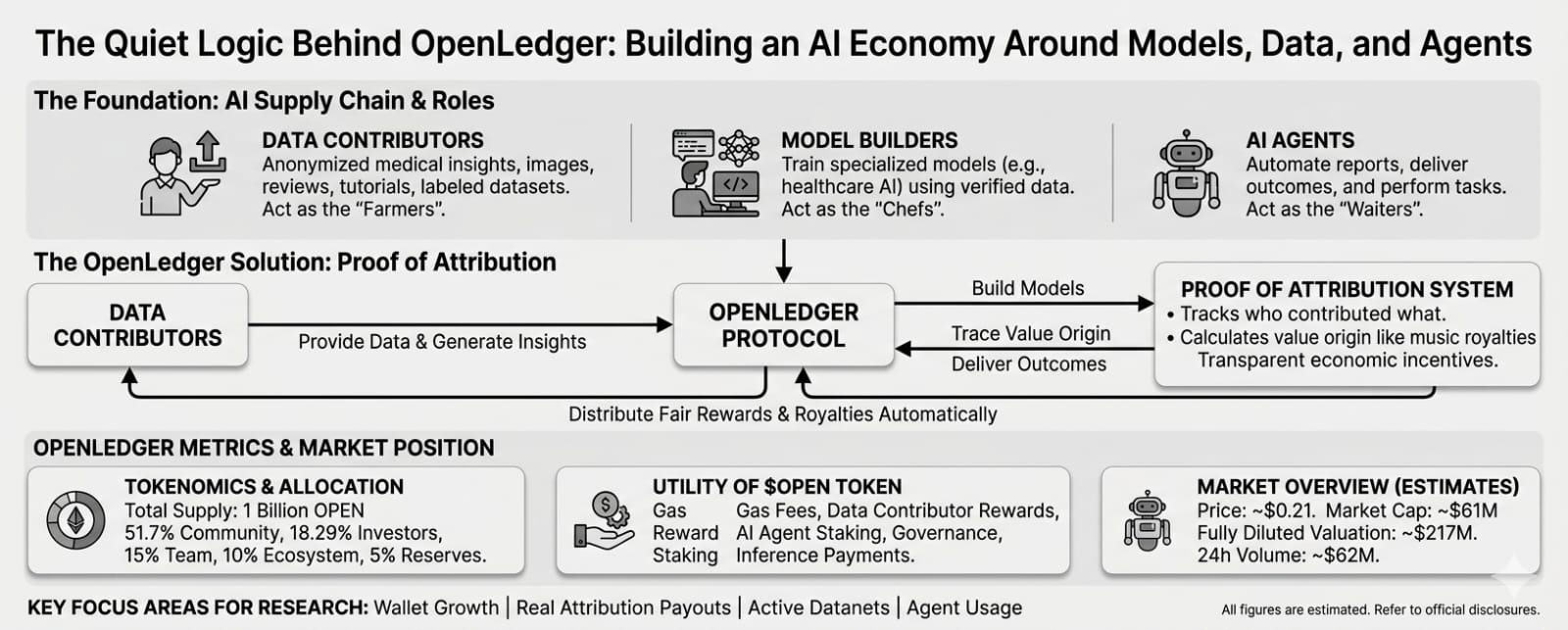
I did this little mental experiment recently. Imagine a local doctor uploads anonymized medical insights into a verified dataset. Somewhere else, an AI developer trains a specialized healthcare model using that information. Then an autonomous AI agent starts helping clinics automate reports. Normally, nobody upstream gets rewarded fairly. But OpenLedger’s idea is simple: track attribution and pay contributors automatically.
That is where the project’s Proof of Attribution system becomes interesting. Instead of AI behaving like a black box, OpenLedger tries to trace who contributed what and where value originated. Think of it like music royalties, except for intelligence itself. When a song streams, artists get paid. OpenLedger asks: why shouldn’t useful data or models work the same way?
The technical framing sounds complicated at first, but I noticed something helpful when explaining it to friends: imagine AI as a restaurant.
Data contributors are farmers.
Model builders are chefs.
AI agents are waiters delivering outcomes.
Traditional AI usually rewards the restaurant owner most. OpenLedger is trying to build a system where the farmer, chef, and waiter all have transparent economic incentives.
That sounds compelling in theory, but theory alone never justifies investment or attention.
So let’s talk about the token reality.
At the current market position, OPEN trades around ~$0.21, with a market cap near ~$61M and a fully diluted valuation of roughly ~$217M. Daily trading volume sits around ~$62M, which tells me attention is still there even after volatility cooled down. The token once reached an all-time high of $1.83 in September 2025, meaning it currently sits about 88% below peak levels.
I noticed many people interpret this only as failure. I’m not sure that is fully accurate.
Sometimes charts are stories of expectations arriving too early.
In OPEN’s case, the early rally looked heavily fueled by Binance airdrop excitement, Korean exchange speculation, and strong VC attention. Then reality arrived. The mainnet launch was delayed until November 2025, while continuous community unlocks added selling pressure. That gap between narrative and shipping mattered.
Still, something important changed after November 2025.
OpenLedger actually shipped its mainnet, introducing a live environment for attribution tracking, contributor rewards, and AI infrastructure. That matters because crypto markets eventually punish promises but sometimes reward execution. The protocol also pushed a broader 2026 roadmap focused on verifiable AI, accountable agents, and transparent model ownership. Partnerships around decentralized AI infrastructure have slowly expanded as well.
Tokenomics deserve a closer look too.
The total supply sits at 1 billion OPEN, with roughly 29% circulating. Allocation leans heavily toward community incentives at 51.7%, followed by 18.29% for investors, 15% for team, 10% ecosystem, and 5% reserves.
But here is the thing I would personally watch very carefully.
September 2026.
That is when the major team and investor cliff unlock begins, after a 12-month cliff followed by 36-month linear vesting. I have seen markets ignore unlock risks until they suddenly care. If insiders choose to de-risk positions, price pressure can become real. Community and ecosystem emissions have already been unlocking gradually since day one, so dilution is not hypothetical here.
On utility, though, OPEN at least avoids the “token with no job” problem.
The token is designed for gas fees, data contributor rewards, AI agent staking, governance, and inference payments inside the ecosystem. In plain English: if OpenLedger’s AI economy grows, the token has multiple reasons to exist beyond speculation.
Still, skepticism matters.
I noticed many AI-crypto projects sell visions bigger than products. My rule now is simple: I stop listening to promises and start watching behavior.
Are developers building?
Are contributors earning?
Are agents actually transacting on-chain?
Narratives are easy. Economic activity is harder to fake.
If I were researching OpenLedger today, I would watch wallet growth, real attribution payouts, active datanets, and agent usage more than price candles.
Because the biggest question is not whether AI becomes huge.
That part feels obvious.
The real question is: who owns the value created by AI?
Will intelligence remain concentrated in giant platforms, or do systems like OpenLedger create an economy where contributors finally participate?
And if data becomes labor, should people be paid every time their contribution teaches a machine something valuable?
I’m genuinely curious where you stand on this. Is OpenLedger building infrastructure early, or is the market still overestimating how fast decentralized AI economies can actually mature?
$OPEN @OpenLedger #OpenLedger $HOME $EDEN #Trump'sIranAttackDelayed #PolymarketNasdaqPredictionMarketPartnership #StriveAcquires382BTCFor$30.3M #CanaanNordicHeatRecoveryMining
