$OPEN as a Coordination Layer: Why the Market Needs an AI-Native Blockchain?
Most developers are trying to run AI models on general-purpose blockchains (L1/L2).
I believe this is an attempt to put a round peg in a square mold.
Conventional networks are designed for simple transactions: transfers, minting, and staking. They are completely unadapted to the specifics of artificial intelligence, which requires working with gigabytes of data every second, precise tracking of authors' contributions, and complex coordination of GPU power.
That is why the market needs an AI-Native blockchain. And this is exactly the task that OpenLedger solves.
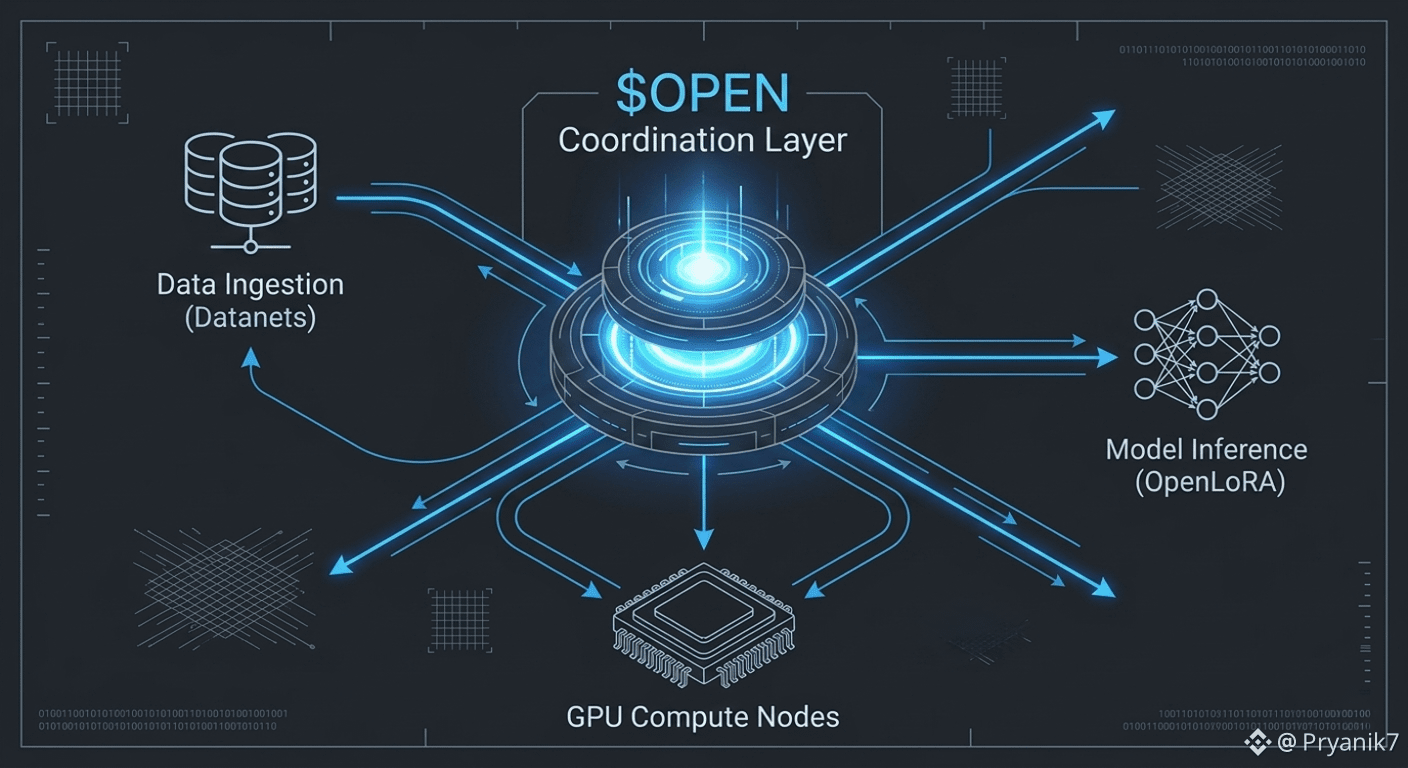
The official project documentation shows that the token works not just as a means of payment. It functions as a Coordination Layer, connecting three disparate worlds:
Datanets, model developers, and hardware operators.
When you run a query on an AI model on the OpenLedger network, instantly coordinates the entire chain:
It pays for the inference (query) -> activates OpenLoRA technology for GPU optimization -> and through Proof of Attribution automatically charges royalties to those whose data the model was trained on.
Without an AI-Native blockchain, this process turns into chaos with high fees and delays.
Therefore, the power of $OPEN does not lie in abstract utilitarianism.
It lies in architectural balance:
the token removes the friction between raw data and computing power, turning disparate technologies into a single, self-regenerating economic flywheel.
For the AI ecosystem, this is a step from a speculative Web3 application to a fully-fledged sovereign infrastructure.
@OpenLedger #OpenLedger $OPEN
Most developers are trying to run AI models on general-purpose blockchains (L1/L2).
I believe this is an attempt to put a round peg in a square mold.
Conventional networks are designed for simple transactions: transfers, minting, and staking. They are completely unadapted to the specifics of artificial intelligence, which requires working with gigabytes of data every second, precise tracking of authors' contributions, and complex coordination of GPU power.
That is why the market needs an AI-Native blockchain. And this is exactly the task that OpenLedger solves.
The official project documentation shows that the token works not just as a means of payment. It functions as a Coordination Layer, connecting three disparate worlds:
Datanets, model developers, and hardware operators.
When you run a query on an AI model on the OpenLedger network, instantly coordinates the entire chain:
It pays for the inference (query) -> activates OpenLoRA technology for GPU optimization -> and through Proof of Attribution automatically charges royalties to those whose data the model was trained on.
Without an AI-Native blockchain, this process turns into chaos with high fees and delays.
Therefore, the power of $OPEN does not lie in abstract utilitarianism.
It lies in architectural balance:
the token removes the friction between raw data and computing power, turning disparate technologies into a single, self-regenerating economic flywheel.
For the AI ecosystem, this is a step from a speculative Web3 application to a fully-fledged sovereign infrastructure.
@OpenLedger #OpenLedger $OPEN