

Hey, friend, I am Xingchen, welcome to the first lesson of (Spot Trading Practice)!
First of all, congratulations. If you have followed along from (Survival in the Crypto Sphere - First Lesson), then you have already mastered 90% of the 'safety' and 'survival' skills that most beginners do not possess. You have completed registration, deposited funds, and are holding USDT, standing at the entrance of this 24-hour non-stop battlefield.
A brand new question has arisen: 'How should I trade?'
When it comes to 'trading', many people immediately think of the two characters: 'gambling'.
'Isn't this just guessing the size?'
'Buying up or down is all based on luck.'
'My friend lost everything playing this.'
If these thoughts have crossed your mind, then today’s class will be the most important cognitive restructuring lesson in your entire trading career.
Because whether you want to become a professional 'trader' or fall into being a 'gambler', that boundary was drawn the moment you opened this article.
Trading vs Gambling: Fundamental Differences in Thinking 🧠
In the eyes of beginners, trading and gambling are almost indistinguishable. But in the eyes of professionals, these are two completely opposite activities.
Let me give you an example: How do you differentiate between a 'professional poker player' and a 'drunk in Las Vegas'?
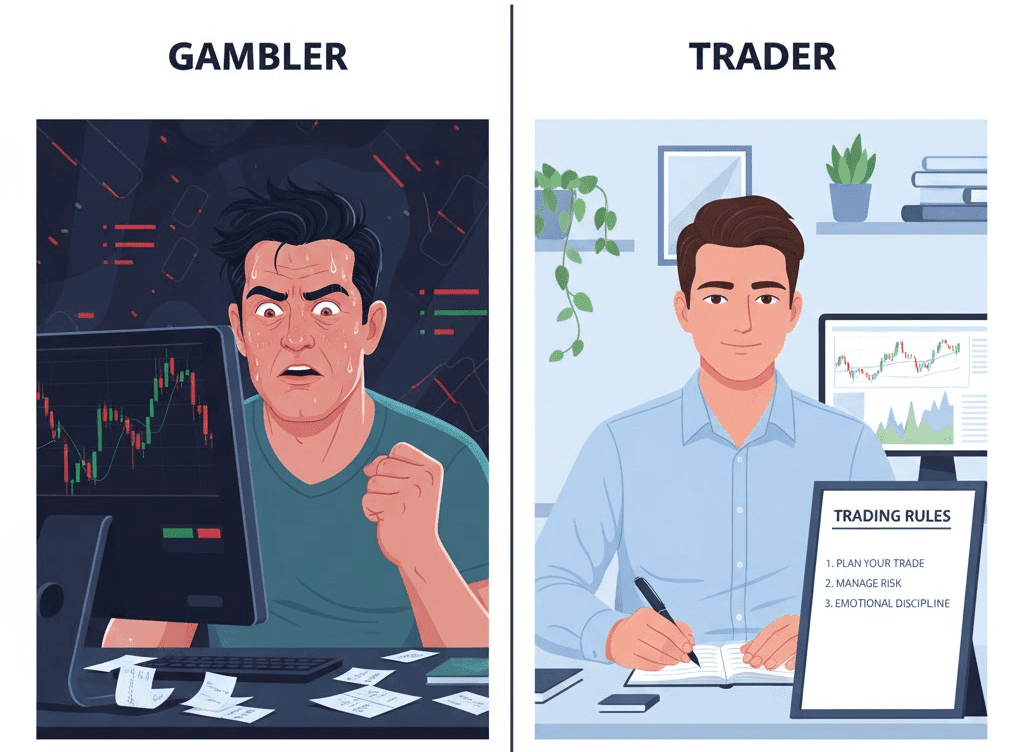
Gambler (drunk): Bets based on 'feelings' and 'luck', wanting to 'go all in' to recover losses when losing, and greedily unable to stop when winning. They have no strategy, no risk control, and entrust their fate to 'fate'.
Professional player: They calculate the 'winning rate' of each hand (how likely am I to win?), calculate 'odds' (if I bet $1, how much can I win back?). They calmly discard most hands (controlling risk) and only decisively bet when the winning rates and odds are in their favor (executing the system).
Gambling is entrusting fate to luck; trading is entrusting decisions to probability.
Whether it's 'gambling' or 'trading' never depends on the market, but solely on you sitting in front of the screen.
Establish a core trading view: Embrace 'uncertainty'
Before becoming a trader, you must accept two cruel but extremely important facts:
Fact 1: The market is always unpredictable
We can never predict with 100% certainty whether the next candlestick will rise or fall. Anyone who tells you 'I can accurately predict highs and lows' is either a liar or a madman.We are like 'weather forecasters'. We can analyze data and conclude that 'there's an 80% chance of rain tomorrow' (high probability decision), but we can never predict 'which specific raindrop will fall on your head at 3:05 PM' (precise prediction).
So, please immediately give up the fantasy of finding a 'holy grail' and '100% win rate'.
Fact 2: Profits and losses come from the same source
'Profits and losses come from the same source' is one of the deepest concepts in trading. It means thatThe reason you made money this time will inevitably be the reason you lose money next time.For example: You made a big profit because you 'stuck to the rules' and bought when the price hit a support level. The next time, you also 'stuck to the rules' and bought at the support level, but the market directly broke down, leading to your stop loss.
Therefore, please calmly accept losses. Losses do not mean you did something wrong; they are merely the necessary trial-and-error costs of your trading system. Just like a store will always have inventory losses, it is a part of trading, not a failure on your part.
The Holy Grail of Trading: Positive Expected Value Decision Making 📈
Since the market is unpredictable, how can we make money?
The answer is: rely on 'positive expected value'.
This sounds very professional, but the principles are frighteningly simple. Opening a casino and starting an insurance company are the most profitable businesses in the world. Why?
Casino: Although sometimes a gambler may win a large amount of money (single loss), the rules of the casino ensure that as long as there are enough players and enough time, the casino will overall be profitable (positive expected value).
Your task: Don't be a gambler; you need to be the 'casino owner'.
You need to establish a system of 'positive expected value'. This only requires two core elements:
Win Rate: Out of your 10 trades, how many did you predict correctly? (For example, 6 times, win rate 60%)
Risk/Reward Ratio: How much can you earn each time you predict correctly? How much will you lose each time you are wrong? (For example, earn $200 when right, lose $100 when wrong, risk/reward ratio is 2:1)
Let’s do some calculations:
Assuming your system is: win rate 50% (not high, right?), risk/reward ratio 2:1 (very strong).
You trade 10 times:
5 correct predictions, earning $200 each = Profit $1000
5 wrong predictions, losing $100 each (because you strictly followed the stop loss from Lesson 7 of (Beginner's Guide)!) = Loss $500
Total: Net Profit $500
Do you see it? Even if half of your trades are wrong, as long as you stick to this system, you will ultimately be profitably stable.
The essence of trading is to give up '100% win rate' in favor of pursuing '100% discipline', using strict stop-loss (controlling losses) and patient holding (amplifying profits) to execute a positive expected value system.
Conclusion: Your first step in transformation
Alright, in today’s class, we've reshaped our fundamental understanding of 'trading' together. I hope you remember that trading is not gambling, but a decision-making game based on probability and discipline. Our goal is not to pursue a 100% win rate, but to fully execute our ‘positive expected value’ system.
The content of this class might be a bit 'brain-burning', but it's very important. I would like to invite you to chat in the comments:
In your past few experiences of watching the market or simulated trading, did you resemble a 'gambler' (based on feelings, emotional, wanting to go all in) or a 'professional player' (thinking probabilistically, having a plan, being disciplined)?
Don't be afraid to say the wrong thing; real feelings are the most valuable.
Since trading is a 'game of chance', in the next lesson, we must know who the other 'players' at the table are. What tricks do they have? We will reveal: (Market participants' game diagram), introducing you to those true 'whales' and 'market makers'!
If this class gives you a brand new and more professional understanding of trading, please be sure to like, bookmark, and follow! This is the first step in your transformation from a 'player' to a 'trader'! See you in the next class!
(Disclaimer: The above content is for sharing trading knowledge and does not constitute any investment advice. All trading involves risks, and the market is highly volatile. Entering the market requires caution, and please ensure proper risk control.)
Click to view: Previous basic teaching and selected article content