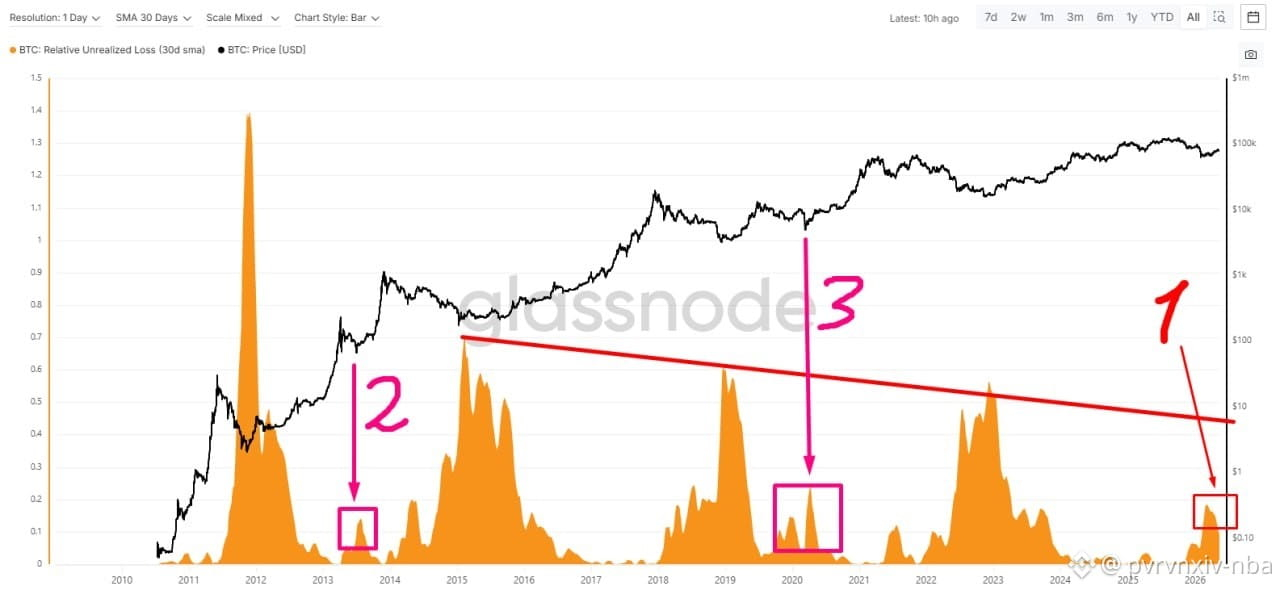
🟠 The chart below shows the ratio of unrealized losses (NUPL) for ALL BTC holders (expressed in USDT) to total market capitalization, in %. At the peak of the decline on February 6, the NUPL ratio jumped to 25%. However, given that we are looking at the entire history (since 2010), it makes sense to smooth these figures to at least a 30-day average, which is what I did. Therefore, the peak NUPL ratio in late February–early March reached ~18% on average (point #1)
Visually, each new cycle is characterized by a decrease in the share of unrealized losses, so it would not be surprising if the current bear market bottom is reached with less pain than in 2022. But even so, if we remove the very first cycle from the equation (due to its extreme volatility) and perform a linear regression, we can see that the hypothetical bottom in the current cycle could be reached around a 40% share of unrealized losses on a monthly average
Could this be a “local” major loss before the next ATH is reached? It could be, as was the case at point #1 (the Mt. Gox debacle) and point #2 (the pandemic). However, visually it doesn’t look the same, because there are no obvious force majeure events targeting both all markets and crypto specifically (like the Chinese ban in May 2021), and the timing is already stretching out too long (force majeure events are usually clear-cut and happen quickly)
—
• Therefore, overall, I’m still leaning more toward a decline. Even if the price of BTC rises even higher now, the key resistance level will remain around $89,000–$90,000, as the point where the structural weakness of the leading crypto asset begins to shift.
#onchain #BTC #ATH $BTC
Visually, each new cycle is characterized by a decrease in the share of unrealized losses, so it would not be surprising if the current bear market bottom is reached with less pain than in 2022. But even so, if we remove the very first cycle from the equation (due to its extreme volatility) and perform a linear regression, we can see that the hypothetical bottom in the current cycle could be reached around a 40% share of unrealized losses on a monthly average
Could this be a “local” major loss before the next ATH is reached? It could be, as was the case at point #1 (the Mt. Gox debacle) and point #2 (the pandemic). However, visually it doesn’t look the same, because there are no obvious force majeure events targeting both all markets and crypto specifically (like the Chinese ban in May 2021), and the timing is already stretching out too long (force majeure events are usually clear-cut and happen quickly)
—
• Therefore, overall, I’m still leaning more toward a decline. Even if the price of BTC rises even higher now, the key resistance level will remain around $89,000–$90,000, as the point where the structural weakness of the leading crypto asset begins to shift.
#onchain #BTC #ATH $BTC