


We have less than a month until the largest IPO in history drops.
SpaceX is about to ring the bell at Nasdaq, with a potential listing date as early as June 12, under the ticker SPCX. Leading the underwriting are Morgan Stanley, Bank of America, Citigroup, JPMorgan, and Goldman Sachs, along with 16 other investment banks handling institutional, retail, and international channels.
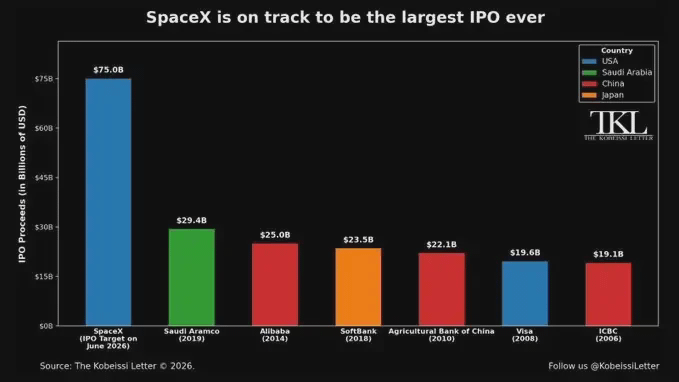
SpaceX aims to raise $75 billion, with a valuation of $1.75 trillion. The historical record set by Saudi Aramco in 2019 at $29.4 billion will be wiped out in one go. Even with the most conservative estimates, this will be the largest IPO in history.
On May 15, SpaceX's private shareholders approved a 5-for-1 stock split, bringing the fair value per share down from $526.59 to about $105.32. The number of circulating shares increased by 400%. This is a clear signal that the company is making room for retail investors. Bloomberg reported last week that Brookfield has already placed a $2 billion bet on pre-IPO shares.
Musk will officially become the world's first trillionaire the moment the bell rings.
And besides Musk, the real biggest winner of this IPO may not be on Wall Street or Silicon Valley.
It's an on-chain trading platform that has been online for less than six months: trade.xyz.
The on-chain Nasdaq prototype is taking shape.
'Price discovery' is the core power in financial markets.
When a new stock is listed, who holds the pricing power? In the past, this power was distributed across a few very clear positions. The primary market belongs to the underwriting syndicate, who roadshows, inquiries, and creates the book, ultimately negotiating an issuance price internally. The transition from primary to secondary is managed by market makers and designated traders responsible for opening matching. Only after the secondary market does the power truly devolve to all buyers and sellers.
trade.xyz is rewriting this power chain.
And this capability has already been proven by trade.xyz during the recent Cerebras IPO.
May 14, 10 PM New York time.
There are three hours left until Cerebras Systems officially opens on Nasdaq. This company is a 'challenger to Nvidia,' with a dinner plate-sized AI chip and a customer list that includes OpenAI. The IPO pricing is $185, already double the market's expected ceiling.
Nasdaq's pre-market matching is still ongoing, and retail investors won't be able to trade this stock until after 1 AM the next day.
But the CBRS contracts on trade.xyz have started to gain volume.
Prices surged from $290 to $380, with nearly $100 million in transaction volume within an hour. By the early morning of the next day, Cerebras officially opened on Nasdaq at an opening price of $350, which is 89% higher than the IPO price. It peaked at $386 during the day.
Related reading: (Cerebras IPO skyrocketed 68%, and the on-chain market had already set the price hours ago).
A more intuitive comparison is to look at trade.xyz alongside traditional Pre-IPO platforms.
Forge Global is one of the largest secondary markets for private equity globally, serving institutional investors, VCs, and qualified individual investors, with entry thresholds of $200,000 annual income or $1 million net worth. On May 12, the day before the IPO pricing, Forge Price gave Cerebras' final reading of $113.50, corresponding to a valuation of $29.26 billion, which is 174% lower than the Nasdaq opening price.
Hiive has a similar positioning but is more active, with a final transaction price of $224.93. This is much more accurate than Forge, but still has a 56% deviation from the Nasdaq opening price.
trade.xyz's quotes range from $290 to $380.
The higher the platform's thresholds, the poorer the pricing. The more open the platform, the more accurate the pricing.
This is not a coincidence; it's a structural difference.
Forge and Hiive are essentially one-way markets. Sellers are employees and early investors looking to cash out, while buyers are qualified investors who believe in the company. No one can publicly bet that 'this company is overvalued' because there are no channels for shorting. This creates a systemic bias where one-way market prices can only be driven by upward pressure, with no outlet for bearish forces.
Forge Price is updated daily and is an output of an algorithm model, not real-time market transactions. Hiive's transactions are discrete, sometimes taking days to execute one. During the roadshow, investment banks release price signals to the market every few days, each time selectively disclosing information.
trade.xyz is a 24/7 matching market that updates prices every 3 seconds. It allows anyone with a USDC wallet globally to participate, whether going long or short. Every transaction and every order is a public expression of the participants' judgment on the company using real money.
The on-chain market is leading Nasdaq in price discovery.
This trend has naturally been captured by top traders.
'Today I received 4 calls from different funds, all watching CBRS trades on trade.xyz for price discovery. This is surreal.' On the day of CBRS's Nasdaq debut, macro blogger Citrini tweeted this.
On the same day, he added a second tweet with just one sentence, accompanied by a photo of Wall Street traders glued to their screens.
'Morgan Stanley's price discovery happens on trade.xyz.'
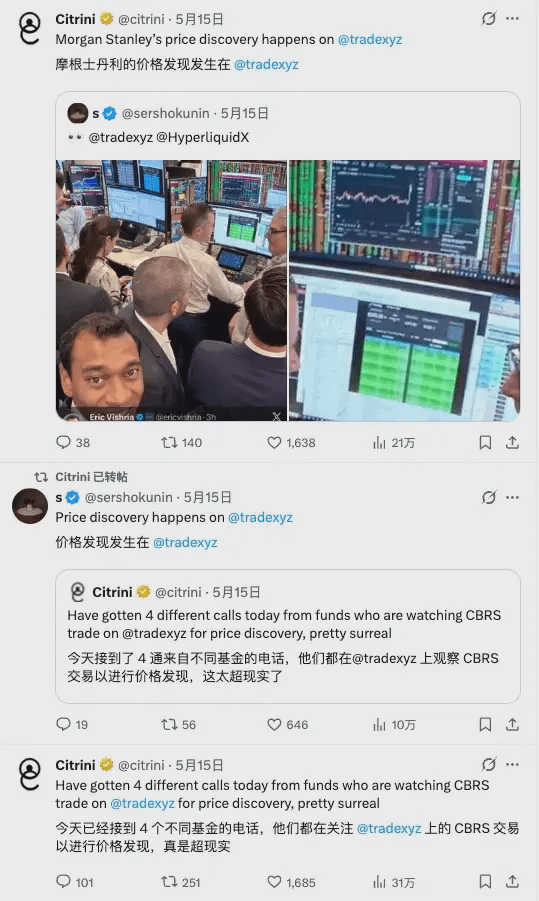
These two tweets were shared hundreds of times. The retweet list includes Benchmark partner Eric Vishria, VanEck's head of digital asset research Matthew Sigel, and a group of accounts that aren’t on Crypto Twitter but usually write about macro and stocks.
It is noteworthy that Citrini himself is not from the DeFi circle. His main content over the past few years has been on macroeconomics, AI, and IPO arbitrage, with a customer base primarily comprised of institutions and family offices. The public endorsement of a HIP-3 contract by such an account signifies that 'price discovery has migrated' into the dialogue framework of traditional finance.
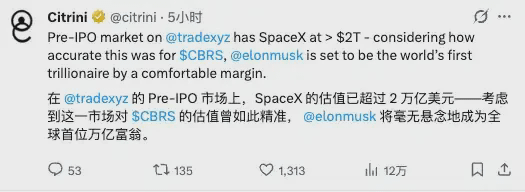
By May 18, the day SPCX went live, Citrini tweeted again. 'On trade.xyz's Pre-IPO market, SpaceX's valuation has already exceeded $2 trillion. Considering how accurately this market valued CBRS, Musk will undoubtedly become the world's first trillionaire.'
In a sense, trade.xyz has transformed from an experimental decentralized trading platform into a 'pricing benchmark' that can be cited by traditional finance professionals.
Hyperliquid is a high-speed train, and trade.xyz is at the front.
Hyperliquid is a high-performance Layer 1 blockchain designed for derivatives trading, featuring a fully on-chain order book system. It processes 200,000 orders per second, with a block time of less than 1 second, and all transactions, matching, and settlements are completed on-chain by Hyperliquid's validator network. To date, Hyperliquid holds a 38% share in the on-chain perpetual contract market, making it the de facto leader in this space.
trade.xyz is a layer of trading interface built on Hyperliquid.
To be more precise, trade.xyz is the first independent deployment under the third improvement proposal HIP-3 of Hyperliquid. HIP-3 allows independent builders to deploy and operate their own perpetual contract markets on the Hyperliquid chain, with Hyperliquid providing the matching engine, margin system, and on-chain settlement while builders define market listings, oracle sources, leverage limits, and parameter rules.
Simply put, Hyperliquid is the underlying infrastructure, while trade.xyz is the product built on top of it. One wallet, one USDC margin, one order book connects all Hyperliquid ecosystem products.
The uniqueness of trade.xyz lies in its ability to connect on-chain matching capabilities to the most valuable off-chain assets—U.S. stocks, indices, commodities, and now the opening of the Pre-IPO sector. It has launched perpetual contracts for mainstream stocks like Apple and Tesla, and received official authorization from S&P Dow Jones Indices to launch the first S&P 500 perpetual contract. The first target in the Pre-IPO space is Cerebras, followed by SpaceX.
The RWA perpetual contract position on Hyperliquid has historically surpassed $2.5 billion for the first time. HYPE surged over 20% in a single day, breaking $40. In the on-chain perpetual contract market, Hyperliquid holds a 38% share. Meanwhile, several events have occurred in the Hyperliquid ecosystem recently. USDH has been taken over by Coinbase, and Circle's USDC has become Hyperliquid's Aligned Quote Asset. Hyperliquid captures 90% of reserve returns for HYPE buybacks and ecosystem incentives.
This is a series of simultaneous events. Coinbase and Circle provide infrastructure backing, and the stablecoin pipeline is now open. The breakthrough in HIP-3's position indicates that real trading demand is flooding in. HYPE's price movement shows that the secondary market is re-evaluating the system's valuation.
trade.xyz is the team that first turned these underlying capabilities into visible products in this system.
2026 is a big IPO year. Cerebras has already landed, and SpaceX will ring the bell on June 12. OpenAI and Anthropic are both in line. Each project is in the strongest narrative sectors of hard tech, AI, and aerospace, which are also the most concentrated areas for retail flow.
Hyperliquid is a high-speed train already in motion, with 2026 being the IPO year, heading to the most concentrated spots in this market. trade.xyz is at the front.
At the moment SpaceX rings the bell on June 12, Morgan Stanley will receive underwriting fees, Brookfield will cash in on its $2 billion bet, and Musk will become the world's first trillionaire.
trade.xyz has captured a narrative. On the eve of the largest IPO in history, the 'pricing power' has shifted. Once this consensus is acknowledged by the market, trade.xyz will become one of the biggest winners during the SpaceX IPO.
This is also a microcosm of the long process of DeFi gradually eating into the TradFi market.