


Only when tokenized assets can be settled in real-time do RWAs truly complete the last mile on-chain.
Written by: angelilu
On the evening of May 14, when the CLARITY Act passed the U.S. Senate Banking Committee with a 15-9 vote, both RWA real-time redemption products went live almost simultaneously. The regulatory 'crypto moment' and the technological 'RWA moment' hit their key milestones on the same night.
One is Upshift Clear, a platform launched in collaboration with Superstate, designed for tokenized real-world asset (RWA) holders to access instant redemptions. The other is Grove Basin, launched by Grove Finance, positioned as a 'programmable credit infrastructure' that promises eligible token holders up to $1 billion in instant stablecoin liquidity in a single day.
Grove Finance wrote an ambitious statement in its announcement: "RWA is about to have its 'stablecoin moment'."
If you've watched RWA grow from $5 billion to $31 billion over the past three years, but have always been puzzled about "how it connects with DeFi," then these two products today provide the initial form of that answer.
What exactly is the "last mile" that RWA is stuck in?
Let's start with the data. RWA.xyz shows that as of May 15, the global on-chain distributed tokenized assets totaled $31.42 billion, with 785,000 holders. Among them, US Treasury bonds accounted for more than half ($15.2 billion), and leading products include Circle USYC, BlackRock BUIDL, Franklin BENJI series, and Superstate USTB.
But tokenization is only the first half; redemption is where the real bottleneck lies.
The redemption process for most tokenized government bonds follows this pattern: Users submit redemption requests during trading hours (usually before a cutoff time on a business day) → the issuer sells the corresponding government bonds or repo positions within the underlying fund → interbank clearing is completed on T+1 or T+2 → users receive USDC or fiat currency. The entire process is essentially no different from buying and selling a traditional money market fund—this is the most criticized aspect of tokenized assets: "On-chain speed, off-chain settlement."
Upshift co-founder Aya Kantorovich put this pain point very bluntly. Having previously worked at institutional crypto brokerage FalconX, she wrote on X, "The most agonizing part for institutional clients is getting interest-bearing assets into their own settlement window. The returns are good, but the redemption track never really works with anything else."
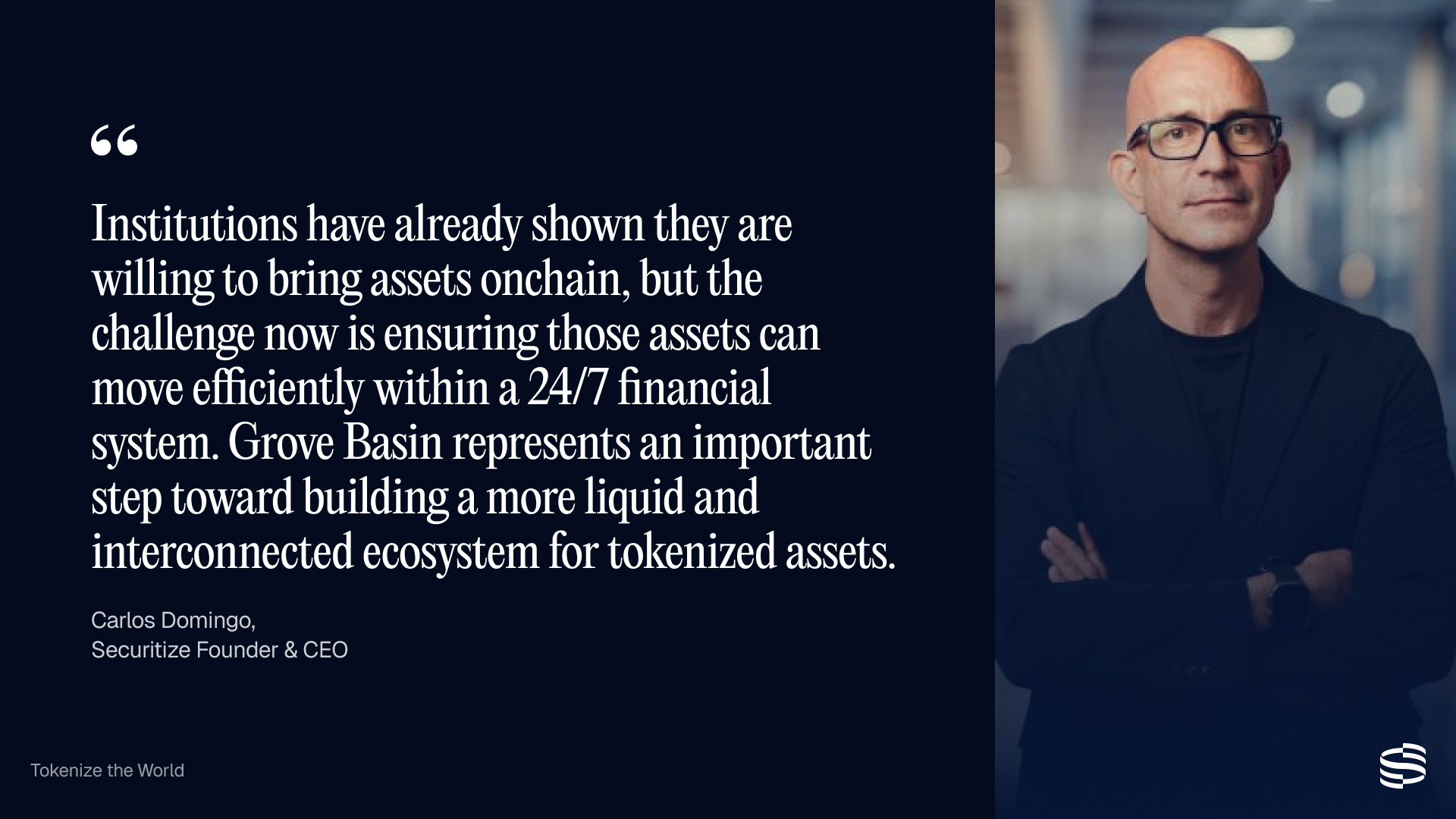
Securitize, a Grove partner, stated that institutions have indicated their willingness to bring assets on-chain, but the current challenge is ensuring these assets can flow efficiently within the 24/7 financial system. Grove Basin represents a significant step towards building a more liquid and interconnected ecosystem for tokenized assets.
Upshift Clear and Grove Basin: Two routes, same destination
For real-time redemption, Upshift Clear's solution is the "USDC reserve pool model": maintaining a dedicated USDC pool, when an RWA holder initiates a redemption, the platform directly provides the equivalent USDC from the pool, bypassing the underlying asset's several-day liquidation process; simultaneously, the platform gradually completes the actual redemption with the issuer in the backend, then replenishes the reserve pool. The first product integrated was Superstate's USCC, with a redemption fee of 0.05% of the redemption amount.
Grove Basin takes a different approach. Instead of being tied to a single product, it positions itself as a "programmable credit infrastructure": allowing any eligible tokenized asset holder to exchange their tokens for stablecoins and exit through standardized endpoints, atomically, within a single block. Grove investor and partner Kevin Chan succinctly summarized its ambition: "Tokenized assets should inherently be settled in a programmable, atomic way."
The underlying principle is the same: the prerequisite for the true usability of tokenized assets is an instant exit layer; otherwise, RWA will forever remain merely an "on-chain custodial certificate," not a true on-chain asset. BlackRock's BUIDL has already validated this exit layer—its partnership with Circle allows large holders to exchange for USDC "in real time" during business hours. However, BUIDL × Circle is a single-point solution, only effective for BUIDL; Upshift Clear and Grove Basin have pushed this to a general layer.
One company is affiliated with OTC, and the other is affiliated with MakerDAO.
Upshift is backed by August Digital—two product lines from the same team. August is an on-chain capital and execution platform for institutional clients, covering more than 13 public chains, over 250 tokens, and more than 70 protocols, with a monthly trading volume of $7 billion and cumulative loan facilitation exceeding $400 million. In March 2025, August completed a $10 million Series A funding round, led by Dragonfly, with participation from 6thMan, Robot Ventures, Foresight Ventures, Maven11, and SCB. Upshift, on the other hand, is August's product entry point for "non-custodial vault" users and integrates with Securitize to generate independent NAV reports to meet institutional transparency requirements.
Upshift co-founder and co-CEO Aya Kantorovich was a founding member of the sales and trading team at institutional crypto brokerage FalconX. She left FalconX a month before the FTX collapse; prior to that, she worked at Pantera Capital. Her and her team's painful experience of "why institutional clients are unwilling to put their interest-bearing assets on-chain" is the initial source of Upshift Clear.
Grove Finance is a direct descendant of the Sky ecosystem. Incubated by Sky (formerly MakerDAO) and supported by Steakhouse Financial (Steakhouse has long been a core RWA advisor within Sky's governance structure). Grove's early collaborations focused on large-scale projects: in June 2025, it officially launched an institutional-grade lending protocol; in October of the same year, it partnered with Janus Henderson to launch a tokenized AAA CLO fund; and it deployed a $250 million on-chain lending strategy on Avalanche, allocating funds to JAAA issued by Centrifuge. In other words, Grove is not a new player in RWA starting from scratch; it is a product of commercializing all the relationships and liquidity management experience accumulated by MakerDAO in RWA over the past three years.
Once you understand the backgrounds of these two companies, their product strategies become clear: Upshift Clear comes from the perspective of an "institutional OTC + Vault product manager," aiming to solve specific clients' current redemption bottlenecks; Grove Basin comes from the perspective of a "protocol-layer financial engineer," aiming to rewrite the entire RWA clearing interface.
Foreseeable risks of the two technologies
Upshift Clear's solution is product-based, tied to a specific asset and providing a specific redemption channel—simple, straightforward, and immediately usable. However, its essence is a "centralized reserve pool," which has a size ceiling and faces difficulties in cross-platform compatibility. Upshift Clear's USDC reserve pool has an upper limit, and large single redemptions may still be restricted.
Grove Basin is infrastructure-based, allowing any tokenized asset to connect and complete atomic settlements through standard endpoints. It addresses not just the redemption of a single product, but the redemption of the entire ecosystem. However, Grove Basin has a high barrier to entry and complexity for "qualified token holders," meaning ordinary retail investors cannot currently access the $1 billion daily liquidity. Both products are still in their early stages, but their paths are already clear.
Why is this called RWA's "stablecoin moment"?
RWA is currently in a phase where the assets exist and are substantial in scale, but are not "usable." A user holding $1 million in BUIDL theoretically earns a 3.4% return, but cannot use it for instant payments, stable collateral, or instant liquidation. You are holding "government bond certificates," not "government bond stablecoins." Upshift Clear and Grove Basin aim to make the latter possible.
Liquidity is always the mother tongue of finance. At the same time, "liquidity equivalence" can also blur the regulatory boundaries between securities and stablecoins—when a tokenized government bond has the same redemption speed as USDC, which category does it belong to? This is a question that the CLARITY Act must answer in the next wave.