


null
On May 4th, Doubao launched a paid version. As the largest AI product in China with the largest user base, Doubao's pricing immediately sparked discussions about whether the era of free AI is over.
But there is one question that almost no one asks: Why would a product that has achieved scale be the first to charge high fees and set the average order value at a not low price of 68 yuan?
The usual scenario is the opposite: products that are lagging behind and haven't yet reached scale are the ones most eager to monetize.
Before the news of this new pricing announcement broke, Growth Black Box had already begun researching the Doubao product team. In this article, we'll attempt to answer those questions.
1
Just how strong is Doubao?
Let me make it clear first, we won't discuss model technology algorithms; the "strength" we're talking about here refers to market penetration.
As of the first quarter of 2026, Doubao's monthly active users reached 345 million, roughly equivalent to the total number of the second to fourth ranked domestic AI products [1]. This is a clear lead, without any suspense.
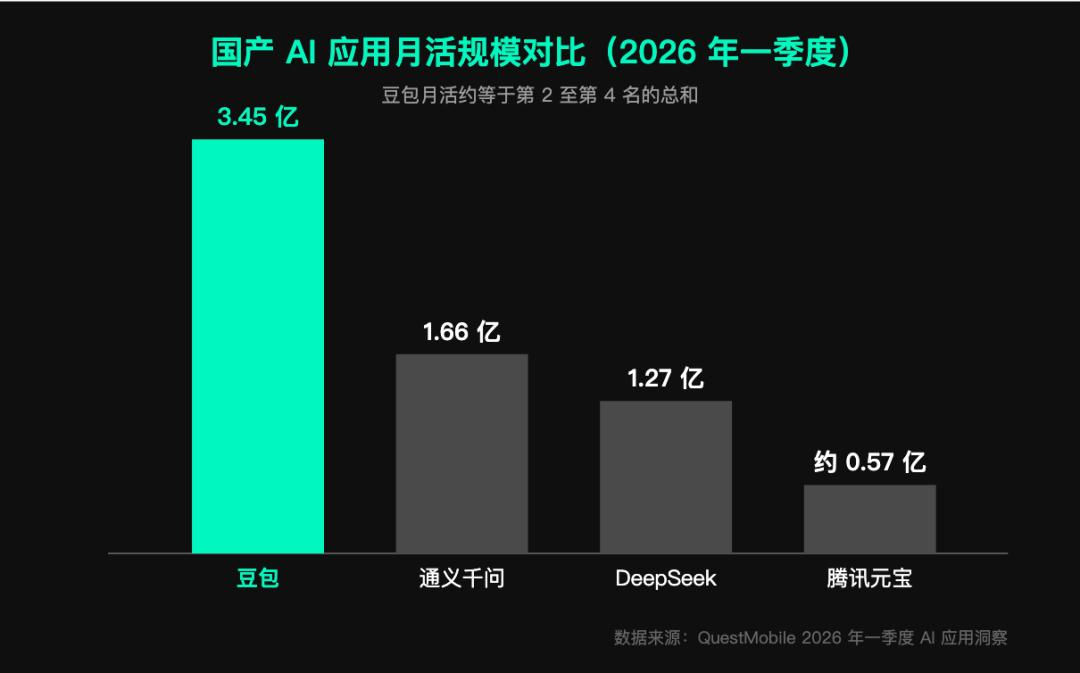
What's even more noteworthy is that it's still growing. A product with such a large user base typically experiences a rapid slowdown in growth, but Doubao hasn't. We understand that Doubao's user base has nearly doubled in the past year, and as of the beginning of this year, it was still adding around 900,000 new users daily. This growth isn't a smooth curve; it experienced slowdowns, surges, declines, and then began climbing again from the fourth quarter of last year, but the direction has always been upward.
The retention rate is also impressive, with Doubao's new user retention rate at approximately 36% on the second day. In this respect, it surpasses many general AI products such as Kimi, MiniMax, Mita, Yuanbao, and Qianwen, and is the highest among products in this category based on the data gathered during our research. In other words, Doubao isn't relying on existing users to maintain its presence; it retains new users, and its core user base is very healthy.
What's more noteworthy than the scale is the "generalization" of Doubao users.
A year ago, Doubao's user profile still had obvious characteristics of an early AI product, with men accounting for more than 70% and concentrated among young people in first- and second-tier cities. However, by the beginning of this year, this structure had changed dramatically, with the gender gap narrowing significantly (57% male: 43% female), and users from fourth-tier cities and below accounting for about 30% of the total, making it significantly more accessible to lower-tier cities than products like Kimi.
One detail clearly illustrates the direction of this change: Doubao's voice call function has a penetration rate of nearly 40%, and this function is particularly popular in fourth- and fifth-tier cities. As we understand it, an increasing number of middle-aged and older users who previously had little exposure to AI are entering Doubao through the simplest and most accessible method: making a phone call.
This fully demonstrates that Doubao is transforming from a "geek tool" into a "national-level everyday tool." However, please remember this "generalization," as we will discuss the other side of this coin later.
Another dimension that is easily overlooked is that Doubao users are not only numerous, but they also use it very deeply. Doubao users open it more than twice a day on average, and each conversation often involves more than six rounds. Roughly estimated, the number of conversations generated on the mobile device alone is in the billions every day. This usage intensity is leading in the industry. According to QuestMobile data, in the first quarter of 2026, the average monthly usage of Doubao reached 54.8 times, which is significantly higher than similar products such as DeepSeek and Qianwen[1].
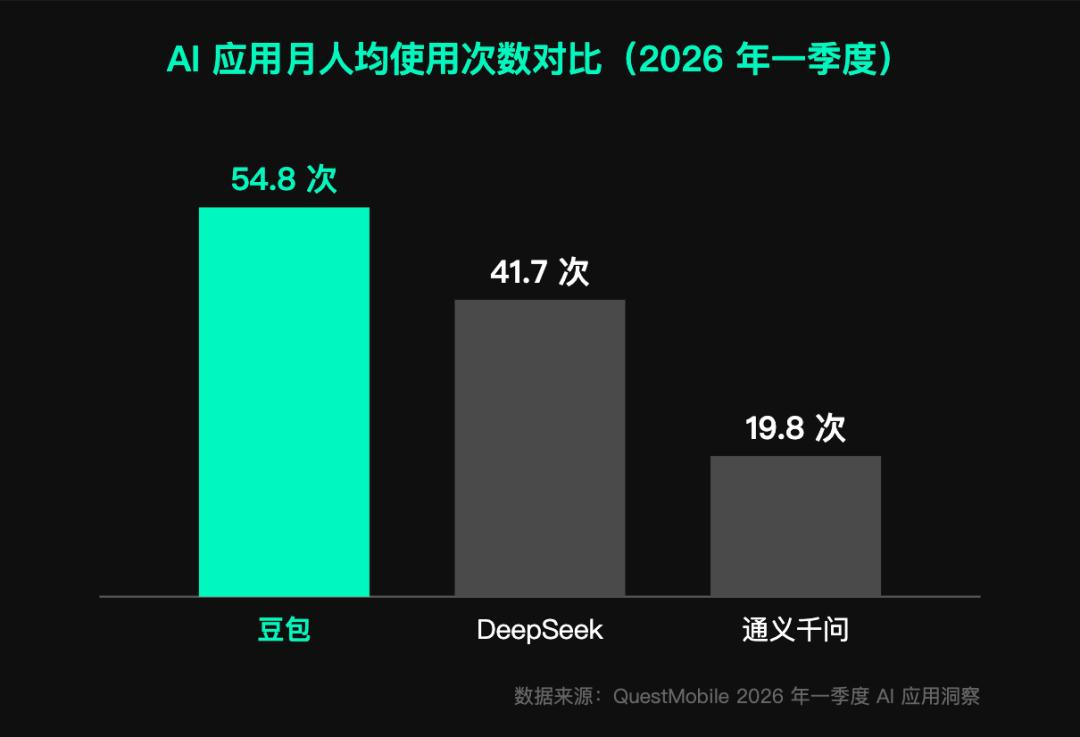
Putting all these factors together, Doubao's profile is quite complete: the AI product with the largest, fastest-growing, most engaged, and most frequently used user base in China. In terms of user base, it holds almost the best hand.
2
Users ask questions on Doubao, but rarely buy from it.
Returning to the initial question: Why is a product with the largest user base the most eager to charge fees? To answer this, we must first figure out how Doubao plans to monetize these users.
For a "national-level life assistant," the most promising and logical monetization path is through consumption. The logic is simple: when users get used to asking Doubao (the platform's name) about everything—questions like "What phone should I buy?" or "Which baby formula is suitable for my child?"—they will naturally occur in large numbers during conversations. The platform simply needs to seamlessly connect the product and transaction the moment a user has the intention to buy, and traffic becomes business. In the era of explosive growth in social media content, Xiaohongshu (Little Red Book) and Douyin (TikTok) have both followed this path.
We also saw from other sources that data from April 2026 showed that the conversion rate of the product cards that appeared in Doubao Answers had reached more than 3%, which is higher than many traditional e-commerce advertisements[2].
Logically, Doubao should have the greatest potential on this path. But surprisingly, we found that Doubao actually encountered the most difficulties on this very path.
Doubao internally categorizes user needs into 14 major categories. Growth Black Box research revealed that "shopping and consumption decisions" ranked 9th, accounting for 6%. Six months ago, this category didn't even exist; shopping-related needs were so few that there was no need to separately analyze it. From nothing to 6%, the growth rate isn't slow, but the absolute value remains very small.
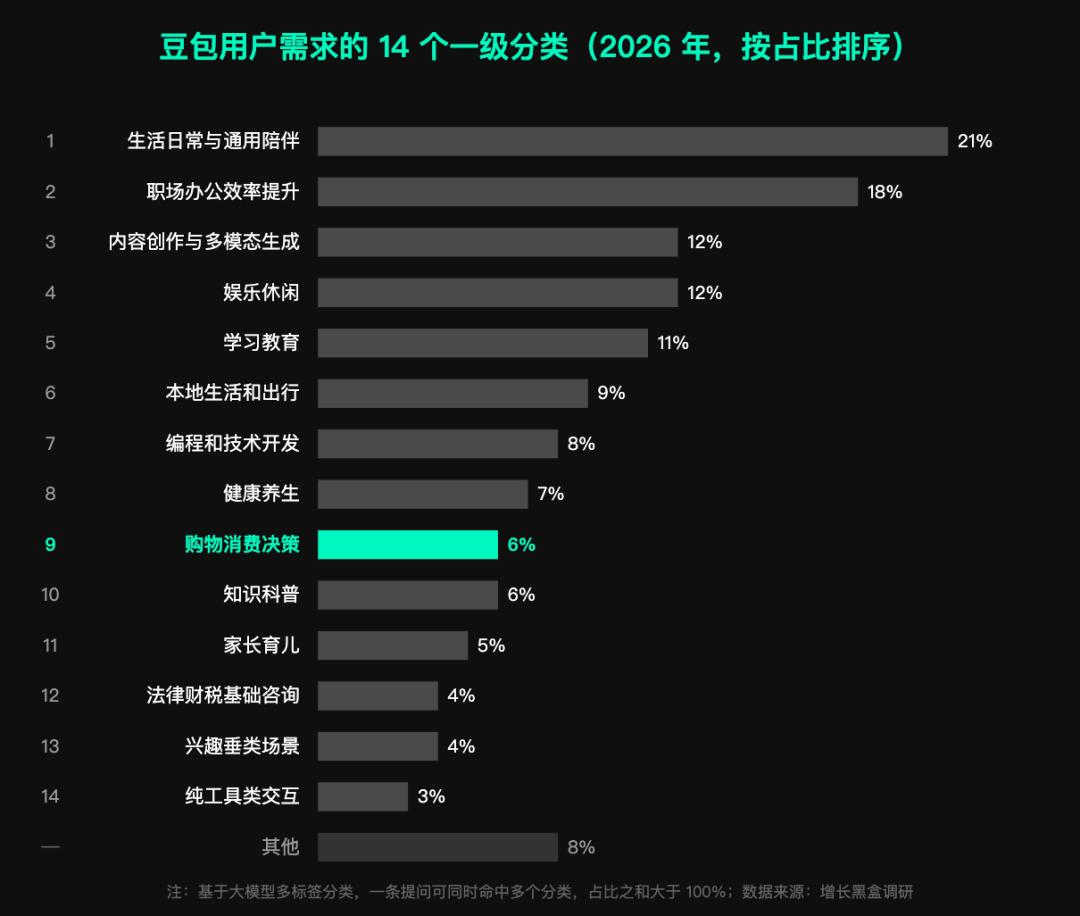
It's important to note that Doubao's categorization is based on a comprehensive judgment made by the model according to the context, and a single question can hit multiple tags simultaneously. Therefore, some consumer intentions will be scattered across other categories such as "parenting," "health," and "daily life." Even taking all of these into account, consumer decision-making is far from being the primary scenario in Doubao's user demand structure.
Within that 6%, product comparisons and purchasing advice account for about half, gift recommendations and budget matching account for about 30%, and the remainder is coupons and explanations of promotional rules. This is a very "light" structure, where users are more focused on consulting and comparing than making a final purchase decision.
This means that within Doubao's massive user base of 345 million monthly active users, only a small fraction of users actually come with the intention of "buying things." They come to Doubao more to ask questions, seek companionship, or handle work-related matters. Shopping is not Doubao's primary focus.
This isn't a flaw in Doubao, but rather a natural consequence of its "universal assistant" positioning. However, for any brand looking to leverage AI to reach consumers, this 6% figure is one that needs to be taken seriously.
In fact, some brands are already trying this. Growth Black Box research indicates that currently 200 to 300 brands are integrating their product information into Doubao's knowledge base, hoping to be more accurately "searched" when users ask questions. These brands cover multiple industries, including apparel, footwear, daily necessities, motorcycles, and even IT services, and their numbers are considerable.
However, based on our understanding, the visible effects of this collaboration on the brand are still relatively limited at this stage, and the Doubao team itself positions it as an exploratory attempt. This is not surprising, and there are three reasons behind it:
The first reason is dilution. Doubao's knowledge base is measured in terabytes, so you can imagine that the product information a brand invests is just a drop in the ocean of information. Unless the user's question is specific enough, such as specifying age, scenario, budget, and needs, it is difficult for the brand's information to be accurately targeted. And most user questions are precisely generalized.
The second reason, and also a proactive principle of Doubao, is that it does not favor paid brands in search ranking. The Doubao team's judgment is straightforward: once users perceive that search results are manipulated for commercial gain, the product's credibility collapses. Therefore, even if a brand completes its integration, it will not be "forced" into the search results.
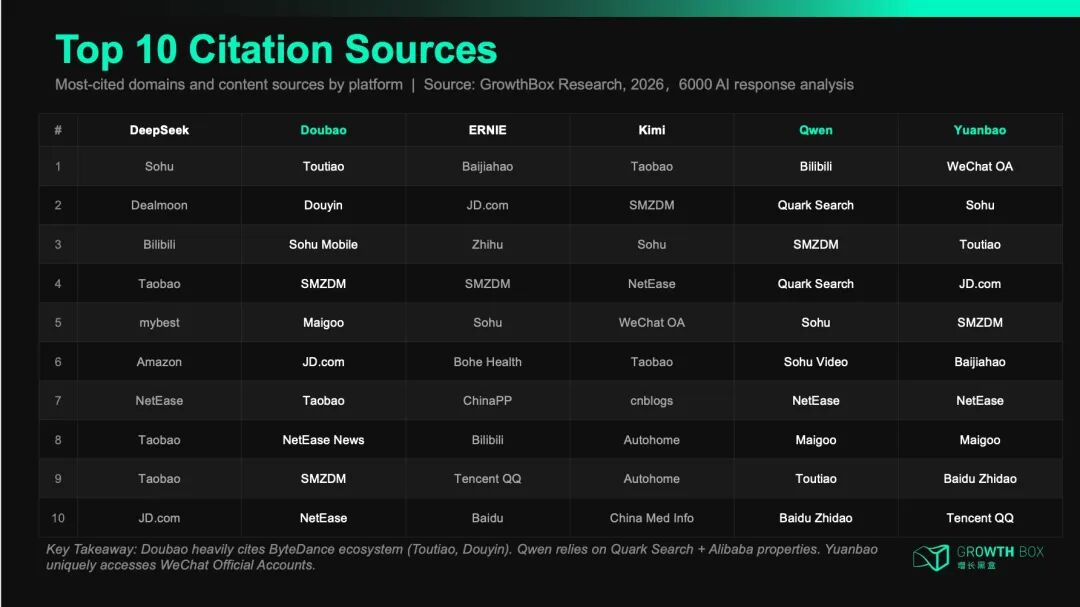
The third reason lies within Doubao's information source structure. Growth Black Box research revealed that when Doubao answers user questions, approximately 85% of the information comes from ByteDance's information sources (such as Douyin and Toutiao), which are typically text-based. Even with Douyin videos, Doubao currently only obtains the title, description, and cover image, without performing semantic analysis on the video content itself, because the cost is too high and the speed cannot keep up with the demands of real-time generation. Many brand marketing campaigns today are in the form of short videos, but given Doubao's current information source structure, it simply cannot "read" what the videos are about.
Previously, Growth Black Box provided data insights into the sources cited in various models for a major international FMCG company:
3
Doubao serves as a "traffic hub" within the ByteDance ecosystem.
At this point, the answer is clear: Doubao has the largest user base, but it hasn't converted that into a consumption scenario. The reason isn't Doubao's product capabilities, but rather its product positioning.
Doubao's team defines itself in three ways: an all-around life assistant, a lightweight creative tool, and an emotional companion. None of these three roles constitute a "consumer decision-making entry point."
Within ByteDance, Doubao is more like a "capability showcase window" and a "traffic distribution platform." It showcases AI-generated images and video creation capabilities to platforms like Jimeng and CapCut, guiding users there. It also differentiates vertical needs such as education and social networking into independent products (Doubao Aixue and Maoxiang were both spun off from Doubao in this way), and delivers incremental users to Douyin e-commerce.
In other words, Doubao is not designed to facilitate transactions; its role is "distribution," not "completion." A more critical constraint is that even if Doubao wanted to enter the e-commerce market, it currently cannot create a closed-loop system.
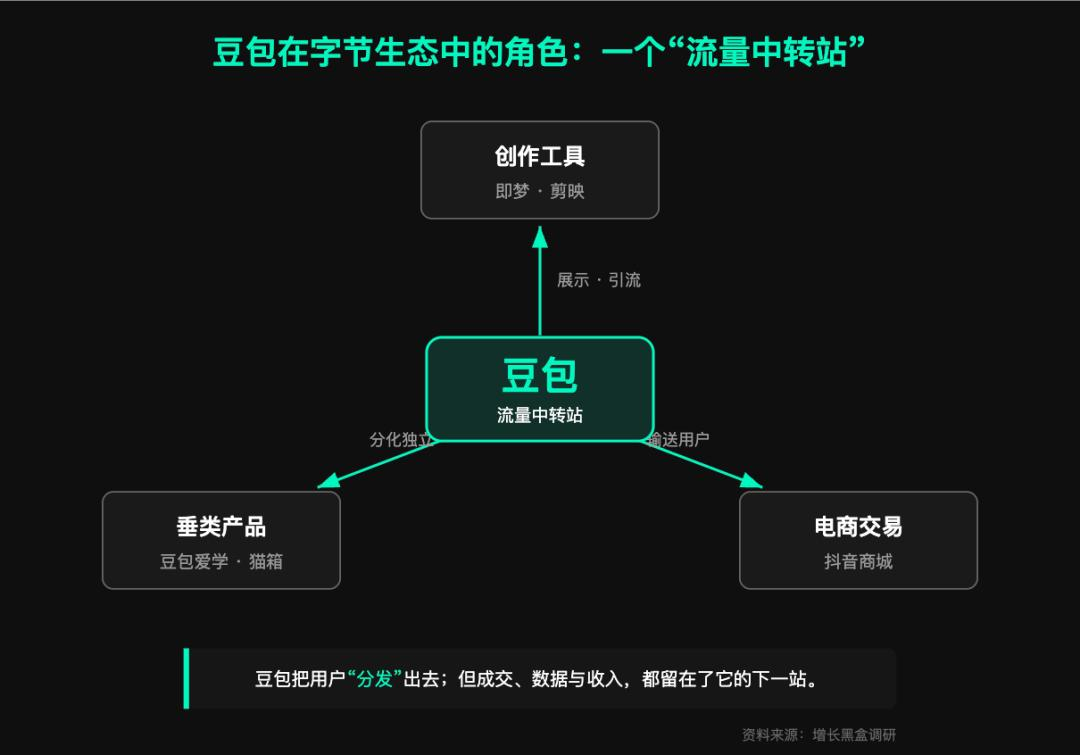
Doubao belongs to ByteDance's Flow system and is organizationally independent and parallel to Douyin; their data is not shared. Even if a user makes a purchase after being redirected from Doubao to the Douyin store, the data will not be sent back to Doubao. Doubao previously attempted to enter the Douyin ecosystem as a mini-program, but this was not sustainable.
As a result, when users inquire about products on Doubao, the most Doubao can do is provide a redirect link, and the probability of triggering this link is extremely low. It is understood that the proportion of product links appearing in questions across all product categories is about 0.1 per ten thousand. Therefore, the actual transactions all occur in places that Doubao cannot see or participate in.
If we compare Doubao with the other two leading large-scale models, the "structural" nature of this constraint becomes even clearer:
Backed by Alibaba, Tongyi Qianwen can connect to Taobao and Fliggy within the app, allowing users to place orders directly through flash sales.
Tencent Yuanbao relies on WeChat and can be integrated with WeChat Pay;
However, the transaction link between Doubao and Douyin e-commerce has not yet been established.
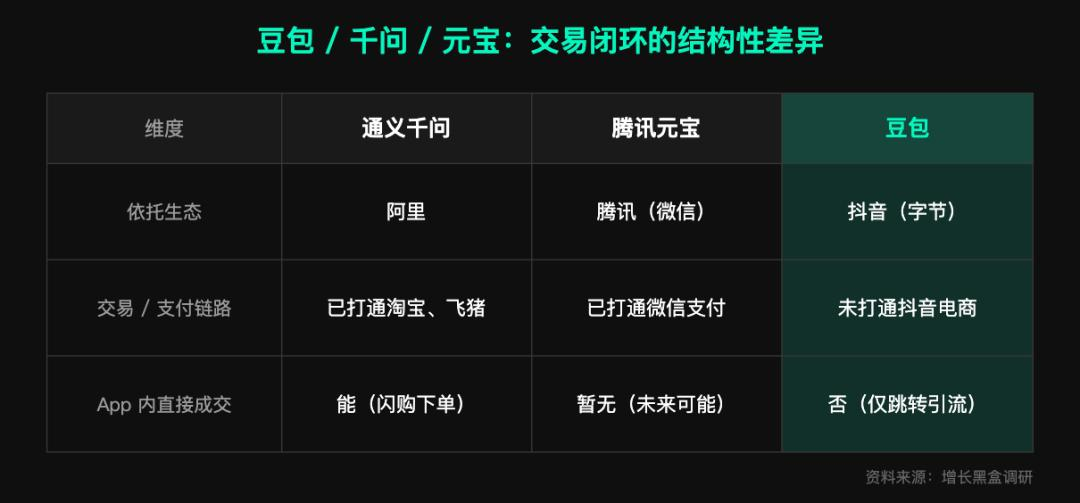
The difference between the three companies is not fundamentally about the quality of their products, but rather the degree of openness of their respective ecosystems. Qianwen and Yuanbao's parent companies are willing to open up their transaction capabilities to their AI assistants, while Douyin and Doubao are always separated by a layer.
4
Rethinking this fee
Now, let's go back to the paid version announcement on May 4th.
Looking back at our research results, the Doubao team has actually made their point very clear: Doubao is entering its third year, and in the early stages, it burned through a lot of money without corresponding returns. At the group level, there is clear pressure to assess ROI, and commercialization must be promoted.
This pressure is very specific. According to public reports, the daily token call volume of Doubao's big model has increased by about 1,000 times compared to when it was first released two years ago. Behind this is the continuous operation of the GPU cluster and huge computing power costs; while ByteDance's investment plan in AI in 2026 is as high as RMB 160 billion, a considerable part of which is invested in the purchase of AI chips[3].
In other words, on one hand, costs are still rapidly increasing, and on the other hand, revenue from end-users (C-end) is almost negligible. Before this, the Doubao App itself had no ads, and C-end revenue was basically zero. Clearly, charging fees was inevitable sooner or later.
Another detail worth noting is that Doubao's contextual recommendation ads were expected to launch in the third quarter. However, they launched the C-end subscription service in early May, even before the third quarter. This "early" launch itself demonstrates the pressure they are under.
However, this charging policy needs a deeper understanding; simply adopting the C-end subscription model doesn't mean everything will be fine.
Qianwen takes the e-commerce and CPS commission model, and its monetization path is almost a natural fit. However, Doubao's C-end subscription is charged for professional scenarios with high computing power consumption such as PPT generation, data analysis, long document parsing, and film and television production [4]. It is hard to say whether Doubao has a natural advantage in these areas. Moreover, basic chat, writing, and query are still free, and will still generate a lot of computing power consumption every day.
Looking back at the user structure of Doubao mentioned earlier—a product that is highly accessible to lower-income groups, rapidly generalized, and has a large number of middle-aged and older users who come in by "making phone calls"—it is not difficult to see that there is a clear tension between its actual user profile and the ideal user profile of "willing to pay 68 to 500 yuan per month for AI".
This is why "how hard is it to collect 68 yuan" has become a real question mark in the public opinion field. Doubao does not lack users, but its largest user group is not the group with the strongest willingness to pay[5].
It is also necessary to correct a widely circulated claim: Doubao is not the "first domestic C-end paid model". Wenxin Yiyan Professional Edition started charging as early as 2023[6]. A more accurate description of Doubao is that it is the first player among the top products to make a high-profile C-end subscription with a relatively high average order value (starting from 68 yuan and up to 500 yuan/month)[7].
Interestingly, Wenxin Yiyan was fully restored to free access in April 2025[6], which may have foreshadowed the future of Doubao to some extent.
In fact, ByteDance does have some experience with consumer-facing subscriptions. Catbox, a social AI product spun off from Doubao, already charges on a monthly subscription basis, though the average order value is only around 50 cents. Catbox and Doubao have different product formats, so this figure cannot be directly applied, but it at least illustrates that scaling consumer-facing subscriptions on a large scale within ByteDance's user base is not an easy task.
Conclusion
Doubao's pioneering move to charge fees is less a sign of commercial advancement and more a pragmatic choice of path within the constraints of its existing structure. After all, the closed-loop e-commerce model is currently impractical due to its position within the ecosystem, making subscriptions the faster path for it.
Doubao's predicament can be summarized in two sentences: it has the most users, but the least "paying" user structure; it has the richest ecosystem, but the least "circulating" internally. This is the real reason why Doubao, with 345 million monthly active users and firmly holding the top position among domestic AI companies, seems the most anxious.
It certainly doesn't lack users, but it lacks an ecosystem niche that can turn users into revenue.
Data Explanation: The content marked "According to Growth Black Box Research" or "According to our understanding" in the article comes from Growth Black Box's in-depth research on the Doubao product team in Q1 2026, and the relevant data is based on the research scope.
References
[1] QuestMobile Q1 2026 AI Application Insights: Doubao, Qianwen, and DeepSeek Monthly Active Users Reach 340 Million, 170 Million, and 130 Million Respectively, with Both User Volume and User Stickiness Rising, and Competition Entering the Second Half | QuestMobile
[2] Doubao, if you dare to charge me, then I'll use "Qianwen" to deal with you! | WeChat Official Account
[3] Doubao tests paid services, will DeepSeek follow suit? Countdown to full charging for AI assistants | 36Kr
[4] ByteDance finally couldn't resist launching a paid version of Doubao? | The Paper
[5] Doubao launches paid plan, how difficult is it to collect 68 yuan a month? | Beijing News
[6] Wenxin's free comment service, is DeepSeek now trembling? | 36Kr
[7] Trending! Doubao to launch paid version, monthly subscription from 68 to 500 yuan! | Securities Times Online
This article is from the WeChat public account "Growthbox", authored by the AI Observation Group.