After checking out the new xBubble from the @dappOS_com team, my first gut feeling is:
It's aiming to tackle a real-world issue: how everyday folks can actually leverage AI effectively.
I've actually been keeping an eye on DappOS for a while now; the team previously secured backing from YZi Labs and Sequoia China / HongShan. Sure, the funding background is a plus, but what I'm really focused on is whether their product roadmap is hitting real demand this time around.
A lot of AI products out there are pretty solid already.
But the problem is:
Users still need to grasp prompts, understand model differences, and know the toolchain;
You still gotta break down tasks, tweak the format, and polish the results yourself.
In some ways, AI has leveled up, but many users have ended up becoming 'AI project managers'.
As for xBubble's low-prompt approach, I find it interesting right here.
It's not about teaching users how to 'command AI', but about letting users express their goals while the system handles the execution path.
The core of this system is its two-layer design:
Bubble Engine
Bubble Pilot
If we simplify it:
SOP is more like a set of 'methods of doing things' that the system has solidified over time.
For example, when creating an industry PPT, you don't start from scratch every time, but rather consolidate:
Research
Structural design
Content organization
Chart generation
Formatting and delivery
These steps gradually become a stable process.
Bubble Engine is more like the learning layer in the background.
It will continuously test different models, tools, and execution paths, solidifying the most stable solutions into SOP.
Bubble Pilot, on the other hand, is more like the scheduling layer.
Users just need to state their requirements, and it will first assess the task type, then match the most suitable SOP.
If there's no corresponding process for the moment, it will also call on a general solution to complete the task while feeding the new requirements back to the Engine for continued learning and solidification.
I think this design is more pragmatic than many projects that just shout 'multi-agent'.
Because what many users really need isn't a 'complex chain', but rather 'stable results'.
The examples provided by the project team are actually quite typical:
For instance:
Creating a business PPT on (China's coffee market 2025 review and 2026 trend outlook)
Building a data comparison dashboard for 'BYD vs Tesla'
Generating promotional videos for products like iced coffee and lemon tea with just a sentence
The focus of these tasks has never been about whether 'AI can generate content'.
But rather:
Can it handle content, structure, visuals, and delivery format all at once?
This point is actually crucial.
Many general agents are more suited for open-ended exploration.
But in scenarios like PPTs, reports, web dashboards, and promotional videos, what users truly want is usually not a bunch of intermediate processes.
But rather a result that's close to 'ready for delivery'.
Also, my previous understanding of Bubble Computer was a bit narrow.
I later realized that it and Bubble Personal are essentially two different operating environments.
Bubble Computer is more like a cloud project space.
It's suitable for handling:
PPTs
Reports
Websites
Videos
These types of multi-step tasks.
The system will complete research, generation, verification, and delivery in a sandbox environment.
While Bubble Personal leans more towards a local environment.
It can operate local files, browsers, applications, and schedules with user authorization.
So it's closer to a real personal workflow.
From this perspective, xBubble is fundamentally not just a chat entry point.
It's more like productizing the 'AI usage experience'.
Right now, many AI agents are still emphasizing:
Autonomy
Long chains
Multi-agent collaboration
But xBubble chooses to stabilize the specific task processes first.
This direction might not be as flashy.
But I think it actually aligns better with what ordinary users and small to medium enterprises really need from AI.
Of course, the product is still in the internal testing phase.
Whether SOP can continuously iterate, whether different tasks can generalize stably, and whether users will stick around long-term—all these still need subsequent data validation.
But at least in terms of direction, I think it's right.
The true hallmark of AI becoming widespread may not be that everyone learns to prompt.
But rather that most people don't even need to know what a prompt is.
Welcome to experience it: https://t.co/VAzxujfs7U

Article
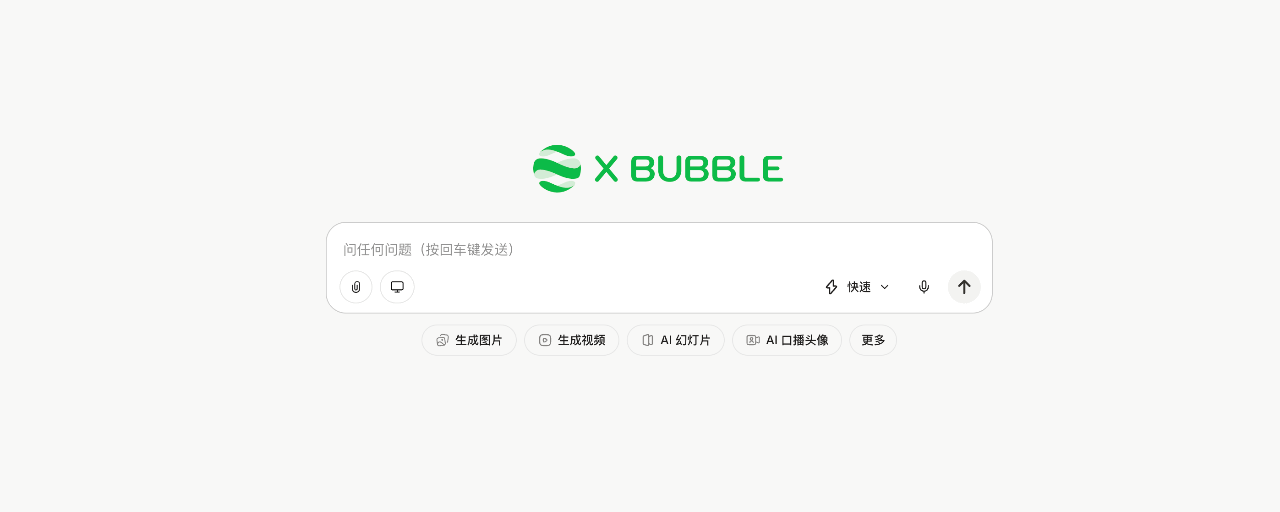
@dappOS_com team's new xBubble - how can everyday people really leverage AI?

--
Disclaimer: Includes third-party opinions. No advice. Binance AI may be used without guarantee. See T&Cs.