
The story of the 48-hour rescue of the financial markets is repeated over and over again.
Federal Reserve Chairman Powell never expected that on Wednesday he could still talk about "strong economic growth" and "continued interest rate hikes" in Congress, but on Thursday a global banking crisis broke his "peaceful days".
The collapse of the trillion-dollar Silicon Valley Bank (SVB) overnight triggered a panic that hit like a tsunami. In just two days, the U.S. financial industry experienced the largest bankruptcy since 2008. Dominoes have fallen one after another, and Wall Street has once again ushered in its "darkest moment". How should Powell deal with the crisis?
48 hours is the golden rescue time, and now it is placed before the Federal Reserve, which wants to turn the tide. It is a life-and-death rescue that shakes the world.
Alarm Bell
On Tuesday, March 7, Silicon Valley Bank was named to Forbes’ annual list of America’s Best Banks for the fifth consecutive year, and was selected to Forbes’ inaugural Financial All-Stars list.

On the same day, Powell attended a congressional hearing as scheduled, and once again warned about overheated economic data, hinting that interest rates would continue to rise aggressively.
But the black swan suddenly arrived and Powell was "caught off guard."
An announcement from Silicon Valley Bank on Wednesday, March 8, became the fuse of the crisis.
Its parent company said it would book a $1.8 billion after-tax loss on the investment sales and seek to raise $2.25 billion by selling a combination of common and preferred shares.

On Thursday, March 9, Founders Fund, a well-known venture capital firm co-founded by PayPal founder Peter Thiel, recommended that companies withdraw funds from Silicon Valley Bank, and a bank run began.
On Thursday alone, depositors and investors withdrew a total of $42 billion from Silicon Valley Bank!
What does 42 billion mean? It is equivalent to a quarter of Silicon Valley Bank's total deposits of 170 billion. Frankly speaking, no bank in the world can withstand a run of this scale.
On Friday, March 10, the California Department of Financial Protection and Innovation (DFPI) issued an announcement stating that due to insufficient liquidity and insolvency, they have taken over Silicon Valley Bank and controlled the bank's deposits in accordance with Section 592 of the California Financial Code.
This means that one of the top 20 banks in the United States collapsed overnight.
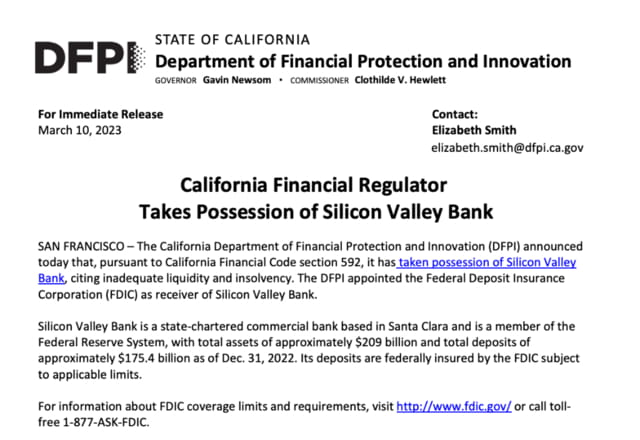
The U.S. financial industry suddenly experienced the largest bankruptcy since 2008, at a speed far exceeding the 2008 financial crisis, causing an uproar in the market.
You know, it took Lehman Brothers more than three months from collapse to bankruptcy, while Silicon Valley Bank only took two days.
The easiest way to deal with a bank bankruptcy is to find a buyer for the bank, but Silicon Valley Bank collapsed at the speed of light and the government was caught off guard.
The atmosphere of "danger" began to spread, and discussions about the Silicon Valley banking storm were endless on the streets. The KBW Bank Index fell nearly 16% in a few days, the largest weekly drop on record, and "alarms" were sounded one after another.
A crisis is also brewing with Signature Bank, the 30th largest bank in the United States with total assets of $110.4 billion.
Powell realized that the situation was not good, and the regular international banking meeting originally scheduled for the weekend in Basel, Switzerland was forced to be postponed.
The fuse that ignited Silicon Valley Bank was the liquidity (bank run) crisis and panic, and the root cause was the floating losses of the bank's bond holdings under aggressive interest rate hikes, and the rapid consumption of cash deposits by technology start-ups (Silicon Valley Bank's main depositors) in the face of difficulties during the interest rate hike cycle.
Everyone saw the Lehman moment in the Silicon Valley Bank crisis.
In the movie "Too Big to Fail", the scene where big figures such as US Treasury Secretary Hank Paulson did their best to save the market is still vivid in our minds. Powell knew that he had to take immediate action to stabilize market confidence.
Bill Ackman, the “Wall Street War God”, even sent out several tweets on March 10:
If the U.S. government fails to provide financial guarantees by Monday, small and medium-sized banks across the country will face a withdrawal (bank run) crisis and the mistake "will be irreversible."

Ackman is not nobody, he has a keen sense of crisis. Wall Street News has detailed that he accurately shorted the US stock market during the 2020 COVID-19 pandemic, and then went long at the bottom, making a huge profit of $3 billion and becoming a legend in one fell swoop.
The US government has less than 48 hours left and the crisis is imminent.
The first task is to maintain confidence
Confidence is the cornerstone of financial stability, and the root of maintaining the operation of the entire financial market remains the most basic trust.
U.S. Treasury Secretary Janet Yellen took the lead on Friday, March 10, and made her first statement on the Silicon Valley Bank incident, calling the U.S. banking system "resilient" and saying that she was meeting overnight with Powell and FDIC Chairman Martin Grunberg to discuss developments surrounding Silicon Valley Bank and would ensure that the problems of Silicon Valley Bank would not spread to other banks.
But market confidence is so fragile that a major crisis for small banks may be brewing.
Small banks account for a large proportion of large depositors, but the FDIC only provides insurance for bank deposits of no more than $250,000. Therefore, at the slightest sign of trouble, these large depositors will immediately withdraw cash, and the risk of bank runs will rise rapidly.
If the US government does not stop the spread of the crisis in time, more than ten banks may be in trouble.
Yellen, Powell and Grunberg realized that if they did not take action, the situation might "get out of control" and turn into a global financial earthquake.
The atmosphere became increasingly tense. Michael Barr, the vice chairman of the Federal Reserve responsible for banking supervision, also joined the crisis group's discussion on Saturday. The four people found that there were now three options before them:
A. Find a buyer for Silicon Valley Bank.
B. The Federal Reserve launches a new mechanism to provide additional funding and liquidity support.
C. Make Silicon Valley Bank and Signature Bank exceptions to the "systemic risk" rules (i.e., the Fed can treat these two relatively small banks as systemically important institutions to prevent the storm they cause from spreading to the entire financial system).
Finding a "buyer" is definitely the best solution for the Federal Reserve. Financial giants have called out one after another: Silicon Valley Bank cannot be liquidated, and the "buyer" please appear quickly.
The elusive "white knight"
On Saturday evening local time, the FDIC launched the auction process for Silicon Valley Bank, hoping that a bank would be able to buy it out from them, and arranged a series of "forced marriages" over the weekend:
Similar to the subprime mortgage crisis in 2008, the US government also first chose to contact major Wall Street banks such as JPMorgan Chase, hoping that they could be the "buyers" again, but when the auction officially started, no major bank made a bid.
The FDIC has turned its attention to alternatives - PNC Financial Services and Royal Bank of Canada - and extended the deadline for the first round of bids.
However, because the government could not provide guarantees, the two banks believed that the deal was meaningless and withdrew from the bidding.
"FDIC is too slow" and "there is no sign of government efforts at all" -
You have to know that even if the "White Knight" bids $1, he will have to bear Silicon Valley Bank's "floating losses" of more than $20 billion, and now the major US banks' own floating losses are enough for them to bear.
Seeing that the "buyer" has not yet appeared, 325 venture capital institutions including Sequoia and 650 founders issued a joint statement on Saturday afternoon:
Silicon Valley Bank cannot fail, and they still hope to maintain business dealings with the bank.
Garry Tan, CEO of Y Combinator, a famous American startup incubator, pointed out that SVB’s closure was a "catastrophe" for start-ups.
Now, only the emergence of a buyer can provide a way out for these start-ups.
What's worse is that on Saturday alone, nearly 20 medium-sized banks experienced massive deposit outflows, and bank share prices showed no signs of rebounding.
Yellen realizes that even if she can determine that the crisis is not systemic, the government may need to consider plan B - emergency intervention.
Seeing that the US government remained "indifferent", Bill Ackman once again "sounded the alarm" on Sunday morning, calling for the government to take action before the market opens on Monday.
If no action is taken before the Asian market opens on Monday, the consequences will be irreversible.

Time passed by minute by minute, and Sunday afternoon arrived.
At this time, even if a "white knight" appeared, it would be impossible for the US government to end the auction before the Asian market opened.
U.S. Congressman Ro Khanna, a Santa Clara Democrat, said on Twitter that he was urging the White House and Treasury Department to take "every possible step under the law" to support the bank.
There are less than 10 hours left until Asian markets open on Monday.
Who will come to the rescue?
Only the Federal Reserve can support
Now that its hopes of finding a buyer have been dashed, what else can the Federal Reserve do?
Among Silicon Valley Bank's users, "big depositors" account for the majority of deposits.
As of the end of 2022, the total deposit amount of depositors with deposits exceeding US$250,000 (the upper limit of deposit insurance compensation) reached US$157 billion, while the total deposit amount of depositors with deposits below US$250,000 was only US$4.8 billion.
That is to say, if the U.S. Treasury does nothing and lets the FDIC act according to existing rules, it will cost the Federal Deposit Insurance Fund about $14.2 billion to handle this bankruptcy case.
But if bank runs spread, can the US government withstand it?
Biden has made it clear to his economic team that he will not approve any policy that would be seen as "saving the banks."
But within just a few days, the second and third largest bank bankruptcies in U.S. history occurred one after another, the government was under increasing pressure, and the global financial industry was shrouded in the shadow of the 2008 subprime mortgage crisis.

As the opening time of major Asian stock markets on Monday approaches, the market's "strings are getting tighter and tighter." Biden made a statement saying that Americans can trust that the banking system is safe and that regulators are acting quickly to resolve problems.
At this time, a meeting that affected the global financial industry also began.
Powell, Yellen and Grunberg must announce their solutions to this incident to the market as soon as possible before the opening of the market to let the market know their determination to stabilize the banking industry.
After the meeting, Yellen immediately updated Biden, Brainard and Zient, and Biden approved the use of emergency powers and the implementation of the rescue plan. Biden said he was pleased that the Treasury Department quickly reached a solution for Silicon Valley Bank.
On Monday, March 13, in response to the market’s “call”, Powell released a “life-saving signal” and urgently announced a rescue plan just 15 minutes after the opening of U.S. stock futures.
A $25 billion Bank Term Funding Program (BTFP) will provide additional funding to eligible depository institutions to ensure banks have the ability to meet the needs of all depositors.
The Federal Reserve, the U.S. Treasury, and the FDIC issued a joint statement that depositors can withdraw all their funds starting March 13. Any shortfall will be made up by taxes on other parts of the banking system, and American taxpayers will not bear any losses.

Senior Treasury officials insisted the package did not amount to the kind of bailout that occurred during the 2008 crisis because shareholders and bondholders would not be bailed out.
According to the Fed’s announcement, it will provide loans for up to one year to all federally insured depository institutions in the United States. The biggest attraction of this loan is that banks can borrow funds equal to the face value of their collateral - which means that the Fed will not pay attention to the market value of the collateral, which in most cases reflects huge unrealized losses caused by rising interest rates.
Silicon Valley Bank, the first to fall in this round of the US banking crisis, had unrealized losses of $15.2 billion by the end of 2022, but this is just the tip of the iceberg of the huge floating losses of the US banking industry. According to data from the Federal Deposit Insurance Corporation, as of the end of 2022, the unrealized losses of the "available for sale" and "held to maturity" investment portfolios on the books of the US banking industry totaled $620 billion.

The market began to bet that the Fed's interest rate hike cycle had to end early. The Fed and Silicon Valley Bank have the same liability/investment maturity mismatch problem, so there may be only one way to support the entire US financial system at present - printing money.

The US government's rescue policy brought a brief excitement to the market, but in less than 12 hours, the crisis began to escalate again, the US financial environment tightened sharply, and the overall financial system remained tense.

During this week, the "wounds" of the global financial market continued to worsen: Credit Suisse, a century-old European bank, was "shaky", and Charles Schwab, the largest brokerage firm in the United States, suffered the largest outflow in six months, and the entire banking industry was in turmoil...
Powell and the U.S. government will be under tremendous pressure in the coming months.
Nothing is too big to fail, and the story of financial markets repeats itself over and over again.
C3 Tip: The views, thoughts and opinions expressed here are the author's own and do not constitute investment advice or recommendations. Every investment and transaction involves risk.