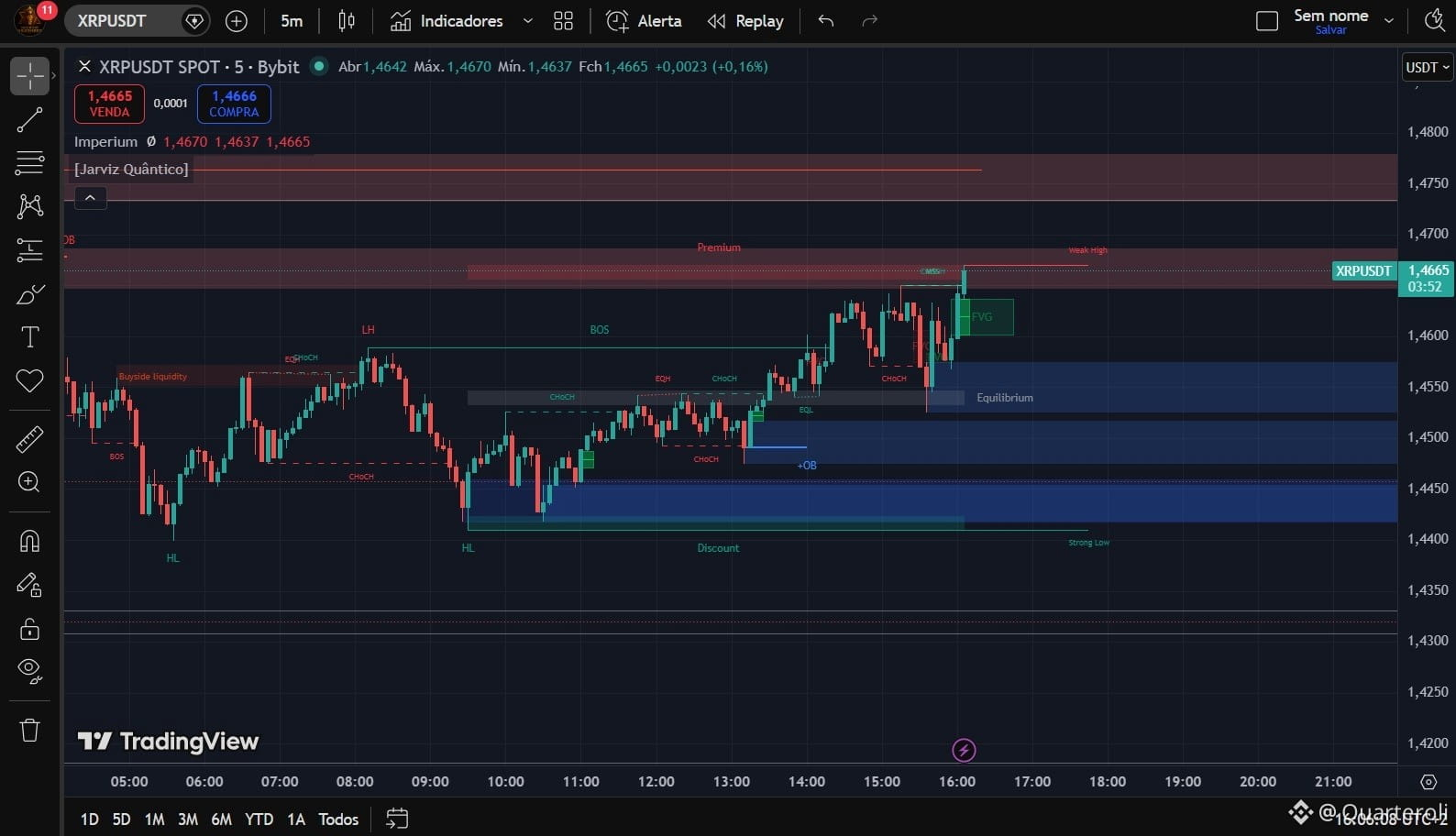
$XRP has been chased by the SEC for 5 years — and now banks are lining up to use it:
US$ 1.5 billion in ETFs. Exchange balances dropped 57% in a year. Standard Chartered forecasts US$ 8. And the CLARITY Act votes on May 14. All at once — not a coincidence…
XRP has spent five years under the shadow of the SEC lawsuit — the largest regulatory action ever taken against a crypto asset! When Ripple settled for US$ 125 million in 2025 and XRP was classified as a digital commodity, the game changed structurally. Seven spot XRP ETFs were approved between late 2025 and early 2026, racking up US$ 1.5 billion in inflows with 43 consecutive days without any net outflows — the second crypto ETF to cross the billion mark the fastest in history, only behind Bitcoin. At the same time, XRP balances on exchanges plummeted 57% in 2025, from 4 billion to 1.7 billion tokens — one of the largest annual supply reductions ever recorded for any crypto asset.
Less supply available. More institutional demand. The equation is simple.
What comes next is even more concrete: the vote on the CLARITY Act on May 14 could solidify XRP as the main bridge currency of the global financial system — the asset that banks use to settle cross-border payments in 3 seconds, 24/7, without the need for nostro accounts tying up capital. Ripple already processes most of the RippleNet volume in the Asia-Pacific region in partnership with SBI, and the launch of the stablecoin RLUSD on Japanese banking rails creates recurring demand for XRP as a bridge asset. Standard Chartered projects US$ 8 by the end of 2026. The Motley Fool talks about US$ 10. Cycle models indicate US$ 10 to US$ 20 by 2028–2030. XRP is no longer a speculative bet on technology — it’s a bet on who will settle the world’s payments. And that race has already begun.
US$ 1.5 billion in ETFs. Exchange balances dropped 57% in a year. Standard Chartered forecasts US$ 8. And the CLARITY Act votes on May 14. All at once — not a coincidence…
XRP has spent five years under the shadow of the SEC lawsuit — the largest regulatory action ever taken against a crypto asset! When Ripple settled for US$ 125 million in 2025 and XRP was classified as a digital commodity, the game changed structurally. Seven spot XRP ETFs were approved between late 2025 and early 2026, racking up US$ 1.5 billion in inflows with 43 consecutive days without any net outflows — the second crypto ETF to cross the billion mark the fastest in history, only behind Bitcoin. At the same time, XRP balances on exchanges plummeted 57% in 2025, from 4 billion to 1.7 billion tokens — one of the largest annual supply reductions ever recorded for any crypto asset.
Less supply available. More institutional demand. The equation is simple.
What comes next is even more concrete: the vote on the CLARITY Act on May 14 could solidify XRP as the main bridge currency of the global financial system — the asset that banks use to settle cross-border payments in 3 seconds, 24/7, without the need for nostro accounts tying up capital. Ripple already processes most of the RippleNet volume in the Asia-Pacific region in partnership with SBI, and the launch of the stablecoin RLUSD on Japanese banking rails creates recurring demand for XRP as a bridge asset. Standard Chartered projects US$ 8 by the end of 2026. The Motley Fool talks about US$ 10. Cycle models indicate US$ 10 to US$ 20 by 2028–2030. XRP is no longer a speculative bet on technology — it’s a bet on who will settle the world’s payments. And that race has already begun.