
The BNB automatic destruction mechanism automatically modifies the BNB destruction amount based on the BNB price in the current quarter and the number of blocks generated by BSC.

BNB and its role in the blockchain ecosystem
It is the native cryptocurrency of the Binance ecosystem. Launched in 2017, BNB initially appeared on the Ethereum blockchain as an ERC-20 token with a total supply of 200 million. In 2019, Binance launched the mainnet switch and migrated all BNB tokens to BNB Chain.
The BNB chain consists of two blockchains, both powered by BNB:
BNB Beacon Chain: Formerly known as Binance Chain, this blockchain handles BNB Chain governance functions such as voting and staking.
BNB Smart Chain (BSC): Once known as Binance Smart Chain, this blockchain uses the Ethereum Virtual Machine to support smart contracts and is fully compatible with Ethereum’s tools and decentralized applications (DApps).
The native Binance Coin is now an important part of the Binance ecosystem. It is used to power the operations of the Binance and Binance.US exchanges, including other applications built on the BNB chain, such as:
pancake exchange
Currency exchange
ape swap
Autoshark Finance
greedy
free finance
Nominex/Nomiswap
Era of dinosaurs
Decentralized Finance
open leverage
These are just a few of the many dApps built on the BNB blockchain. Binance remains the largest cryptocurrency exchange by trading volume and one of the most popular exchanges in the world.
What is coin burning?
A token burn is when a cryptocurrency project destroys a portion of its tokens, usually to reduce the circulating supply and increase the value of the remaining tokens. The coins are sent to a dead crypto wallet with an unknown private key, meaning the coins can never be spent again.
Token burning usually occurs quarterly or semi-annually. Binance, for example, has committed to burning BNB coins every quarter until 100 million BNB are burned. This would leave a total supply of 100 million BNB – the maximum possible supply of BNB.
Blockchains and cryptographic protocols regularly burn tokens and tokens for a variety of reasons, including:

How is BNB destroyed?
Burning BNB has some burning mechanisms, as described below:
Real-time combustion mechanism (BEP-95)
First up is the Binance Evolution Proposal (BEP)-95 burning mechanism. With BEP-95, BNB is burned in real time by burning a portion of the gas fees spent on BSC. Since the upgrade of the BNB smart chain in 2021, BEP-95 has continued to destroy about 860 BNB on average every day.
Binance CEO Changpeng Zhao implemented BEP-95 to speed up the burning of BNB, which was slower than planned. BEP-95 provides a constant stream of BNB for destruction by burning a portion of the gas fee collected by the validators of each block.
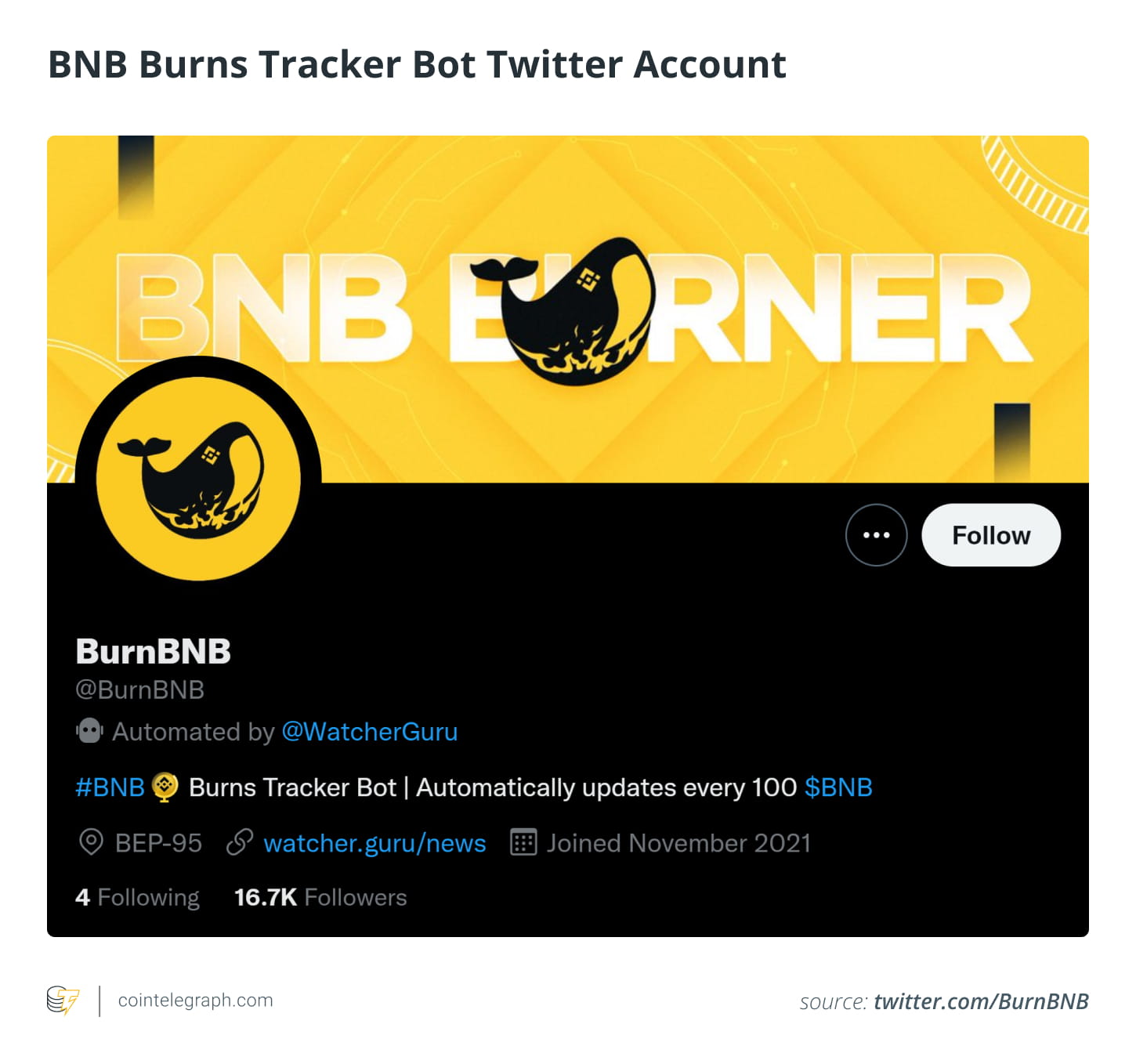
BEP-95 completely relies on the BSC network, so it will continue to destroy BNB after reaching the 100 million destruction target. BEP-95 destruction progress can be tracked via the BNB Burns Tracker Bot on Twitter:
Quarterly automatic destruction
The second method is a scheduled quarterly burn conducted by Binance. During these burns, a specific amount of BNB is bought back from the open market and burned. The first burn took place in October 2017, with 986,000 BNB burned.
Quarterly burns are conducted using Binance’s profits and announced in advance. The exact amount of BNB burned depends on several factors, including overall profitability, BNB circulating supply and the number of blocks produced each quarter. As of the latest burn in April 2022, a total of 1,839,786.261 BNB have been burned:

What is BNB automatic destruction?
BNB auto-destruction was created at the same time as Binance Chain and Binance Smart Chain were released and renamed to BNB Chain. Binance stated that the automatic burning mechanism is designed to maximize the value of BNB tokens and provide a sustainable and secure long-term growth plan for the BNB ecosystem.
Binance used to conduct quarterly BNB burns based on BNB trading volume on its exchange. However, the quarterly burn was replaced by an automatic BNB burn in December 2021.
Auto-burns still occur quarterly, but they are no longer based solely on Binance’s trading volume.
The BNB automatic destruction mechanism automatically adjusts the amount of BNB that needs to be destroyed based on two factors:
BNB price
Number of blocks produced by BSC per quarter
According to Binance, the new BNB burning mechanism provides better transparency and is more predictable than the previous quarterly burning method. According to the Binance team, the new automatic burning mechanism will help stabilize the BNB price and protect it from large fluctuations.
How does BNB auto-destruction work?
From a technical perspective, BNB automatic destruction uses on-chain information from the BNB Smart Chain to calculate how much BNB should be burned. This is how the mechanism "adjusts" the amount of combustion.
The amount burned is also affected by supply and demand dynamics, meaning that when the price of BNB drops, the burn rate increases. As mentioned earlier, token burning increases the value of a cryptocurrency.
BNB auto-destruction is designed to remain independent of BNB trading volume on Binance (which was once its sole basis). This is to assure the BNB community that the process is verifiable, objective and transparent.
The goal is to continue running automatic burns until the 100 million mark is reached. It will do this automatically using the following formula:

In the above equation, B represents the total amount of BNB to be destroyed, and N represents the number of blocks produced on the BNB smart chain this quarter. The average block generation time is 3 seconds, and the approximate value of the block generation per hour is set at 1200 blocks. Standard calculations would give a value of N of approximately 2,592,000 blocks. This value may fluctuate depending on the exact number of days in each month in a particular quarter.
P is the average price of BNB at that time. The average price fluctuates in a range of 10% to 20% daily, with the median determined based on a sample of BSC-accepted oracle vendors such as ChainLink. This is typically performed every 10,000 blocks and takes approximately 8.3 hours to produce.
K is initially set to 1000, a constant price anchor. Its value is subject to change and depends largely on the community of BNB Smart Chain. Members can submit BEP proposals and conduct community votes to update this value.
BNB quarterly destruction
The old quarterly destruction mechanism has been updated to quarterly automatic destruction. Auto-burn achieves the same goal but is more efficient and transparent. The chart below shows the expected quarterly BNB auto-burn volume at various BNB average prices:

How to check BNB automatic destruction record?
BNB’s automatic destruction history is traceable. The website keeps a record of all previous destructions, including details of each destruction:

For example, if we click on the latest burn, Burn #BNB

So, how much BNB has been destroyed so far? The total amount of BNB burned to date is 35,750,684.88. Based on current price data, this equates to $7,866,304,917.03. You can also follow real-time values and details about BNB burning events.
When is the next BNB burn?
The most recent BNB burn occurred on April 19, 2022, when 1,830,382 BNB, or $772,363,806, were destroyed via automatic burning. There is no specific date for the 20th Burn, but it is expected to occur anytime between July 16 and 20, 2022.
Typically, Binance CEO Changpeng Zhao announces BNB burn dates on Twitter, so it’s worth watching this space for updates on the next automatic burn.