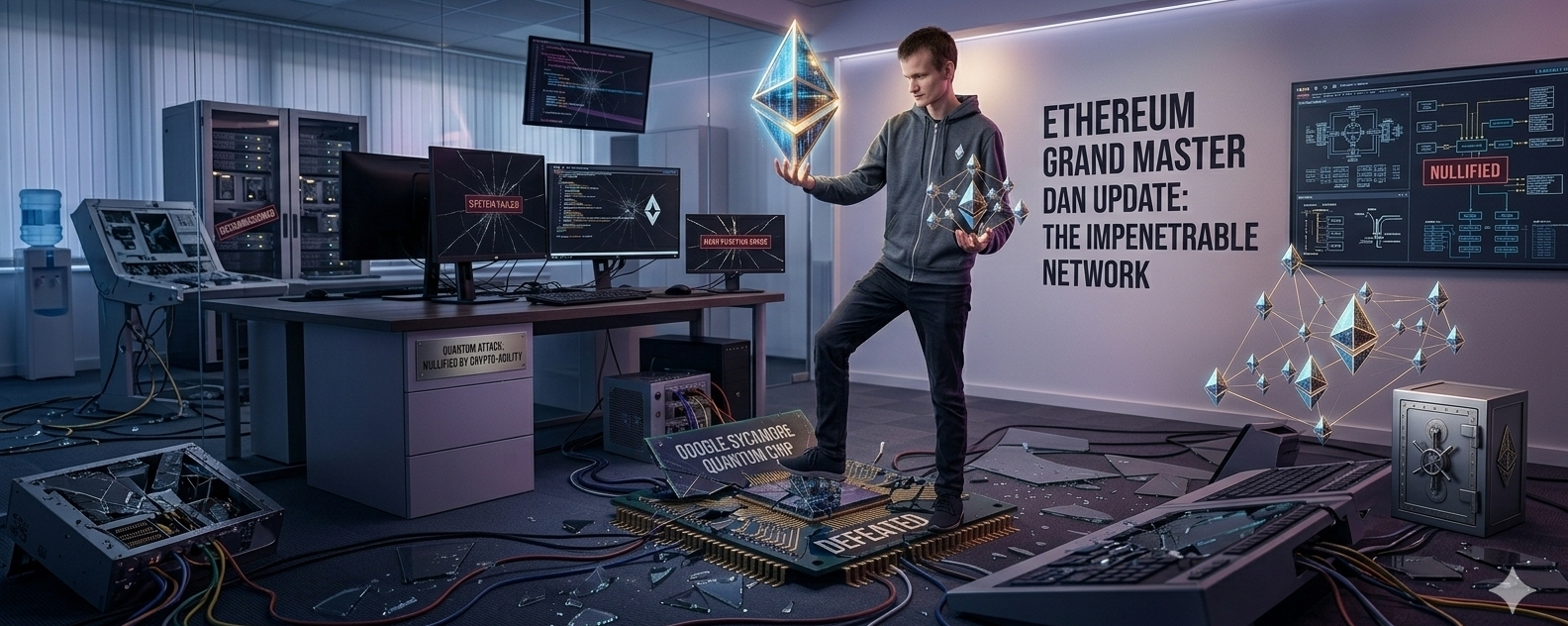

The issue with BITCOIN today is its slow conservatism in addressing the solutions that many other coins like ETHEREUM are already solving, known as the marajoara quantum chip developed by Google. Google itself warned that by 2029, there could be an updated version of this chip that might threaten BITCOIN. Quickly, ETHEREUM and its developers gathered to tackle this issue and started the updates.
PECTRA brings: The EIP-7702 and Account Abstraction
The big star of Pectra is Ethereum Improvement Proposal (EIP) 7702, proposed by Vitalik Buterin. It allows regular accounts (EOAs, like the ones we use in MetaMask) to temporarily function as "smart contracts."
Relation to Quantum Defense: Quantum computing threatens current signature algorithms (like ECDSA). Account abstraction is the gateway to cryptographic agility. If an account is governed by code (smart contract) instead of just a fixed private key, it becomes much easier to update the signature method to a quantum-resistant algorithm in the future without the user needing to migrate all their funds to a new wallet.
the GLAMSTERDAM upgrade happening now in June 2026
Unlike Pectra, which introduced cryptographic agility via EIP-7702, Glamsterdam focuses on making the network "robust enough" to support the heavy post-quantum algorithms.
Here are the points where it touches on quantum defense:
1. Preparation for Post-Quantum Cryptography (PQ)
Although Glamsterdam has the "stars" EIP-7732 (ePBS) and EIP-7928 (Block-level Access Lists), it occurs in parallel with the creation of the new Post-Quantum (PQ) team at the Ethereum Foundation, led by researchers like Justin Drake.
The role of Glamsterdam: While it doesn't implement quantum signatures by default yet, it optimizes data processing to handle signatures that will be much larger than current ones. For Ethereum to be secure against quantum computers, it will need more complex zero-knowledge proofs (ZK-proofs), and Glamsterdam is laying the groundwork for LeanVM (an optimized virtual machine for ZK).
The Hegotá upgrade, scheduled for the second half of 2026 (following Glamsterdam), is where Ethereum starts to "reap the rewards" of all the groundwork laid in previous versions. If Pectra created agility and Glamsterdam reinforced the structure, Hegotá focuses on the technical viability of large-scale quantum defense.
The big challenge of post-quantum cryptography (PQ) is that keys and signatures are much larger than current ones. Hegotá tackles this through two fundamental technical pillars:
1. Verkle Trees (The "Magic" of Compression)
This is the main functionality of Hegotá. Currently, Ethereum uses Merkle Patricia Trees to store data. Verkle Trees allow nodes to validate transactions without needing to download the entire state history of the network (the so-called statelessness).
Relation to Quantum Defense: Quantum-resistant signatures (like those based on hash) take up a lot of space. Without Verkle Trees, the network would become too heavy and slow if it tried to implement quantum defense now. Verkle Trees free up "technical wiggle room" for Ethereum to support the weight of these new signatures without blowing up the cost of running a node.
2. EIP-8141 (Frame Transactions)
Emerging within the timeline of Hegotá, this proposal introduces a change in how transactions are structured.
Quantum Defense: It allows you to "decouple" the account from the type of signature. This means that the network will accept different types of cryptography within the same account. This is what we call crypto-agility: if a quantum computer threatens the network, you can simply "plug in" a post-quantum signature into your transaction without needing to change addresses or migrate your assets in a traumatic way.