



In the current market environment, the entire crypto space's demand for 'mechanism innovation' projects has reached a nearly frenzied level. Unlike past meme projects that relied solely on narratives, influencers, or community sentiment, market funds are increasingly willing to pay for 'new operational logic' and 'new asset structures.'
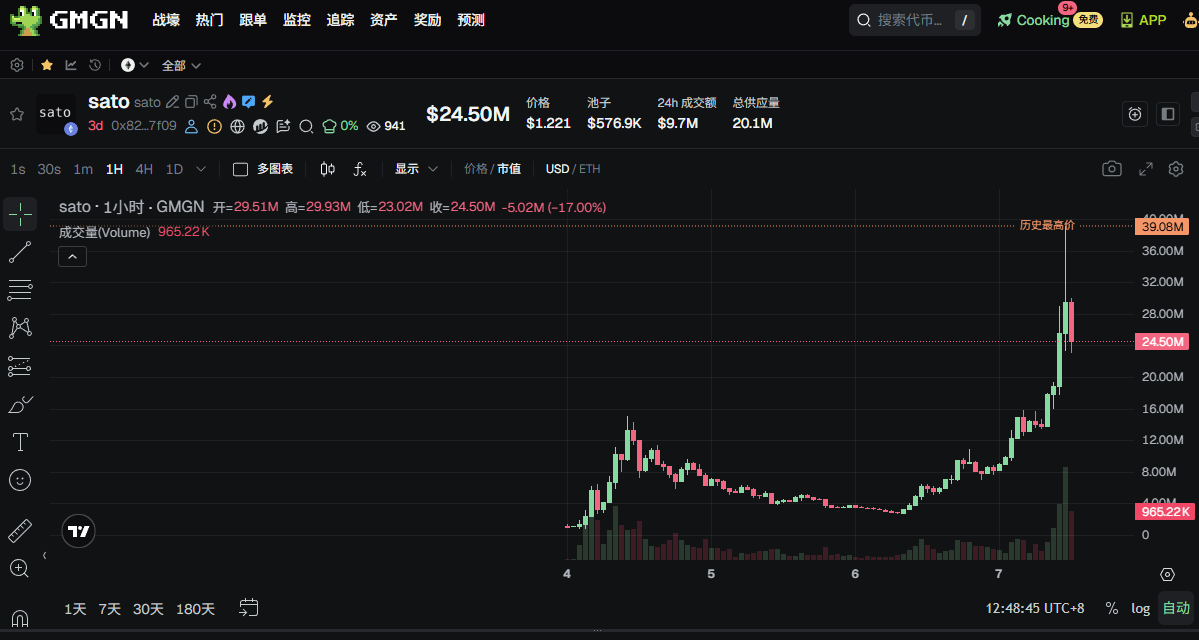
With almost zero pre-heating and just a single official website, sato has become the talk of the crypto community over the past few days: it launched only four days ago, and its market cap briefly approached $40 million, currently stabilizing around $25 million. Odaily Planet Daily will detail the operational mechanics behind sato in this article.
What exactly is sato?
sato is an ERC-20 token deployed on Ethereum, and its core mechanism is built on Uniswap v4 Hook. There’s no pre-mine, no team allocation, no admin privileges, and no upgrade or pause functionalities; the entire system operates automatically through on-chain code.
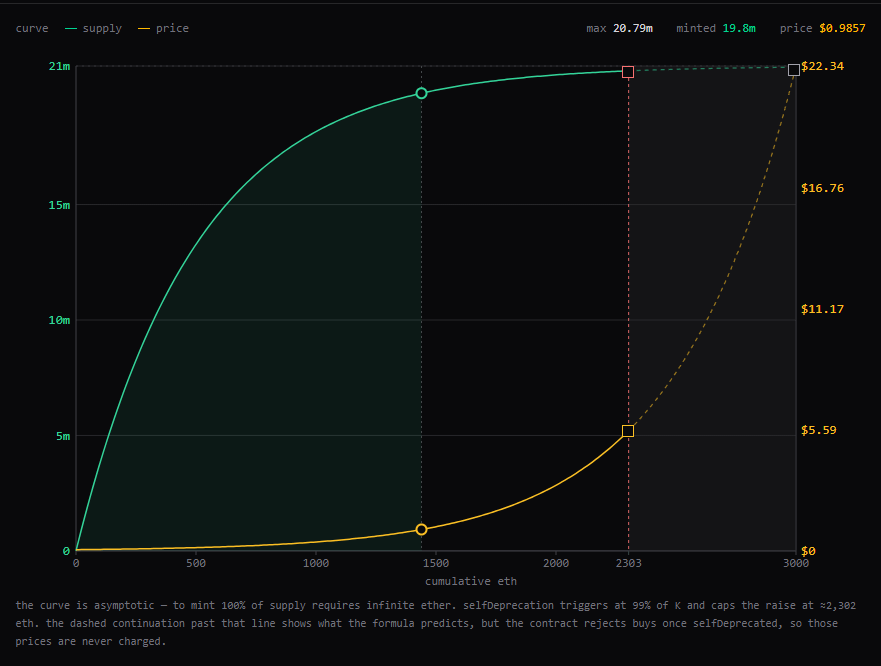
sato uses a Bonding Curve for its issuance. Users pay ETH to the Hook contract, and the system will automatically mint new sato according to a fixed mathematical formula. As the accumulated ETH entering the system increases, the subsequent purchase prices will rise. All ETH will be permanently held in the Hook as the system's reserves.
When selling, users can swap sato back to the system for ETH; once the minted sato tokens reach 99% of the total supply, the sold sato will be directly burned, preventing it from re-entering the market. The system charges a 0.3% fee on both buy and sell transactions, which will permanently reside in the Hook and cannot be withdrawn by anyone.
The theoretical supply of sato is capped at 21 million tokens, but the system will permanently stop minting once it reaches 99% supply, or 20.79 million tokens. After halting issuance, users can no longer purchase new coins through the Curve, but can still sell sato back to the system for ETH, with the Curve continuing to exist as a permanent on-chain buyback pool.
The core mechanism of sato
The sato mechanism is somewhat like a variant of Pump.fun's Bonding Curve model, but more extreme. In sato, users also purchase tokens from the system through the Curve, but unlike traditional Bonding Curve projects, sato distinctly separates the entire system into 'Issuance Phase' and 'External Market Phase.'
Phase One: Issuance Phase
In this phase, users are not trading with other holders but directly with the system itself. After users deposit ETH into the system, the Curve will automatically mint new sato according to a fixed formula, and as more ETH accumulates in the system, the subsequent mint prices will also rise.
In a sense, this phase resembles an automatically running 'internal market system,' where the Curve is responsible for both token issuance and pricing.
Phase Two: 'External Market Phase'
Once the supply of sato reaches the set limit of 99%, the system will permanently stop minting, and users can no longer purchase sato from the system through the Curve. It’s only at this point that sato will truly start circulating in secondary markets like Uniswap, with the price no longer determined by the Curve formula but by market buy and sell dynamics.
However, the Curve itself won't disappear. While the system has halted the issuance function, it retains the 'recycling' function. Users can still sell sato back to the system for ETH, and the sold sato will be directly burned, preventing it from re-entering the market. In a sense, the Curve will transition from an 'issuance system' to a permanently existing on-chain buyback pool. The operational logic of sato can actually be understood as a process of 'gradually transitioning from the internal market to the external market.'
sato: Reconstructing Digital Scarcity
What truly attracts the market to sato isn't just the Bonding Curve, Hook, or the deflationary mechanism itself, but its attempt to retell a story of 'digital scarcity.'
Bitcoin established the consensus of digital gold through fixed supply and high production costs. sato attempts to transfer this logic to Ethereum. The difference is that Bitcoin completes issuance by consuming energy; sato chooses to embed all costs directly into the system's reserves. Each sato corresponds to real ETH entering the system.
This is why many consider sato a very 'sexy' on-chain experiment. It combines the scarcity and post-acceleration gameplay attributes of Bonding Curves while retaining the composability and liquidity of the Ethereum ecosystem. There’s no pre-mine, no team control, no admin privileges, and even the operational logic after the Curve ends has been pre-written on-chain.
Whether this model can ultimately form a long-term consensus akin to Bitcoin remains to be verified by the market over time. But at least for now, sato is no longer just an ordinary Ponzi scheme; it feels more like an experiment on 'Ethereum-native scarce assets.'