

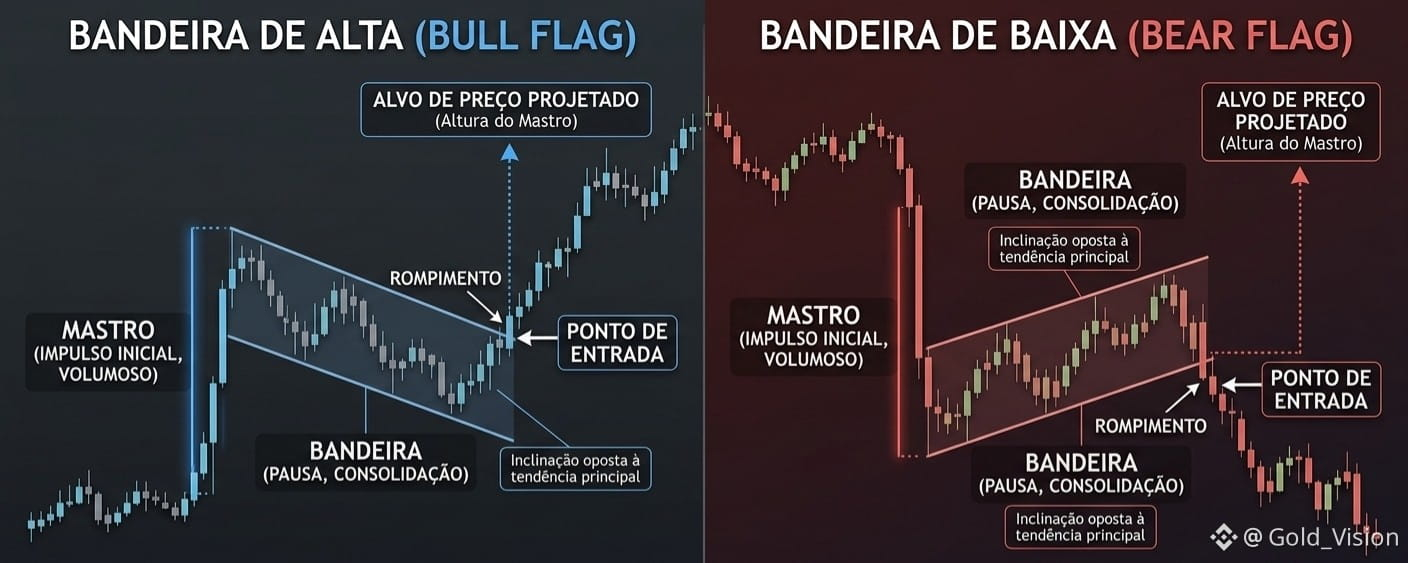

Flags are continuation patterns in trading. They represent a brief pause or consolidation in the market after a strong, directional move, acting like a "breather" for the price before it resumes its original journey.
They are highly favored by traders because they offer an excellent risk/reward ratio, as the move that precedes them is typically replicated after the breakout.
1. Structure of a Flag
A flag consists of two main parts:
The Pole: This is the initial movement, strong and nearly vertical (up or down). It represents an aggressive imbalance between supply and demand.
The Flag: This is the consolidation phase that follows. The price is contained between two parallel trend lines that slope against the direction of the pole.
* If the pole is bullish, the flag slopes slightly downward.
* If the pole is bearish, the flag slopes slightly upward.
2. Types of Flags
Bull Flag
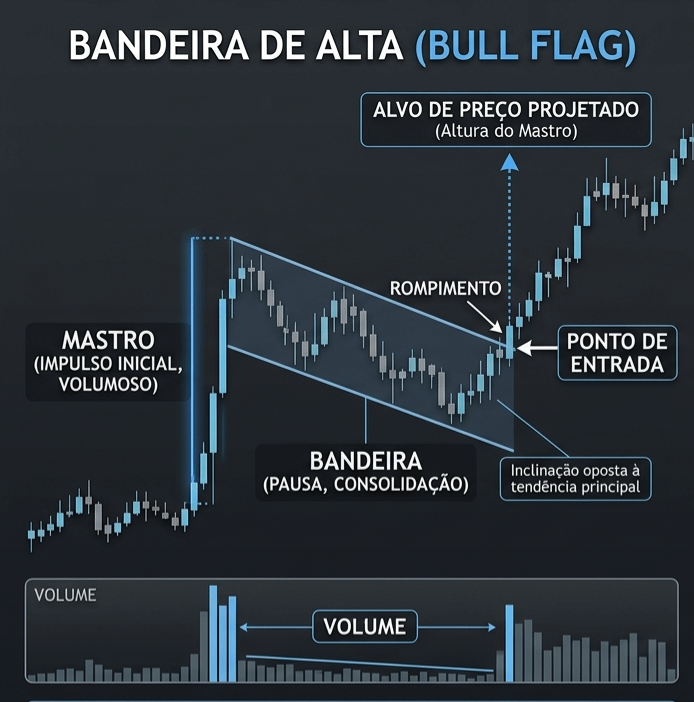
Occurs after a vertical rise. The price "rests" in a narrow descending channel. The breakout of the upper line signals that buyers have regained control.
Bear Flag
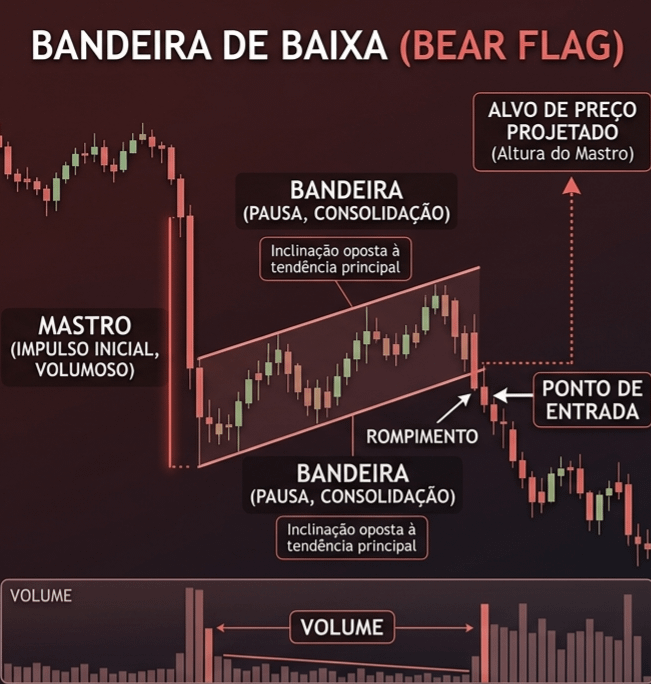
Occurs after a sharp drop. The price makes a small recovery in a narrow ascending channel. The breakout of the lower line signals that the selling pressure has regained control.
How to Trade Flags
Entry Point
The entry occurs on the breakout of the flag channel in the direction of the main trend.
Tip: Volume often decreases during the formation of the flag and should increase significantly on the breakout candle.
Target (Projection)
The most common technique is to measure the height of the Pole and project that same distance from the breakout point of the flag.
Logic: The market tends to repeat the intensity of the first impulse.
Stop Loss
The stop is generally placed just below (in Bull Flags) or above (in Bear Flags) the opposite end of the flag (the lowest/highest point of consolidation).
Flags vs. Pennants
Although very similar, the visual difference is simple:
Flag: The consolidation is a rectangle (parallel lines).
Pennant: The consolidation is a small symmetrical triangle (converging lines).
Both serve the same function and follow the same target rules based on the pole.
> Caution Note: If the "flag" lasts too long or if the slope is too steep, it may cease to be a flag and become a reversal channel. An ideal flag is short and quick.