

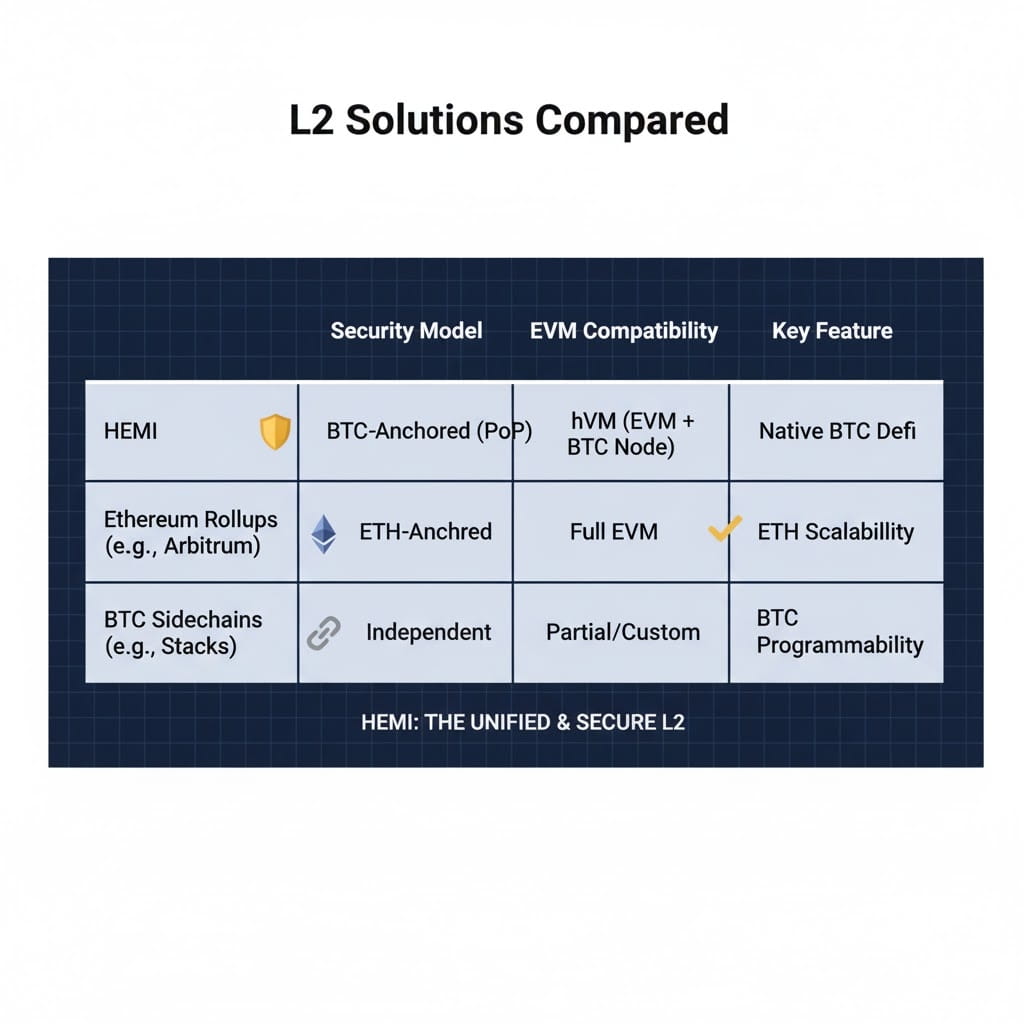
If we say that Ordinals opened Bitcoin's 'Pandora's box', then L2s like HEMI are building an 'industrial-grade' application factory for it. This article will not discuss the basic concepts, but will focus on HEMI's 'relevance' and 'professionalism': how does it specifically unlock unprecedented use cases in the Bitcoin ecosystem through hVM and PoP consensus?
Since 2024, the hotspots in the Bitcoin ecosystem have shifted from inscriptions and runes to L2. However, most solutions are still caught up in the 'how to transfer BTC faster and cheaper' dilemma. The emergence of Hemi (HEMI) forces us to consider a more 'professional' question: do we want just a faster Bitcoin, or a more powerful Bitcoin?
HEMI's answer is the latter. It aims to leverage Bitcoin's security to build a brand new, programmable financial layer.
High relevance: Bitcoin native use cases unlocked by HEMI
'Relevance' is a high scoring criterion for CreatorPad. The value of HEMI does not lie in speculating a new L2, but in the 'real use cases that are currently unattainable' that it can bring.
1. BTC lending without wrapping:
Current situation: Currently on Aave or Compound, you must use wBTC (a type of ERC-20 token), which requires trust in custodians.
HEMI's solution: With the reading capability of native BTC UTXOs through hVM (Hemi Virtual Machine), users can directly use BTC 'dormant' in their Bitcoin addresses as collateral to borrow stablecoins or other assets. This process is trustless, and your BTC never leaves the security of Bitcoin L1 (overseen by HEMI's PoP consensus).
2. Bitcoin-driven Staking and Restaking:
Professional insight: The Proof-of-Proof (PoP) consensus of Hemi itself creates a new form of 'mining' or 'staking'.
Future potential: We can envision that holders of the $HEMI token in the HEMI ecosystem can participate in staking to protect the network. Furthermore, the security anchoring of HEMI's BTC allows it to serve as a 're-staking' layer similar to EigenLayer, providing 'Bitcoin-level' security for other DApps and generating yields.
3. Complex financial derivatives and RWA (Real World Assets):
The prosperity of Ethereum's DeFi lies in the programmability of EVM. HEMI's hVM brings this programmability to Bitcoin's 'ledger'.
Creative use cases: This enables developers to build complex financial instruments, such as options and futures collateralized by Bitcoin, and even bringing RWAs (like tokenized government bonds) into the Bitcoin ecosystem, using BTC as margin.
Professional analysis: The economic model of the $HEMI token
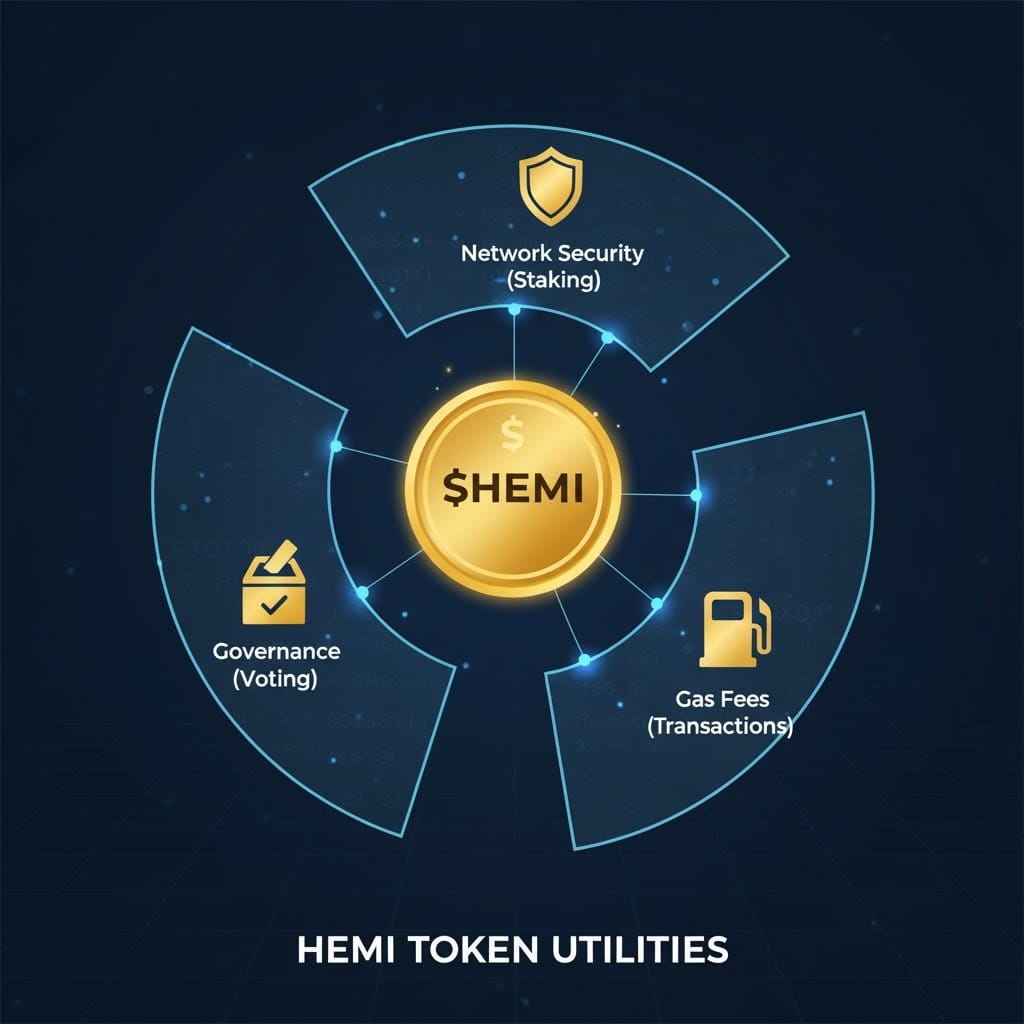
The 'professionalism' of a protocol is also reflected in its token economics. The $HEMI token is not just a speculative tool; it is the 'lifeblood' of the HEMI ecosystem.
Transaction fees (Gas Fee): As an L2, all operations on the HEMI network (executing hVM contracts) require $HEMI as gas fees.
Network security (Staking): As mentioned earlier, the $HEMI token will be used for staking to incentivize PoP miners and validators to maintain network security, ensuring that HEMI's state is correctly anchored to Bitcoin.
Governance: $HEMI holders will have the right to vote on future upgrades, parameter adjustments, and the use of the treasury of the protocol.
Conclusion: HEMI - not just an L2, but a 'super financial layer'
The vision of HEMI is grand: it does not want to be just the 'co-pilot' of Bitcoin, it aims to be the 'super hub' connecting the security of Bitcoin and the flexibility of Ethereum.